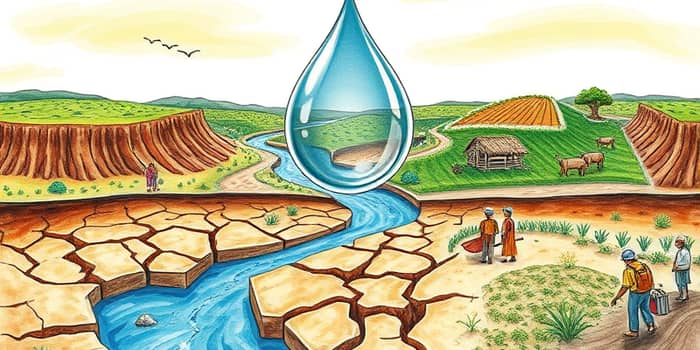
The world is witnessing an unprecedented transformation of water resources as aquifers dry and rivers vanish. Far beyond environmental rhetoric, this crisis demands bold action and strategic investment. We must confront the stark reality of water bankruptcy and pivot toward solutions that secure our shared future.
The Scale of the Crisis
In January 2026, United Nations scientists declared humanity had entered an era of global water bankruptcy. This term captures the persistent overuse of surface and groundwater, outpacing natural replenishment and inflicting irreversible damage on vital ecosystems.
More than 4 billion people now experience severe water scarcity at least one month each year, while 75 percent of humanity lives in regions deemed water-insecure. Over 2.2 billion individuals lack access to safely managed drinking water, and 3.5 billion are without adequate sanitation. The stakes extend to agriculture: 3 billion people depend on areas where total water storage is in decline, putting half of global food production at risk.
Root Causes of Water Bankruptcy
Understanding why this crisis has unfolded is essential for crafting effective solutions. Multiple human-driven factors have converged to deplete our water capital:
- Chronic groundwater depletion through unsustainable pumping and irrigation.
- Poor land and water management practices, including deforestation and soil degradation.
- Inefficient irrigation leaving over 40 percent of agricultural water wasted.
- Weak governance, mispriced water services, and limited accountability.
- Climate change accelerating glacier melt, drought frequency, and evaporation.
Economic and Social Impacts
The cost of this depletion is staggering. We lose 324 billion cubic meters of freshwater annually—enough to supply 280 million people—and wetlands the size of the European Union vanish every fifty years. The economic toll exceeds US$5.1 trillion per year in lost ecosystem services, with droughts alone costing US$307 billion annually.
Beyond finance, water stress fuels geopolitical tensions. Cross-border disputes over shared rivers are intensifying, from the Nile to the Indus. Urban centers suffer too: half of the world’s largest cities now face critical water stress, threatening public health, social stability, and economic growth. Rural communities endure land subsidence and failed harvests, creating waves of migration and conflict.
Pathways to Sustainable Water Security
Reversing these trends requires coordinated, multifaceted strategies. The World Bank’s Global Water Monitoring Report outlines a comprehensive three-part strategy that can restore water systems and build resilience.
First, manage water demand more efficiently through advanced metering, regulation, and pricing reforms that reflect true resource value. Second, expand alternative water supply via recycling, desalination powered by renewable energy, and improved storage infrastructure. Third, ensure fair and effective water allocation by strengthening legal frameworks, transparency, and community participation.
Empowering Global Collaboration
Water knows no borders. Two-thirds of freshwater flows across national lines, yet most shared basins lack formal agreements. To reduce conflict and enhance stability, nations must embrace partnerships built on trust and data.
- Invest in data-driven monitoring systems to detect loss and predict shortages at local levels.
- Prioritize water-smart agriculture technologies that boost yields with less water, such as drip irrigation and drought-resistant seeds.
- Align trade policies with sustainability through virtual water trade, importing water-intensive goods when local supplies are scarce.
- Strengthen cross-border water governance with binding accords and conflict-resolution mechanisms.
The Role of Investors and Innovators
Capital can be the catalyst for change. Private investors, development banks, and philanthropists have unprecedented opportunity to fund water infrastructure, cutting-edge technologies, and capacity-building initiatives.
Financing can target:
- Large-scale desalination plants powered by solar and wind.
- Advanced water treatment and recycling facilities in urban centers.
- Digital platforms using AI and satellite imagery to optimize irrigation.
- Community-led conservation programs that restore wetlands and recharge aquifers.
By channeling resources into these areas, backers not only safeguard water supplies but also stimulate job creation, economic growth, and social equity.
A Call to Action
We stand at the cusp of irreversible change. Yet, continental drying is not inevitable. Leaders can still reverse the tide through bold policies, smart investments, and collective willpower. Every drop conserved, every policy reformed, and every project funded brings us closer to a resilient future.
As individuals, organizations, and governments unite behind this cause, they honor the shared legacy of our planet and ensure safe water for generations to come. The time to invest in this vital resource is now.
References
- https://phys.org/news/2026-01-world-era-global-bankruptcy-scientists.html
- https://www.circleofblue.org/newsletter/the-stream-january-13-2026-water-scarcity-among-major-global-political-risks-for-2026-report-warns/
- https://www.worldbank.org/en/news/press-release/2025/11/04/world-annual-fresh-water-losses-could-supply-280-million-people
- https://unhabitat.org/news/02-feb-2026/why-the-worlds-water-crisis-is-increasingly-an-urban-challenge
- https://worldpopulationreview.com/country-rankings/countries-with-water-scarcity
- https://www.eurasiagroup.net/live-post/risk-10-the-water-weapon
- https://abcnews.go.com/International/planet-entered-era-water-bankruptcy-new-report/story?id=129422093
- https://www.chathamhouse.org/2026/02/world-far-meeting-its-growing-water-needs-can-un-still-lead-response
- https://unu.edu/inweh/news/world-enters-era-of-global-water-bankruptcy
- https://healthpolicy-watch.news/world-enters-new-era-of-water-crisis-un-says/
- https://www.who.int/news/item/26-08-2025-1-in-4-people-globally-still-lack-access-to-safe-drinking-water---who--unicef
- https://unstats.un.org/sdgs/report/2023/goal-06/