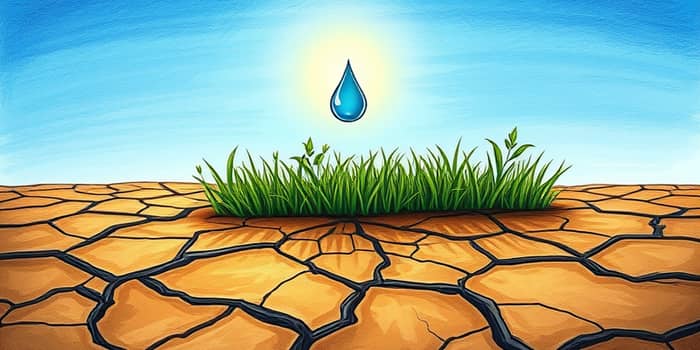
Water is the lifeblood of our civilization, yet it is vanishing at an alarming rate. The scale of this crisis is staggering, with profound implications for every aspect of human life.
Imagine a world where communities fight over every drop, and economies falter under the weight of scarcity. This dystopian vision is becoming our reality as freshwater resources dwindle.
Investing in water is no longer optional; it is an urgent imperative for global survival. This article delves into the crisis and offers practical solutions.
The Global Thirst: A Crisis Unfolding
Annually, the world loses 324 billion cubic meters of freshwater. This loss equals the needs of 280 million people each year, driven by droughts and unsustainable practices.
Global water use has risen by 25% since 2000, exacerbating stress in already dry regions. Nearly two-thirds of the population faces acute scarcity for at least one month yearly.
Water stress is emerging in both historically scarce and abundant areas. Regional vulnerabilities are expanding rapidly, with no continent spared.
- Central America grapples with dwindling supplies.
- Eastern Europe faces increasing water insecurity.
- Northern India confronts severe shortages.
- Southeastern Brazil, once water-rich, is now under pressure.
By 2025, half the world's population will live in water-stressed areas. This timeline demands immediate action to avert disaster.
Access and Safety: The Human Toll
Over 2 billion people lack access to safe drinking water. This statistic represents a profound injustice, affecting health and dignity globally.
One in four people worldwide cannot rely on clean water. Children suffer disproportionately, with hundreds dying daily from waterborne diseases.
- 2.2 billion lack safely managed drinking water services.
- 115 million drink directly from surface water sources.
- Nearly 500 million experience year-round scarcity.
- Only 0.007% of Earth's water is readily available for human use.
Regional disparities are stark, with countries like Qatar having minimal water per capita. India owns just 4% of global freshwater despite 18% of the population.
Economic Impacts: Ripples Through Society
Water scarcity is linked to lower real GDP growth and higher inflation, destabilizing economies. A one standard deviation increase reduces output growth by 0.12–0.16%.
By 2050, some regions could lose up to 11.5% of GDP growth. World Bank models predict shrinkage of up to 6% in vulnerable areas like Sub-Saharan Africa.
An estimated $260 billion is lost globally each year due to inadequate water and sanitation. This economic drain underscores the need for investment in basic infrastructure.
- Time spent collecting water costs billions in lost opportunities.
- Women bear a heavy burden, sacrificing income for water collection.
- Agricultural losses lead to food insecurity and higher prices.
- Job market instability affects water-dependent industries.
Every $1 invested in water and sanitation yields a $4 economic return from health and productivity gains. Universal access could save $18.5 billion annually from avoided deaths.
Systemic Risks and Infrastructure Failures
Water distribution networks lose 30% of supply globally due to underinvestment. This inefficiency exacerbates scarcity and raises costs for consumers.
Climate change intensifies these risks, with droughts threatening regions like the Lake Chad basin. Fluctuating water levels endanger millions and disrupt economies.
Infrastructure must be upgraded to handle growing demands. Smart technologies and better management can reduce losses and enhance resilience.
Geopolitical Tensions: Water as a Flashpoint
Cross-boundary water disputes are a growing global concern. Most freshwater sources lack sharing frameworks, leading to conflicts.
- The Nile River: Ethiopia's dam controls 90% of Egypt's freshwater.
- The Indus River: India manages flows critical for Pakistan's agriculture.
- Kheng Grou Dam: Morocco's project may restrict water for Algerians.
- Iran faces severe shortages, sparking protests and instability.
Water scarcity is projected to trigger or worsen conflicts. Shared resources are increasingly volatile, demanding diplomatic solutions.
Displacement and Migration: The Human Tide
Around 700 million people could be displaced by water scarcity by 2030. This mass migration poses social and economic challenges, straining resources globally.
Water-driven challenges spur movement and potential conflict. Investing in local water security can mitigate displacement and foster stability.
Solutions and Intervention Strategies
Virtual water trade saves 475 billion cubic meters annually. This approach reduces global water use by importing water-intensive goods.
The World Bank recommends a three-part framework for action. This strategy includes demand management and supply expansion.
- Manage water demand through technologies and regulations.
- Expand alternative supplies via recycling and desalination.
- Ensure fair allocation across sectors and regions.
Policy effectiveness is key; allocating 25% of water to higher-valued uses can eliminate losses. Transformative solutions require coordinated effort from governments and investors.
Data and Monitoring: Guiding the Way Forward
The World Bank's Global Water Monitoring Report provides unprecedented insights. Satellite data enhances our understanding of water availability and loss.
Leaders can now target interventions at national and local levels. This data-driven approach is essential for crafting effective policies.
Climate Projections: Preparing for the Future
Climate scenarios show severe water shortages ahead. Extreme scarcity may affect vast areas by 2080, including North America and Asia.
Projections highlight the need for proactive adaptation. Investing in resilience now can prevent future crises.
Investing in Water: A Practical Guide
Individuals and institutions can contribute to water security. Supporting sustainable technologies and policies offers tangible benefits.
- Invest in water-efficient agriculture and industries.
- Advocate for fair water pricing and allocation.
- Promote public awareness and conservation efforts.
- Fund research into desalination and recycling innovations.
The broader economic threat includes $58 trillion at risk from degrading ecosystems. Securing water resources safeguards global stability and prosperity for generations to come.
References
- https://www.worldbank.org/en/news/press-release/2025/11/04/world-annual-fresh-water-losses-could-supply-280-million-people
- https://outreach-international.org/blog/water-scarcity-in-the-world/
- https://www.circleofblue.org/newsletter/the-stream-january-13-2026-water-scarcity-among-major-global-political-risks-for-2026-report-warns/
- https://www.bis.org/publ/work1314.htm
- https://www.greenmatch.co.uk/blog/global-water-access-and-quality
- https://www.worldbank.org/en/topic/water/publication/high-and-dry-climate-change-water-and-the-economy
- https://ionexchangeglobal.com/the-global-water-crisis-causes-facts-and-solutions/
- https://water.org/our-impact/water-crisis/economic-crisis/
- https://worldpopulationreview.com/country-rankings/countries-with-water-scarcity
- https://www.dni.gov/index.php/gt2040-home/gt2040-deeper-looks/future-of-water
- https://www.who.int/news/item/26-08-2025-1-in-4-people-globally-still-lack-access-to-safe-drinking-water---who--unicef
- https://www.morganstanley.com/ideas/water-scarcity-causes-and-solutions
- https://www.un.org/en/global-issues/water
- https://www.worldwildlife.org/news/press-releases/water-crisis-threatens-58-trillion-in-economic-value-food-security-and-sustainability/
- https://www.weforum.org/stories/2026/01/water-catalyst-next-wave-global-growth/