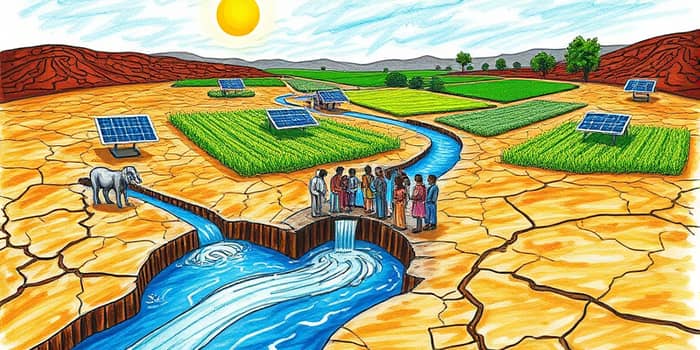
Water scarcity is not only a local hardship but a global systemic risk to food systems, economies, ecosystems, and societies. Nations around the world face a complex challenge: how to secure enough water for agriculture, industry, and households while preserving aquatic environments for future generations.
Understanding Water Scarcity and Its Dimensions
Water scarcity occurs when the demand for freshwater exceeds available supplies in a region. It manifests in multiple forms that must be addressed together.
- Physical scarcity: not enough water in absolute terms.
- Economic scarcity: infrastructure, governance, or finance barriers prevent access to available water.
- Water stress: a ratio of withdrawals to renewable resources that surpasses sustainable thresholds.
- Renewable water: freshwater naturally replenished through hydrologic cycle of rain and evaporation.
Framing water as a critical natural asset with economic value shifts our perspective from scarcity to stewardship and investment.
The Human Toll: Health, Sanitation, and Inequality
Despite advances in technology and policy, about 2.2 billion people still lack safely managed drinking water services, and 4.5 billion lack safely managed sanitation. The burden falls disproportionately on vulnerable communities in low-income regions.
Every community without clean water faces increased risk of waterborne diseases, malnutrition, and lost productivity. A staggering statistic highlights the crisis: every two minutes a child dies from a disease linked to unsafe water and poor sanitation.
A lack of reliable water supplies perpetuates gender inequality, as women and girls often shoulder the time cost of water collection, limiting education and economic opportunities. Universal basic water and sanitation services could generate more than $18.5 billion in economic benefits each year.
Declining Resources and Soaring Demand
Global freshwater withdrawals have increased roughly six-fold since 1900, driven by population growth, industrialization, and intensive agriculture. Since 2000 alone, withdrawals rose by 25%, one-third of which occurred in already dry regions.
The average renewable water availability per person fell by 7% over the past decade, with regions like Northern Africa and Western Asia experiencing some of the lowest per-capita endowments globally. Agriculture accounts for about 72% of freshwater withdrawals, highlighting the urgent need to improve irrigation efficiency and crop selection.
This dual trend of declining availability and growing demand underscores the need for holistic investments in water conservation, reuse, and recycling technologies.
Mismanagement and Accelerating Losses
Worsening droughts, deforestation, and wetland degradation contribute to an annual loss of 324 billion cubic meters of freshwater—enough to meet the needs of 280 million people. Poor water pricing, weak governance, and distorted incentives fuel unsustainable land and water management.
Recent studies reveal “continental drying” hotspots where water use growth exceeds 25% since 2000 in already stressed regions such as Central America, northern India, and parts of Brazil. Addressing these challenges demands integrated policies that align agricultural, industrial, and urban water use with environmental conservation.
Regional Snapshots: A World of Contrasts
Water stress varies dramatically across the globe, presenting unique challenges and opportunities for investment:
- Middle East & North Africa: Countries like Kuwait and Qatar rank among the lowest in renewable water per person, intensifying competition between agriculture and urban needs.
- South Asia: India holds 18% of the world’s population but only 4% of freshwater; mega-projects upstream threaten 30% of its supply.
- Sub-Saharan Africa: Low irrigation coverage and chronic under-investment leave millions reliant on unsafe sources during dry seasons.
- Latin America: Abundant water in some areas conceals localized stress where urbanization and agriculture collide.
- High-income regions: Even England faces water constraints that could curb housing and commercial growth, demonstrating water’s integral role in economic planning.
Understanding local contexts is essential for crafting sustainable solutions that respect social, economic, and ecological boundaries.
Economic Impacts and Financial Risks
Water scarcity poses significant macroeconomic risks. Research indicates that a one standard deviation increase in water scarcity could reduce real GDP growth by up to 0.16 percentage points and raise consumer price inflation by nearly 3%. Meanwhile, water-intensive industries face higher costs and production losses.
At the household level, inadequate water and sanitation services cost the global economy an estimated $260 billion annually in lost productivity and health expenses. Fortunately, investments yield strong returns: every $1 invested yields $4 return through lower medical costs and improved livelihoods.
Energy and industry also suffer. In India, water shortages led to the loss of 8.2 terawatt-hours of electricity generation between 2017 and 2021—enough power to run 1.5 million homes for five years.
Investing in a Vital Resource: Solutions and Opportunities
To turn the tide on water scarcity, investors, governments, and communities must collaborate on targeted strategies that maximize impact and resilience.
- Adopt efficient irrigation methods such as drip and precision irrigation to cut agricultural water use by up to 40%.
- Invest in wastewater treatment and reuse infrastructure, tapping into a reliable alternative supply for industry and irrigation.
- Implement water-smart urban planning with green roofs, rainwater harvesting, and permeable surfaces to reduce runoff and recharge aquifers.
- Support nature-based solutions like wetland restoration and reforestation to enhance watershed health and natural filtration.
- Deploy advanced metering, remote sensing, and data analytics to monitor consumption and detect leaks in real time.
Such investments not only secure water supply but also drive economic growth, job creation, and technological innovation.
Conclusion
Water scarcity demands urgent action and bold investment. By recognizing water as a fundamental critical natural asset with economic value, stakeholders can unlock sustainable growth and safeguard ecosystems. The choices made today—whether in financing infrastructure, reforming policies, or embracing new technologies—will determine our collective water future. With coordinated effort and strategic investment, we can ensure that every community thrives with access to safe, reliable water.
References
- https://www.worldbank.org/en/news/press-release/2025/11/04/world-annual-fresh-water-losses-could-supply-280-million-people
- https://www.bis.org/publ/work1314.htm
- https://humannecessityfoundation.com/water-scarcity-in-2025/
- https://www.publicfirst.co.uk/the-impact-of-water-scarcity-on-the-economy.html
- https://www.fao.org/newsroom/detail/renewable-water-availability-per-person-plunges-7-percent-in-a-decade-as-global-scarcity-deepens--fao-data-shows/en
- https://www.worldbank.org/en/topic/water/publication/high-and-dry-climate-change-water-and-the-economy
- https://worldpopulationreview.com/country-rankings/countries-with-water-scarcity
- https://water.org/our-impact/water-crisis/economic-crisis/
- https://www.unwater.org/publications/un-world-water-development-report-2025
- https://www.dni.gov/index.php/gt2040-home/gt2040-deeper-looks/future-of-water
- https://www.who.int/news/item/26-08-2025-1-in-4-people-globally-still-lack-access-to-safe-drinking-water---who--unicef
- https://www.wri.org/insights/highest-water-stressed-countries
- https://unstats.un.org/sdgs/report/2025/goal-06/
- https://www.worldwildlife.org/news/press-releases/water-crisis-threatens-58-trillion-in-economic-value-food-security-and-sustainability/
- https://www.unwater.org/water-facts/water-scarcity
- https://ourworldindata.org/water-use-stress