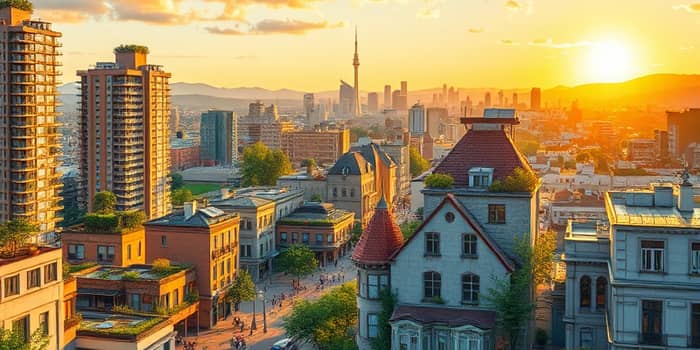
As the world’s population increasingly converges on cities, the demand for housing, transportation, and services intensifies. Understanding these dynamics is vital for policymakers, developers, and communities eager to build resilient, inclusive urban futures.
Global Urban Growth: Numbers and Narratives
By 2023, over 57.5% of the world’s population lives in urban areas, up from just 30% in 1950. The UN’s WUP25 report forecasts that two-thirds of population growth through 2050 will be absorbed by cities, adding nearly one billion new residents.
This unprecedented shift is driven by factors such as economic opportunity, social amenities, and rural-to-urban migration. By 2030, more than 60% of humanity—about five billion people—will call towns and cities home, converting nearly 6 million square kilometers to urban use.
- Population boom in cities spans Asia, Africa, and Latin America.
- Megacity proliferation quadrupled since 1975, now 33 globally.
- Urban land conversion threatens biodiversity and carbon sinks.
Asia alone will account for almost half of new urban dwellers, with China’s coastal corridor and India’s capital clusters leading growth. Sub-Saharan Africa follows, with regions around Lake Victoria and the Nile seeing rapid expansion.
Challenges and Opportunities in Today’s Cities
The rapid influx of residents creates an affordable housing crisis looms large in many markets. Urban home prices have surged beyond income growth, while mortgage rates rise, placing stress on middle- and low-income households.
Simultaneously, high-density projects and build-to-rent communities offer promise: the US BTR sector, valued at $4.4 trillion, maintained 95.5% occupancy in 2022. Yet authorized housing units—1.5 million in 2024—still fall short of demand.
- Demand for high-density development outpaces available land and financing.
- Suburban shifts during pandemic revealed supply-demand mismatches.
- Infrastructure investments struggle to keep pace with growth.
These figures underscore the scale of the build-to-rent market, yet also highlight regional disparities. In high-growth metros, demand far outstrips new supply, while some urban areas face slowing population gains and rising vacancy.
Strategies for Sustainable Urban Planning
To align growth with sustainability, stakeholders must adopt holistic approaches. Prioritizing public transit, green spaces, and mixed-use zones can mitigate congestion and sprawl, fostering vibrant communities.
- Inclusive zoning reforms incentivize affordable housing near transit.
- Green infrastructure networks enhance resilience and health.
- Data-driven land-use planning anticipates future needs.
- Community engagement initiatives ensure equity and belonging.
By integrating compact development with reliable transit, cities can reduce per-capita land consumption and carbon footprints. European and North American models demonstrate that efficient, mixed-use neighborhoods thrive when paired with tactical investments in bike lanes, pedestrian plazas, and smart utilities.
Developers and policymakers should collaborate on financial instruments—such as public-private partnerships and social impact bonds—to fund essential infrastructure. At the same time, promoting adaptive reuse of underutilized buildings can preserve cultural heritage and lower environmental costs.
Equally important is empowering residents through participatory planning. Local workshops, digital platforms, and citizen assemblies can surface diverse perspectives, ensuring that new developments reflect community needs and values.
Practical Steps for Stakeholders
Cities and developers can take immediate action to navigate urbanization’s challenges and prospects:
- Conduct comprehensive needs assessments to map service gaps.
- Set measurable sustainability targets aligned with COP30 goals.
- Leverage technology platforms for real-time data sharing.
- Establish cross-sector task forces for integrated decision-making.
- Foster regional cooperation on housing supply and transport.
Through these steps, urban growth can become a catalyst for innovation rather than a source of strain. When cities harness sustainable urban planning principles, they transform into engines of economic opportunity and social cohesion.
The path forward demands bold leadership, creative financing, and inclusive governance. By embracing smart growth, communities can ensure that the next billion city dwellers inherit thriving, equitable urban environments.
Together, we can shape cities that not only accommodate swelling populations but also nurture well-being, prosperity, and environmental stewardship for generations to come.
References
- https://worldpopulationreview.com/country-rankings/most-urbanized-countries
- https://www.zillow.com/research/2020-urban-suburban-report-28802/
- https://www.copernicus.eu/en/news/news/observer-seven-things-we-learned-un-world-urbanization-prospects
- https://www.tenantcloud.com/blog/2023-real-estate-trends-urban-suburban-shifts-and-the-rise-of-single-family-living
- https://journalistsresource.org/environment/global-urban-expansion-impact-biodiversity-carbon-2030/
- https://www.grandviewresearch.com/industry-analysis/us-real-estate-market-report
- https://thefinancialexpress.com.bd/others/nearly-half-of-global-population-live-in-cities-un-report
- https://www.nar.realtor/newsroom/home-prices-increased-in-73-of-metro-areas-in-fourth-quarter-of-2025
- https://www.un.org/development/desa/pd/world-urbanization-prospects-2025
- https://www.statista.com/outlook/fmo/real-estate/united-states
- https://ourworldindata.org/grapher/urban-population-share-2050
- https://constructioncoverage.com/research/cities-investing-most-in-new-housing
- https://www.statista.com/statistics/270860/urbanization-by-continent/
- https://www.nar.realtor/research-and-statistics
- https://population.un.org/wup/