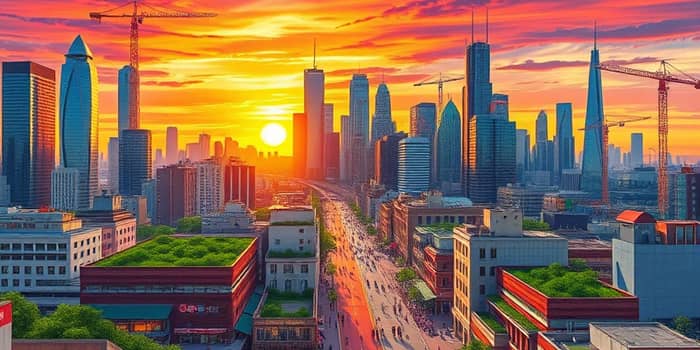
In today’s rapidly evolving global economy, cities stand at the forefront of economic transformation. From bustling metropolises to emerging urban hubs, the shift towards city life brings with it unprecedented profit opportunities in emerging cities. This article explores how businesses, investors, and policymakers can harness the power of urbanization to drive sustainable growth.
Urban areas already shape the future of work, commerce, and innovation. As over half the world’s population now resides in cities, strategic engagement with this trend offers a path to scalable wealth creation. By understanding the dynamics of urban growth—from agglomeration economies to infrastructure investments—stakeholders can position themselves for long-term success.
Economic Powerhouses: Cities and Productivity
Cities generate approximately 80% of global GDP despite housing just over 50% of the world’s population. In India alone, urban areas with 23% of the population contribute a disproportionately large share of national output—for example, Mumbai produces nearly 4% of GDP with just 2% of the population. Such data highlight the urban areas contribute disproportionately higher GDP and demonstrate the economic gravity of cities.
International comparisons further underscore this trend. Mumbai’s GDP rivals that of entire countries like Lithuania and Croatia. Delhi’s output surpasses Slovakia, while Bengaluru and Pune outpace Slovenia, Estonia, and Latvia respectively. These statistics illuminate not just scale but the concentrated power of urban centers to accelerate growth and productivity.
Agglomeration Economies: The Engine of Growth
Agglomeration economies describe the productivity premium gained when firms and workers locate close to each other. Research shows that wage elasticity to population density is significantly higher in developing regions: 0.19 in China, 0.12 in India, and 0.17 in Africa, compared to only 0.043 in the United States. Workers in dense urban clusters drive wage growth and innovation.
These benefits arise from improved job matching, knowledge spillovers, and efficient use of capital. As businesses cluster, they tap into wider talent pools, share resources, and benefit from specialized supply chains. Understanding these dynamics enables investors to pinpoint where urban density translates directly into profit and economic resilience.
Investing in Infrastructure and Real Estate
Governments worldwide are responding to urban expansion with strategic allocations. India’s Union Budget 2026 dedicates ₹5,000 crore to developing tier-2 and tier-3 cities under City Economic Regions (CERs). This funding aims to boost housing, retail, and hospitality through improved connectivity and job creation. Such measures create fertile ground for real estate and infrastructure investments.
- Real estate development in emerging urban corridors
- Public transit and smart mobility solutions
- Sustainable energy and renewables infrastructure
- Commercial and mixed-use property projects
Investors seeking stable returns can look to affordable housing schemes, public-private partnerships, and greenfield infrastructure projects. By aligning with government priorities, stakeholders access incentives and minimize risks while supporting urban resilience.
Navigating Challenges: Affordability and Sprawl
Rapid urbanization brings challenges that, if unaddressed, can constrain long-term profitability. Housing prices in North America and Canada exceed incomes by 35–38%, and in Europe, they run as much as 50% above median earnings. When demand outpaces supply, property markets become volatile, straining both residents and investors. Solutions such as slum upgrades, targeted subsidies, and rent controls offer pathways to stable real estate yields.
- Housing affordability crises in major cities
- Urban sprawl raising transport and social costs
- Environmental impacts from unplanned growth
By proactively addressing these issues, stakeholders can unlock new opportunities. For instance, compact city designs, transit-oriented developments, and mixed-income housing projects can reduce peripheral sprawl while maintaining productivity gains.
Strategies for Sustainable and Profitable Cities
Long-term urban prosperity hinges on sustainability. Cities account for over 70% of global carbon emissions, and unchecked growth can exacerbate inequality. public-private partnerships drive long-term resilience by financing green infrastructure and resilient design. Examples include rooftop solar networks, urban wetlands restoration, and adaptive reuse of industrial spaces.
Integrating technology and data analytics enhances efficiency. Smart traffic management, real-time energy monitoring, and IoT-enabled waste systems cut costs and optimize resource use. Such innovations appeal to socially responsible investors and align with emerging ESG criteria, opening access to green finance and impact capital.
Regional Trends and Comparative Insights
Understanding regional dynamics helps tailor investment strategies. The following table highlights key trends and profit implications across major regions:
Actionable Steps for Stakeholders
To capitalize on the urbanization advantage, investors and policymakers can adopt these steps:
- Target real estate in tier-2 and tier-3 cities poised for growth.
- Form partnerships with local governments and community groups.
- Invest in green bonds and sustainable infrastructure projects.
- Support MSMEs through microfinance and digital platforms.
- Leverage data-driven tools for urban planning and risk management.
By focusing on scalable models and inclusive growth, stakeholders not only secure returns but also foster resilient communities that thrive in the long run.
Conclusion: Seizing the Urbanization Advantage
Urbanization is more than a demographic shift—it is a catalyst for economic transformation. By embrace smart urban growth strategies, businesses and governments can unlock vast reservoirs of productivity and innovation. The path forward requires a balance of ambition, sustainability, and social equity, ensuring that city growth benefits all.
As two-thirds of global population growth heads to cities by 2050, the window to invest in urban infrastructure, housing, and services has never been clearer. The future belongs to those who anticipate change, align with evolving policy landscapes, and invest in solutions that drive both profit and progress.
Now is the moment to harness the urbanization advantage. Through informed strategies, collaborative investments, and visionary planning, stakeholders can build thriving cities that serve as engines of prosperity for generations to come.
References
- https://economictimes.com/industry/services/property-/-cstruction/union-budget-2026-urbanisation-to-reshape-real-estate-growth/articleshow/127846991.cms
- https://ourworldindata.org/urbanization
- https://www.developmentaid.org/news-stream/post/186952/urbanization-and-sustainable-cities-development
- https://www.lincolninst.edu/publications/working-papers/costs-benefits-urban-expansion/
- https://www.copernicus.eu/en/news/news/observer-seven-things-we-learned-un-world-urbanization-prospects
- https://desapublications.un.org/publications/world-economic-situation-and-prospects-2026
- https://www.brookings.edu/articles/the-economic-benefits-of-cities-in-the-developing-world/
- https://www.worldbank.org/en/topic/urbandevelopment
- https://www.worldbank.org/en/topic/urbandevelopment/overview
- https://www.urban.org/projects/opportunity-zones/opportunity-zones-2026-selection-tool
- https://unstats.un.org/sdgs/report/2022/goal-11/
- https://publications.wri.org/transformations-equitable-sustainable-cities/current-urbanization-global-south-realities