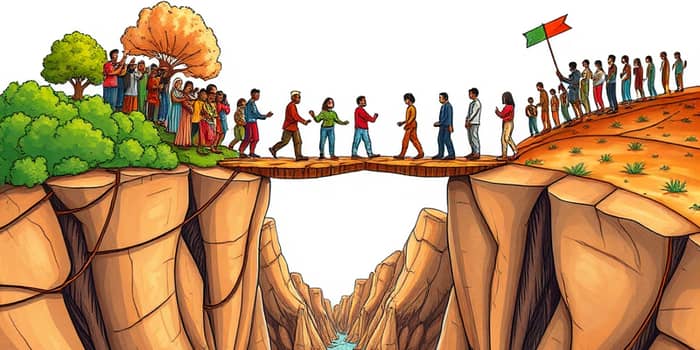
In a nation celebrated for opportunity, the stark reality of wealth inequality shadows countless lives.
Persistent and growing racial wealth gaps reveal a crisis that demands our attention and action.
These disparities are not just numbers; they represent deferred dreams and untapped potential for millions.
Intergenerational wealth transfers favor the privileged, perpetuating cycles that few can escape.
By delving into this issue, we can uncover pathways to a fairer society.
Human capital myths obscure deeper truths about why education alone fails to close divides.
The Scale of the Wealth Gap
Data paints a sobering picture of economic imbalance across America.
Recent statistics highlight how gaps have widened, not narrowed, over time.
- Black households' mean net worth gap with white households grew to $1.15 million in 2022.
- White average household wealth reached about $1.5 million in Q4 2024.
- The top 10% own nearly all total wealth, dominating economic resources.
- Billionaire wealth surged by $2 trillion in 2024, accelerating inequality.
- Millennials and Gen Z own $1.35 per $1 of boomers at the same age.
These figures underscore a system where wealth begets more wealth for the few.
Education, often touted as a equalizer, reveals its limits in this context.
- College-educated Black households have less wealth than white high school graduates.
- Wealth by education shows increases, but gaps persist across all levels.
- Overall, growth since the Great Recession has been inequitable.
This data calls for urgent reflection and reform.
Historical Roots and Persistent Causes
The wealth gap is not a recent phenomenon but a legacy of historical injustices.
U.S. racial history has embedded disparities that resist simple fixes.
Federal tax laws enable low-cost wealth transfers, primarily benefiting white families.
Myths about human capital, such as education or income sufficiency, are challenged by reality.
- Gaps are driven by systemic factors, not individual effort alone.
- The pandemic widened existing divides, highlighting vulnerabilities.
- Global comparisons show the U.S. as starkly unequal.
Understanding this context is crucial for crafting effective solutions.
Wealth concentration via tax subsidies skews resources away from those in need.
This history sets the stage for ongoing struggles and potential change.
The Human Impact of Economic Disparities
Behind every statistic lies a human story of struggle and resilience.
Wealth gaps affect access to education, healthcare, and housing, limiting life chances.
Income poverty traps 7.4% of households under $15,000 a year.
Families face daily challenges due to these economic divides.
- Reduced opportunities for children in low-wealth households.
- Health outcomes worsen with economic insecurity.
- Community resources dwindle in areas hit hardest.
Addressing these impacts requires empathy and actionable strategies.
Broader economic inequality fosters social tension and undermines cohesion.
By acknowledging this, we can build a more inclusive narrative.
Policy Solutions for a More Equitable Future
Numerous reforms offer hope for reducing wealth disparities through systemic change.
These solutions span taxation, asset-building, and social supports.
Progressive taxation can redistribute resources to fund equity initiatives.
This table outlines key areas where intervention can make a difference.
Specific recommendations provide a roadmap for action.
- Make the tax code more progressive to support low-wealth families.
- Raise the minimum wage and ensure paid leave for workers.
- Invest in Baby Bonds and auto-enroll retirement plans.
- Expand access to education from early childhood through college.
- Strengthen safety nets like Medicare and SNAP programs.
Racial and equity-specific measures include reparations and anti-discrimination efforts.
These policies aim to tackle root causes, not just symptoms.
What You Can Do to Make a Difference
Individual and collective actions can complement policy changes for greater impact.
Start by educating yourself and others about these issues.
Community organizing amplifies voices for systemic reform.
- Support local initiatives that promote financial literacy and asset-building.
- Advocate for policy changes at local, state, and national levels.
- Volunteer with organizations focused on economic justice.
- Engage in conversations to challenge myths about wealth.
- Invest in diverse businesses and communities to foster growth.
Every small step contributes to a larger movement for change.
Voting rights and anti-lobbying efforts ensure democratic participation.
By taking action, you become part of the solution.
Looking Ahead with Hope and Determination
The journey to overcome wealth disparities is long, but not insurmountable.
With informed strategies and persistent effort, we can bridge divides.
Global goals like UN Goal 10 inspire collaborative action against inequality.
History shows that change is possible when people unite for justice.
Let this article be a catalyst for reflection and empowerment.
Together, we can build a future where economic opportunity is truly for all.
References
- https://news.duke.edu/stories/2024/06/10/u-s-racial-wealth-gap-is-persistent-and-growing-new-research-finds/
- https://belonging.berkeley.edu/six-policies-reduce-economic-inequality
- https://www.stlouisfed.org/open-vault/2025/june/the-state-of-us-household-wealth
- https://www.clasp.org/press-room/news-clips/10-solutions-fight-economic-inequality/
- https://www.statista.com/statistics/203961/wealth-distribution-for-the-us/
- https://inequality.org/article/ten-solutions-bridge-racial-wealth-divide/
- https://www.oxfamamerica.org/explore/issues/economic-justice/extreme-inequality-and-poverty/
- https://siepr.stanford.edu/publications/policy-brief/policy-cocktails-attacking-roots-persistent-inequality
- https://inequality.org/facts/wealth-inequality/
- https://nonprofitquarterly.org/from-precarity-to-promise-how-public-policy-can-reverse-the-wealth-gap/
- https://www.visualcapitalist.com/visualizing-global-wealth-inequality/
- https://www.hks.harvard.edu/centers/mrcbg/programs/growthpolicy/racial-wealth-inequality-social-problems-and-solutions
- https://www.census.gov/topics/income-poverty/income-inequality.html
- https://democrats-financialservices.house.gov/issues/narrowing-the-wealth-gap.htm
- https://www.un.org/sustainabledevelopment/inequality/