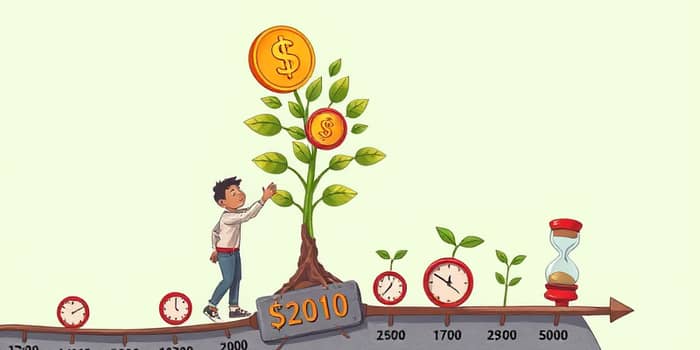
Imagine a world where every moment you delay in managing your finances chips away at your future wealth. This isn't a dystopian fiction; it's the reality of the time value of money, a principle that could redefine your financial destiny.
At its core, this concept teaches us that money available today holds more potential than the same amount in the future, all because of its ability to grow through interest or investments.
Understanding and leveraging this can transform your approach to saving, investing, and building a secure future, making time not just a resource, but your greatest asset.
The Core Concept: Time Value of Money
The time value of money (TVM) is the bedrock of personal finance and investing. It posits that a dollar today is worth more than a dollar tomorrow due to its earning potential.
This potential arises from factors like opportunity costs and inflation, which erode future purchasing power. By investing or saving money now, you can offset these risks and harness growth over time.
TVM underpins critical decisions, from choosing between spending and saving to evaluating complex corporate strategies like lease versus buy options.
- It motivates early saving by highlighting the exponential benefits of compounding.
- It helps in assessing loans and investments by discounting future cash flows.
- It encourages patience, as time can turn small, consistent actions into substantial wealth.
Embracing TVM means recognizing that every financial choice you make today echoes into your tomorrow, shaping your financial landscape in profound ways.
Compound Interest vs. Simple Interest: The Growth Multiplier
To grasp TVM fully, you must understand the difference between compound and simple interest. Simple interest applies only to the original principal, offering linear growth.
In contrast, compound interest earns interest on previously earned interest, accelerating wealth accumulation in a snowball effect. This is why compounding is often hailed as the eighth wonder of the world.
Consider this example: $5,000 invested at 5% simple interest over 5 years yields $1,250 in interest, totaling $6,250.
With the same amount at 5% compounded annually, you earn $1,381.41 in interest, totaling $6,381.41—a higher effective yield. More frequent compounding, such as monthly or daily, further boosts this growth.
- $1,000 at 5% simple interest grows to $1,250 after 5 years.
- When compounded, it becomes approximately $1,276.28 in the same period.
- This demonstrates how compounding magnifies returns, making it a powerful tool for long-term investors.
By prioritizing investments that compound, you set the stage for exponential financial growth that can outpace inflation and build lasting security.
Key Calculations and Formulas: Mastering the Math
To apply TVM practically, familiarize yourself with key calculations like future value (FV) and present value (PV). FV represents what a cash flow will be worth after growing via compound interest.
PV, on the other hand, discounts future cash flows to their worth today, using formulas like PV = FV / (1 + i)^t, where i is the interest rate and t is time.
Another invaluable tool is the Rule of 72, which estimates how long it takes for an investment to double: simply divide 72 by the annual return rate.
For instance, at a 7% return, your money doubles about every 10 years. This rule simplifies planning and highlights the impact of higher rates on wealth building.
Use these calculations to set realistic goals and make informed financial decisions that align with your timeline and risk tolerance.
The Power of Starting Early: Time as Your Greatest Ally
Time is the most critical factor in leveraging TVM. Starting your investment journey early can lead to exponentially more wealth due to longer compounding periods.
For example, investing $1,000 annually at 7% from age 25 to 60 yields approximately $183,967. If you start at age 35, it drops to about $122,708—a stark difference of over $61,000.
This underscores why procrastination can be costly. Early actions, no matter how small, accumulate into significant sums over decades.
- Reinvest dividends and interest through tools like DRIPs to accelerate compounding.
- Utilize tax-advantaged accounts such as 401(k)s or IRAs for tax-deferred growth.
- Avoid early withdrawals to let your investments mature fully.
As Warren Buffett famously said, time transfers wealth from the impatient to the patient. By embracing patience and consistency, you harness time's transformative power for financial freedom.
Practical Applications: From Savings to Investments
TVM isn't just theoretical; it applies to everyday financial decisions. In personal finance, it encourages building savings habits early, as today's money can compound into a substantial retirement nest egg.
For investments, use TVM to evaluate stocks via intrinsic value calculations or compare payout options, such as receiving a lump sum now versus installments later.
In loans and credit, discount future payments to make informed choices about terms and interest rates. Real estate assessments also rely on TVM for profitability analysis and financing decisions.
- Savings and retirement planning: Start small, but start now to maximize growth.
- Investment evaluation: Use discounted cash flow models to find undervalued assets.
- Loan decisions: Consider the present value of future payments to avoid overpaying.
- Business and real estate: Apply TVM to project evaluations and capital allocation.
Be mindful of risks like inflation, which can erode future value. Higher interest rates boost future value but reduce present value, so balance your strategies accordingly.
Inspiring Insights and Strategies for Success
To stay motivated, reflect on powerful quotes and real-life applications. Remember that "time is your biggest ally as an investor," and compounding can work wonders with patience.
Incorporate tools like compound interest calculators to visualize growth and set tangible goals. Tie TVM to real-life scenarios, such as comparing CDs, stocks, or real estate investments.
- Quotes for inspiration: "The stock market is a device for transferring money from the impatient to the patient" (Warren Buffett).
- Practical tools: Use online calculators to simulate different investment scenarios.
- Real-life ties: Apply TVM to everyday choices, like saving for a down payment or planning college funds.
By investing time wisely through early, consistent actions, you can build a financial future that's not only secure but abundant. Start today, let compounding do the heavy lifting, and watch your wealth grow beyond imagination.
References
- https://pressbooks.pub/fundamentaloffinance/chapter/chapter-3-time-value-of-money/
- https://ssb.texas.gov/compounding-time-your-side
- https://www.heygotrade.com/en/blog/value-investing-what-is-it
- https://www.carsonwealth.com/insights/blog/compounding-wealth-and-wisdom/
- https://corporatefinanceinstitute.com/resources/valuation/time-value-of-money/
- https://www.edvisors.com/money-management/financial-fluency/compound-interest/
- https://gallaghermohan.com/blogs/top-5-key-elements-of-time-value-of-money-in-real-estate-investing/
- https://www.nbc.ca/personal/advice/savings-investment/the-rule-of-72-and-the-magic-of-compound-interest.html
- https://www.businessinsider.com/personal-finance/investing/time-value-of-money
- https://www.fiducientadvisors.com/blog/the-power-of-compounding-how-time-can-be-your-best-investment-ally
- https://en.wikipedia.org/wiki/Time_value_of_money
- https://www.investor.gov/financial-tools-calculators/calculators/compound-interest-calculator
- https://www.bankrate.com/investing/time-value-of-money/
- https://www.snbonline.com/financial-learning-center/compound-growth
- https://www.allgenfinancial.com/time-value-money/