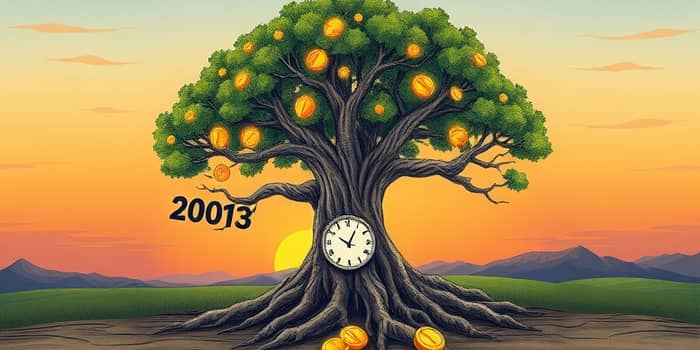
In a world obsessed with instant results, the quiet power of patience often gets overlooked.
Yet, in investing, it transforms uncertainty into a reliable wealth-building strategy that has stood the test of time.
This article delves into how long-term horizons consistently reward those who embrace waiting over rushing.
By weaving together historical evidence, mechanistic insights, and practical advice, we uncover why patience is not just a virtue but a financial superpower.
You will learn to harness time to your advantage, turning market volatility into opportunity.
What Is Long-Term Investing?
Long-term investing typically involves holding assets for 5 to 10 years or more, often spanning decades.
It focuses on business and economic growth rather than short-term price fluctuations.
This approach is closely tied to buy-and-hold strategies in diversified portfolios like broad equity indexes.
- Core philosophy: Emphasize time in the market over attempts at market timing.
- Key benefit: It allows investors to capture recovery after crises instead of selling low.
- Emotional angle: Patience flattens short-term volatility, reducing stress and impulsive decisions.
Contrast this with day-trading, where the odds resemble a coin toss.
Over extended periods, the market's chaotic nature gives way to surprising reliability.
Historical Performance: The Numbers That Inspire
Historical data reveals that stocks have delivered robust returns over long horizons, despite short-term ups and downs.
For instance, the S&P 500 with reinvested dividends shows compelling averages across different timeframes.
These numbers highlight the critical role of reinvested dividends in driving growth.
Year-to-year volatility can be extreme, as seen in dramatic swings.
- Major down years: 2008 (-37.0%), 2002 (-22.10%), 1974 (-26.47%).
- Major up years: 1954 (+52.62%), 1933 (+53.99%), 1995 (+37.58%).
Recent decades, like the last 10 years, have seen strong gains, such as 12.57% nominal annually.
Global markets echo this pattern, with the MSCI World index positive in about 65% of months since 1979.
This underscores that diversification and staying invested are key to capturing returns.
The Magic of Compounding: Returns on Returns
Compounding is the engine of exponential growth in investing, where earnings generate more earnings over time.
It turns small differences in annual returns into vast wealth disparities over decades.
Consider a Vanguard analysis with £10,000 invested for 50 years.
- Cash savings at 3.1% average: Grows to £45,553.
- Diversified portfolio at 5.2% average: Grows to about £128,214.
- 100% shares at 7.5% average: Grows to about £365,592.
This shows how a few percentage points compounded can multiply outcomes three to eight times.
Moreover, stocks' real returns have consistently outpaced inflation, protecting purchasing power.
Holding too much cash long-term risks erosion by inflation, making investing essential.
How Time Flattens Risk and Boosts Odds
As holding periods lengthen, the probability of positive returns increases significantly, smoothing out risk.
Data on S&P 500 rolling periods illustrates this powerfully.
- 1-day holding: Odds of gain ~54%, similar to a coin toss.
- 1-year holding: Odds rise to around 70%.
- 10-year holding: Historically, a 100% chance of positive return over the past 82 years.
This means that patience virtually eliminates losses over sufficient timeframes.
The range of outcomes also narrows with time.
Over one year, returns can swing from +50% to -40%, but over 30 years, they compress to strong gains with no deep losses.
This phenomenon, known as time-diversification, reduces volatility and enhances reliability.
It allows investors to weather storms without panic selling.
Practical Guidance for Cultivating Patience
To apply this wisdom, start with a disciplined investment plan that aligns with long-term goals.
Avoid the temptation of market timing, which often leads to missed opportunities.
Instead, focus on consistent contributions and portfolio rebalancing.
- Behavioral tip: Automate investments to remove emotion from decisions.
- Portfolio advice: Diversify across asset classes like stocks and bonds for stability.
- Mindset shift: View market downturns as buying opportunities, not threats.
Regularly review your strategy, but avoid frequent changes based on short-term news.
Embrace the power of staying invested through all market cycles.
Remember, missing just a few of the best market days can drastically reduce returns.
Studies show that investors who exit during volatility often lock in losses and miss recoveries.
- Action step: Set up a long-term portfolio with low-cost index funds.
- Monitoring: Check performance annually, not daily, to maintain perspective.
- Education: Learn about historical trends to build confidence in patience.
By integrating these practices, you can transform investing from a source of stress into a path to financial freedom.
Patience is not passive; it's an active choice to trust in time and data.
Start today, and let compounding work its magic over the decades ahead.
References
- https://petersonwealth.com/the-real-benefits-of-long-term-investments-why-patience-pays-off/
- https://tradethatswing.com/average-historical-stock-market-returns-for-sp-500-5-year-up-to-150-year-averages/
- https://www.vanguardinvestor.co.uk/articles/latest-thoughts/investing-success/the-power-of-long-term-investing-how-much-could-you-make
- https://www.slickcharts.com/sp500/returns
- https://www.franklintempleton.com/forms-literature/download/RLTI-FL
- https://novelinvestor.com/historical-returns/
- https://www.ishares.com/us/investor-education/investing-101/long-term-investing
- https://pages.stern.nyu.edu/~adamodar/New_Home_Page/datafile/histretSP.html
- https://marketinsights.citi.com/Financial-Education/Investing/The-Importance-of-Being-Invested.html
- https://totalrealreturns.com
- https://www.capitalgroup.com/individual/planning/market-fluctuations/long-term-investing-benefits.html
- https://curvo.eu/backtest/en/market-index/msci-world
- https://www.guggenheiminvestments.com/advisor-resources/interactive-tools/sp-500-historical-trends
- https://www.usbank.com/investing/financial-perspectives/investing-insights/buy-and-hold-long-term-investment-strategies.html
- https://fred.stlouisfed.org/series/FEDFUNDS