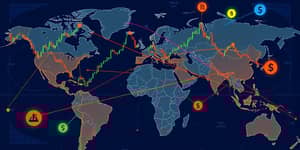
In an era of unprecedented connectivity and shifting economic power, investors must look beyond domestic markets to capture growth and manage risk. While global foreign direct investment fell by 11% to $1.5 trillion in 2024, the underlying opportunity set remains vast and dynamic.
From resilient private markets outpacing public benchmarks to the rapid evolution of generative AI in decision-making, today’s investment landscape demands agility and informed strategy. This guide offers a comprehensive roadmap for investors eager to broaden their horizons and harness the full potential of cross-border capital allocation.
Why Go Global?
Global diversification offers more than geographic spread—it provides resilience against localized downturns and access to high-growth sectors not available at home.
- diversify across asset classes to reduce portfolio volatility
- Tap into emerging markets with above-average GDP growth
- Balance currency and interest rate exposures strategically
By expanding internationally, investors can smooth returns, capitalize on regional trends, and fortify their portfolios against domestic headwinds.
Strategic Frameworks for Global Investment
Success in cross-border investing hinges on a rigorous decision-making approach. A proven three-step model helps align your objectives with market realities:
- the strategic three-pronged framework evaluating where, when, and if to expand
- Market selection based on regulatory environment, infrastructure quality, and government incentives
- Timing considerations tied to fundraising cycles, operational readiness, and local policy shifts
Adhering to this process ensures disciplined entry and exit strategies, allowing for clear validation milestones and an optimized risk-reward balance through leverage data-driven decision-making tools.
Sectoral Opportunities and Risks
Different asset classes present unique growth vectors and risk profiles. Understanding these nuances is critical for effective allocation.
- Infrastructure demands $6.5 trillion per year to support the global energy transition by 2050
- Real estate deal value rose 11% to $707 billion in 2024, with data centers delivering 11.2% returns
- Private debt remains attractive for its senior capital security despite modest deal-value declines
- Venture capital in Asia lags due to regulatory shifts, while North America leads in new fund formations
Careful selection within each sector, combined with localized expertise, can uncover high-conviction opportunities and mitigate execution risks.
Navigating Technology and Geopolitics
Advances in generative AI and big data analytics are transforming how opportunities are sourced and risks are assessed. Investors who adopt robust risk management processes gain an edge in volatile times.
Conversely, escalating geopolitical tensions and evolving trade policies have contributed to the recent FDI contraction. A proactive stance—monitoring policy developments and stress-testing portfolios—can shield capital from sudden regulatory shifts.
Practical Steps for Execution
Moving from strategy to action requires tactical precision. Key steps include:
- Conducting in-depth local market research and talent acquisition planning
- leverage local partnerships and insights to navigate complex legal and cultural landscapes
- Establishing clear validation gates to track ROI and decide on scaling or exit
These operational considerations—headcount management, legal compliance, and tailored go-to-market models—ensure you respond swiftly to evolving market conditions.
Case Studies: Lessons from Leading Investors
Companies like Credit Karma, Gilt, and Geniebook exemplify disciplined global expansion by rigorously applying the “where, when, if” framework. Their journeys highlight the importance of product localization, phased rollouts, and strategic alliances to achieve rapid scale without overextending resources.
A Snapshot of Key Metrics
Conclusion: Charting Your Global Path
Expanding beyond borders is not merely an option but a strategic imperative for forward-looking investors. By embracing rigorous frameworks, staying attuned to macroeconomic trends, and cultivating strong local relationships, you can unlock sustainable, long-term growth and resilience.
The global marketplace awaits. Now is the time to broaden your horizons, seize international opportunities, and write the next chapter of your investment journey.
References
- https://www.mckinsey.com/industries/private-capital/our-insights/global-private-markets-report
- https://www.reforge.com/blog/international-growth-where-when-if
- https://www.ici.org/research/stats/trends_01_25
- https://www.jpmorgan.com/insights/markets-and-economy/top-market-takeaways/tmt-in-the-rear-view-how-did-our-2025-themes-pan-out
- https://www.nature.com/articles/s41599-023-01787-8
- https://www.imf.org/en/publications/weo
- https://www.pewresearch.org/internet/2018/07/03/the-positives-of-digital-life/
- https://www.blackrock.com/corporate/insights/blackrock-investment-institute/publications/outlook
- https://www.ml.com/articles/health-savings-accounts-explained.html
- https://www.worldbank.org/en/publication/global-economic-prospects
- https://www.oecd.org/en/data/insights/statistical-releases/2025/11/international-trade-statistics-trends-in-third-quarter-2025.html
- https://geopolitique.eu/en/2024/04/26/macron-europe-it-can-die-a-new-paradigm-at-the-sorbonne/
- https://unctad.org/publication/world-investment-report-2025