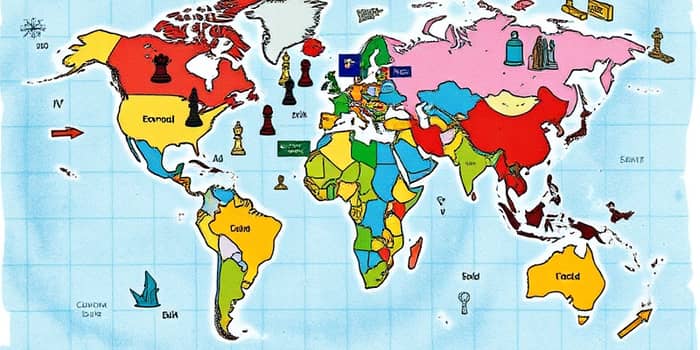
In today's interconnected world, the forces of geopolitics are reshaping markets with unprecedented intensity.
The US-China rivalry and ongoing trade tensions are central to this transformation, driving uncertainty across global economies.
As nations navigate conflicts, investors must adapt to new volatility and risks in this chaotic era.
This article delves into the key influences, from trade wars to supply chain shifts, offering practical insights for resilience and growth.
By understanding this complex game board, you can make informed decisions and thrive amidst turbulence.
The Geopolitical Chessboard: Understanding the Risks
Geopolitical risks have reached historic highs, threatening global stability and economic growth.
Conflicts like the Russia-Ukraine war disrupt energy security and inflate food prices worldwide.
The Israel-Hamas conflict fuels Middle East instability, impacting energy and food security further.
These events lead to supply chain disruptions and inflationary pressures that ripple through markets.
- Russia-Ukraine War: Continues to affect European energy and global inflation.
- Israel-Hamas Conflict: Drives higher costs and regional uncertainty.
- US-China Tensions: Risk financial decoupling and technology blacklisting.
- Other Hotspots: Include South China Sea confrontations and cyberattacks.
Moreover, rising nationalism and protectionism trends are accelerating deglobalization threats.
This geopolitical fracture exposes vulnerabilities, as highlighted during the COVID-19 pandemic.
Businesses and investors must stay vigilant to navigate these evolving risks.
Trade Policies and Tariffs: The New Normal
Trade policy has emerged as a top disruption, cited by 60% of executives as the biggest global growth risk.
Under potential US tariffs post-2025, sweeping changes could include a baseline 10% on most imports.
Specific tariffs might reach 50% on copper and 25% on cars, driving an average effective rate to 18.2%.
This represents the highest tariffs since the 1930s, reshaping global trade dynamics.
- US Tariffs Under Trump: Expected to trigger significant market adjustments.
- Global Responses to Tariffs: China redirects exports to Europe and Mexico.
- Trade Fragmentation Costs: Estimated from $0.6tn to $5.7tn annually.
- Realignment Trends like Friendshoring: Replace WTO norms with bilateral deals.
Countries are negotiating new agreements to adapt to this patchwork of rules.
Despite challenges, global trade growth has accelerated in 2025, showing surprising resilience.
Economic Impacts and Market Projections
The economic fallout from geopolitics is significant, with global growth projected to slow to 2.3% in 2025.
Inflation remains persistently above pre-pandemic levels, and central bank rates are settling higher.
Financial fragmentation could cost billions, as systems disintegrate into competing blocs.
Market effects include increased volatility in equities, bonds, and commodities.
Historically, tariffs have altered shipping patterns and passed costs directly to consumers.
Investors should prepare for elevated sovereign yields and dollar dominance in this environment.
Building Resilience in Supply Chains
Supply chains are on the front lines of geopolitical disruptions, requiring robust strategies for adaptation.
Companies are adopting geographic diversification and reshoring initiatives to mitigate risks effectively.
- Diversification Across Regions: Spread operations to reduce dependency.
- Supplier Engagement and Monitoring: Strengthen key partnerships for stability.
- AI and Machine Learning Tools: Enhance ROI and risk assessment.
- Critical Minerals Access Strategies: Secure resources for energy transition.
Critical minerals competition is intensifying, with Asia-Pacific governments leading in securing access.
The US Inflation Reduction Act is boosting investment in renewables, driving demand for these resources.
By leveraging technology and strategic planning, businesses can build more resilient networks.
Global Powers: Strategies and Priorities
Leading nations are crafting distinct strategies to navigate this complex geopolitical landscape.
The US focuses on tariffs and high-tech competition, with a strong national security bias.
China invests boldly in manufacturing and tech, with over 25% of industrial R&D spending.
Europe is pursuing trade deals to access nearly 2 billion customers, despite internal divisions.
- US Priorities and Reshaping Relationships: Aim for potential China deals.
- China's Approach to Reducing Dependencies: Deepen Global South trade ties.
- Europe's Role in Geopolitical Expansion: Increase defense spending and influence.
- Global South Influence in Rivalries: Foster new collaborations and power shifts.
These strategies highlight the shifting balance of economic and political influence worldwide.
Understanding these priorities helps in anticipating market movements and opportunities.
Navigating the Future: Opportunities Amid Chaos
Despite the risks, there are significant opportunities in this chaotic geopolitical environment.
Peaceful US-China coexistence is possible, leading to transactional deals later in 2025.
Businesses can realign through bilateral FDI provisions and adapt to emerging norms.
The energy transition is gaining momentum, aided by geopolitical shocks like the Russia-Ukraine war.
- Energy and Climate Policy Shifts: Drive decarbonization despite polarization.
- AI Revolution Accelerating Impact: Transform sectors with ongoing innovation.
- Labor Market Flux and Adaptations: Address changes and debt vulnerabilities.
- Longevity Economy and New Opportunities: Tap into aging population trends.
To thrive, organizations must stay agile, monitor trends continuously, and build collaborative networks.
Embrace the mix of risks and rewards, and seek cooperation in a fragmented world.
By mastering the geopolitical game board, you can secure growth and inspire resilience in uncertain times.
References
- https://www.spglobal.com/en/research-insights/market-insights/geopolitical-risk
- https://www.weforum.org/stories/2025/08/inflection-points-7-global-shifts-defining-2025-so-far-in-charts/
- https://www.wellington.com/en-us/institutional/insights/geopolitics-in-2025
- https://www.mckinsey.com/capabilities/strategy-and-corporate-finance/our-insights/economic-conditions-outlook
- https://www.bcg.com/publications/2025/geopolitical-forces-shaping-business-in-2026
- https://www.blackrock.com/corporate/insights/blackrock-investment-institute/interactive-charts/geopolitical-risk-dashboard
- https://www.brookings.edu/articles/a-look-back-at-2025-and-whats-in-store-for-2026-from-the-global-economy-and-development-program/
- https://hbr.org/2025/12/15-reasons-to-be-optimistic-about-globalization
- https://kpmg.com/xx/en/our-insights/risk-and-regulation/top-risks-forecast-2025.html