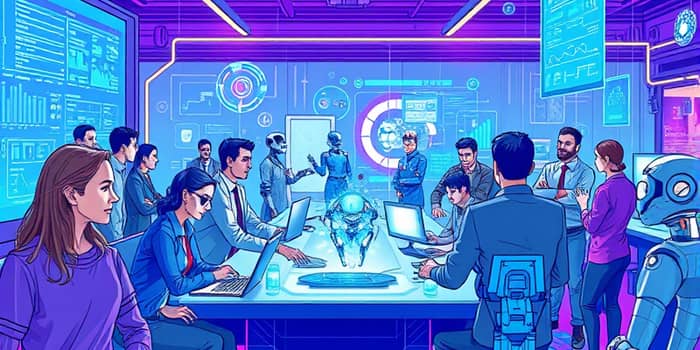
The workplace landscape is evolving at an unprecedented pace, driven by advances in AI and automation. Organizations and individuals must navigate this transition strategically to harness the benefits while mitigating risks.
Emerging AI Agent Workforces
By 2026, enterprises will increasingly rely on AI agents to handle specific tasks. Gartner forecasts that 40% of enterprise applications will incorporate these agents, a leap from under 5% just a year earlier. This rapid AI adoption at scale marks a shift from simple automation to intelligent execution.
Agentic AI refers to systems capable not only of analyzing data but also of taking actions on behalf of human teams. Organizations are developing orchestration platforms to manage this second workforce of agents, defining permissions, escalation paths, and quality controls. Yet, the path is not without hurdles: Gartner warns that over 40% of agentic AI initiatives might be canceled by 2027 due to cost, governance, or lack of clear ROI.
Job Exposure and Automation Velocity
Recent research indicates that up to 93% of jobs could experience AI-driven disruption, six years ahead of prior estimates. While some occupations face high exposure to AI, others remain relatively shielded. Partially automatable tasks now account for 40% of work activities, up from just 15% previously, and fully automatable tasks have increased from 1% to 10%.
To illustrate these trends, consider the following overview of key job families:
This table underscores the varying pace at which different sectors adapt. Roles in computing and mathematics face fast and broad changes, while professions grounded in human interaction evolve more gradually.
Human-AI Collaboration in Hybrid Teams
Instead of viewing AI as a replacement, many organizations are cultivating human-AI collaboration and oversight to amplify workforce capabilities. Hybrid teams combine human insight with AI precision, leading to:
- Faster decision-making through real-time data analysis
- Enhanced creativity by automating repetitive chores
- Reduced error rates via consistent machine execution
- Streamlined workflow design supported by AI recommendations
These benefits depend on robust governance frameworks. Managers now oversee both human staff and autonomous agents, ensuring that ethical guidelines and performance standards are upheld.
Market Adaptation and Organizational Resilience
Organizations that thrive will embrace continuous learning and upskilling as core metrics, enabling teams to adapt swiftly to technological shifts. Industry leaders refer to such entities as “Frontier Firms,” distinguished by their agility and data-driven culture.
Key strategies for building resilience include:
- Investing in modular AI infrastructure that scales with demand
- Orchestrating a balanced mix of human and agent labor pools
- Embedding feedback loops to refine AI performance over time
- Promoting cross-functional teams to break down silos
These approaches not only mitigate the risk of project failure but also unlock compounded operational gains, including higher consistency and lower error margins.
Bridging Skill Gaps and Policy Imperatives
To ensure equitable growth, policymakers and educators must address the widening policy and skill gaps. Without targeted interventions, the benefits of AI could exacerbate inequality and leave many workers behind.
Effective interventions should focus on:
- Developing curriculum that reflects current AI capabilities
- Offering subsidies for reskilling and continuous education
- Creating public-private partnerships to align skills with market needs
- Tracking labor market data through an AI Preparedness Index
Public sentiment favors augmentation over full replacement, with 94% supporting AI tools that enhance human work. Governments can build on this goodwill by fostering policies that share economic gains and safeguard entry-level opportunities.
Looking Ahead: Opportunities and Challenges
The next decade will witness a collision of AI, talent dynamics, and geoeconomic shifts. Organizations and individuals that anticipate change will find themselves at a long-term competitive advantage positioning, while those that resist may struggle with underinvestment and inertia.
Key uncertainties include the pace of regulatory adaptation and the distribution of AI-driven productivity gains. Scenarios range from accelerated growth with broad benefits to fragmented outcomes marked by regional disparities.
Regardless of the path, one principle holds true: success depends on a human-centric approach. By co-designing AI solutions with end users and embedding learning into every process, we can create a future of work that is more efficient, inclusive, and fulfilling.
As 2026 unfolds, the organizations that master the orchestration of human and machine talent will define the next era of innovation.
References
- https://greatleadership.substack.com/p/future-of-work-trends-2026-agent-workforce
- https://www.cognizant.com/us/en/aem-i/ai-and-the-future-of-work-report
- https://www.library.hbs.edu/working-knowledge/riley-performance-resistance-2026
- https://www.weforum.org/stories/2026/01/how-ai-will-affect-work-in-different-industries/
- https://www.imf.org/en/blogs/articles/2026/01/14/new-skills-and-ai-are-reshaping-the-future-of-work
- https://hbr.org/2026/02/9-trends-shaping-work-in-2026-and-beyond
- https://www.nexford.edu/insights/how-will-ai-affect-jobs
- https://www.deloitte.com/us/en/insights/topics/technology-management/tech-trends.html