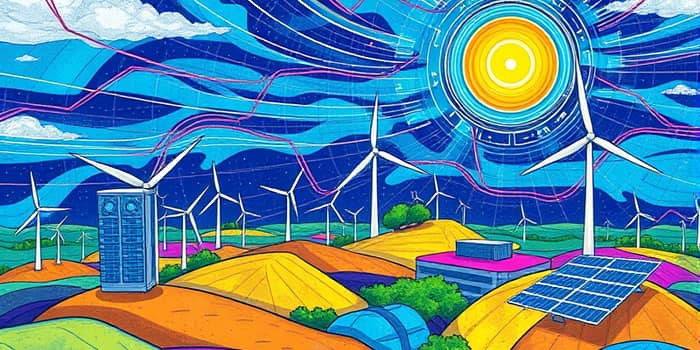
In an era of rapid change, investors must look beyond today's headlines to build wealth that endures.
Megatrends like economic security and AI infrastructure are reshaping global markets with unprecedented force.
By understanding these forces, you can transform uncertainty into opportunity and secure your financial future.
The Forces Shaping Tomorrow's Markets
2026 will be defined by several powerful themes that demand attention from forward-thinking investors.
These trends are not isolated; they interact to create new possibilities and challenges.
- Economic security, focusing on resilient supply chains and national defense.
- Energy transition, driven by renewables and rising power demand.
- AI infrastructure, encompassing data centers and productivity gains.
- Sustainable investing maturation, moving beyond labels to performance.
- Circular economy, emphasizing waste recycling and materials efficiency.
- Emerging areas like sustainable agriculture and climate adaptation.
Geopolitical tensions and AI-driven investments amplify these themes, offering diverse asset class opportunities.
This dynamic landscape requires a proactive approach to portfolio construction.
Key Statistics to Guide Your Strategy
Data reveals the scale and urgency of these shifts, providing a roadmap for strategic decisions.
Power demand is surging, with data centers projected to consume 8% of US power by 2030.
- Global data-center electricity will grow 15% annually through 2030.
- Clean energy investment hit $2.2 trillion in 2024, signaling a pivot.
- $3 trillion in data center capex is expected, with less than 20% deployed.
- Sustainable private debt has raised $61 billion since 2014.
- S&P 500 is forecasted to reach 7,800, a 14% gain in 12 months.
- Renewables are 2.5 times more labor-intensive than fossil fuels.
These figures underscore the momentum behind sustainable and tech-driven growth.
Ignoring them could mean missing out on transformative returns.
Economic and Macro Outlook
The global economy remains resilient, buoyed by AI investments that sustain growth.
Above-trend growth and easing policy, such as Fed rate cuts, create a favorable environment.
Disinflation is expected to converge to a sustainable pace by 2027, encouraging selective risk-taking.
Policy shifts, like US moves favoring traditional energy, may impact clean energy investments.
China's lead in clean tech poses competitive risks, particularly for US AI initiatives.
Private credit is rising at the intersection of liquidity and growth sectors, offering non-dilutive financing.
This backdrop empowers investors to focus on asset-specific narratives rather than broad market fears.
Seizing Opportunities Across Asset Classes
Diversification across various assets can harness the potential of these megatrends effectively.
This table highlights how each class aligns with future growth drivers like AI and sustainability.
By allocating strategically, you can build a portfolio that thrives in tomorrow's markets.
Navigating the Risks Ahead
Every opportunity comes with risks that require careful management and foresight.
Geopolitical tensions and economic security issues can disrupt supply chains and inflate costs.
- Sustainable investing faces policy shifts and fund underperformance, prompting a focus on metrics.
- AI and energy sectors grapple with supply chain constraints and China's clean tech dominance.
- Credit markets may see wider spreads due to tech issuance and data center ABS.
- Physical climate risks, like extreme weather, drive adaptation costs and infrastructure gaps.
- Talent shortages in renewables could slow deployment and innovation.
These dynamics demand vigilance and adaptive investment strategies to mitigate potential losses.
Proactive risk assessment ensures your portfolio remains resilient amid volatility.
Strategic Questions for Smart Investing
To capitalize on these trends, ask yourself key questions that guide decision-making.
Beyond core themes, consider areas like the circular economy and climate adaptation for hidden gems.
- How can you integrate circular innovations, such as biomethane from waste, into your holdings?
- What role does climate adaptation, like HVAC upgrades, play in long-term resilience?
- Is your portfolio constructed for selective risk, with AI high-conviction plays balanced by diversification?
- Are you leveraging income strategies via EM debt, securitized assets, or dividend stocks?
- Do you have tools to identify firms excelling in resource security and energy independence?
These inquiries foster a holistic approach to investing that aligns with future realities.
Active management can uncover firms poised for consolidation and growth in shifting landscapes.
Conclusion: Building a Future-Proof Portfolio
The journey to tomorrow's markets begins with education and action today.
Embrace megatrends like AI infrastructure and energy transition as catalysts for wealth creation.
Use statistics and outlooks to inform your allocations, focusing on opportunities across asset classes.
Manage risks through diversification and continuous monitoring of geopolitical and economic shifts.
Ask strategic questions to refine your approach and stay ahead of evolving dynamics.
By doing so, you transform uncertainty into a roadmap for sustainable success.
Invest with vision, and let tomorrow's possibilities shape your financial legacy.
References
- https://am.gs.com/en-us/advisors/insights/article/investment-outlook/megatrends-thematic-investing-2026
- https://www.ml.com/articles/economic-market-outlook-2026.html
- https://www.ishares.com/us/insights/inside-the-market/2026-market-outlook-investment-directions
- https://www.morganstanley.com/insights/articles/stock-market-investment-outlook-2026
- https://www.jpmorgan.com/insights/global-research/outlook/market-outlook
- https://www.blackrock.com/corporate/insights/blackrock-investment-institute/publications/outlook
- https://www.robeco.com/en-int/themes/expected-returns-2026-2030
- https://www.schroders.com/en/nordics/professional/insights/2026-sustainable-investment-outlook-7-key-trends-for-north-america-in-the-year-ahead