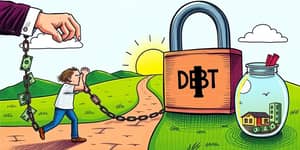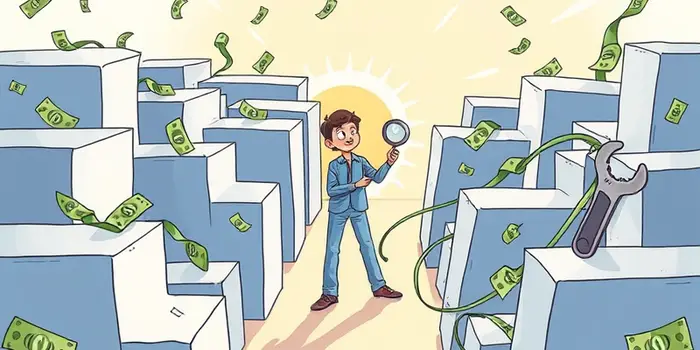
Every day, we face countless money decisions that should be simple, yet they often feel overwhelming and costly. Financial friction creates invisible barriers that steer us away from what truly matters, draining our wallets and well-being.
This friction isn't just about obvious fees; it's woven into the very fabric of how we think and act with money. Cognitive overload from endless options can leave us exhausted, making it easier to choose short-term convenience over long-term gain.
But there's hope: by becoming aware of these drags, we can start to fight back. Smoothing out financial friction empowers us to reclaim control and build a more sustainable, fulfilling financial life.
Understanding the Many Faces of Financial Friction
Financial friction manifests in various forms, each adding a layer of complexity to our decisions. It's not just one thing but a combination of factors that work against our best interests.
At its core, it includes transaction costs that eat into our resources. Hidden fees and unnecessary expenses can quickly accumulate, reducing the net value of our exchanges without adding any real benefit.
- Common examples include annual banking fees, ATM charges, and brokerage commissions.
- These costs are often mandatory but do little to improve our financial outcomes.
Cognitive and psychological aspects also play a huge role. Decision fatigue sets in when we're bombarded with choices, making it hard to evaluate sustainability or ethical options.
- Mental effort to research green investments or repair options can feel like a burden.
- This leads many to default to familiar, unsustainable choices out of sheer exhaustion.
Systemic and structural factors further complicate matters. Policies and market designs often favor consumption over durability, creating barriers to circular economies.
- Advertising pushes us toward excess, while regulations may hinder sustainable practices.
- These elements make aligned actions, like investing in repair infrastructure, seem daunting.
The Daily Drag: How Friction Shapes Our Choices
In our everyday lives, financial friction quietly influences our behaviors, often without us realizing it. Choosing local produce or mending clothes can feel like uphill battles.
The perceived higher cost and effort involved push us toward quicker, less sustainable alternatives. Social pressure and cultural narratives amplify this, framing simplicity as a loss in social capital.
Behavioral economics offers insights into why this happens. Prospect theory shows that we tend to undervalue long-term sustainable gains due to risk aversion.
- The endowment effect makes us overvalue what we already own, hindering divestment from unsustainable assets.
- Decision fatigue depletes our energy, leading to status-driven consumption over thoughtful choices.
This creates a cycle where friction reinforces itself, making it harder to break free. High perceived effort reduces our intention to adopt better financial habits, trapping us in suboptimal patterns.
Macro Impacts: Friction in the Bigger Picture
Beyond personal finance, financial friction has broader economic implications. It explains why economic downturns can persist and deepen over time.
Macroeconomic models highlight how frictions like spreads between saver returns and borrower costs widen during crises. This cuts investment in essential areas like plant and equipment.
Agency problems arise when external funding becomes costlier due to monitoring and incentives. Debt limits tied to collateral value further restrict access to capital.
- Negative shocks to net worth can tighten these frictions, amplifying their effects as seen in events like the Great Recession.
- Households, especially poorer ones, face higher loan rates, increasing their sensitivity to financial risks.
Quantifiable elements, such as funding wedges and wealth distribution analysis, show how friction exacerbates inequality. Low-resource groups are disproportionately affected, making it harder for them to escape financial stress.
Strategies to Fight Back: Smoothing Out Your Money Matters
To combat financial friction, we can adopt practical strategies that reduce its impact on our lives. It starts with minimizing transaction costs through smart choices.
- Avoid high-fee accounts and platforms that nickel-and-dime you for basic services.
- Negotiate fees where possible and opt for low-spread investment tools to keep more of your money.
Reducing cognitive load is equally important. Simplify your financial decisions by setting up defaults that align with your goals.
- Auto-enroll in ethical funds or sustainable saving plans to bypass decision fatigue.
- Use clear certifications and labels to quickly identify trustworthy options without extensive research.
On a systemic level, advocate for policies that support circular economies and repair infrastructure. Behavioral nudges can help counteract the effects of advertising and social pressure.
Personal tools like building financial literacy are key. Prioritize retained earnings and internal funds to avoid costly external borrowing, and divest from high-friction assets that drain your resources.
- Promote durability and sharing economies in your community to create a culture of sufficiency.
- Counter consumption narratives with stories that highlight the benefits of mindful living.
A Table to Guide Your Friction-Fighting Journey
This table provides a clear roadmap for identifying and addressing different types of friction in your financial life. Tailor your approach based on your specific challenges to maximize impact.
Embracing a Smoother Financial Future
Fighting financial friction isn't about perfection; it's about progress. Each small step you take to reduce these drags brings you closer to financial peace and sustainability.
Remember that persistence is key. Temporary shocks might test your resilience, but with the right strategies, you can build a buffer against long-term effects.
Start today by auditing your expenses for hidden fees. Simplify one decision at a time to gradually reduce cognitive overload and regain control.
Ultimately, smoothing out your money matters allows you to align your finances with your values. It frees up resources for what truly matters, from personal well-being to planetary health.
Embrace this journey with confidence, knowing that every effort counts. Together, we can transform financial friction from a silent enemy into a manageable challenge, paving the way for a brighter, more prosperous future.