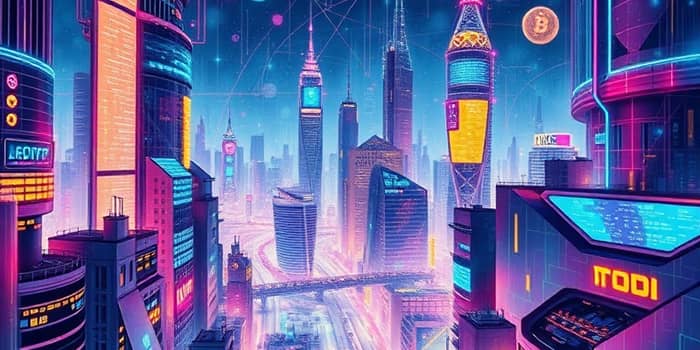
We stand at a pivotal moment in history, where innovation is accelerating at an unprecedented pace, reshaping every facet of human existence.
Disruptive technologies are not mere upgrades; they are seismic shifts that fundamentally alter markets and societal norms.
From artificial intelligence to biotechnology, these forces invite us to embrace change and harness their potential for a brighter future.
What Are Disruptive Technologies?
At their essence, disruptive technologies are innovations that displace established products and create entirely new markets.
They often emerge from niche applications before scaling to revolutionize industries, much like personal computers did to mainframes.
This process transforms behaviors, driving economic and social evolution in ways we can scarcely imagine.
Top Trends Defining 2025
Looking ahead, several key trends are set to dominate the technological landscape, offering both challenges and opportunities.
According to experts, these innovations will shape how we work, live, and interact in the coming years.
- Generative AI Enablement: Embedding AI into applications for enhanced content creation and workflow automation.
- People-Centric Productivity: Tools designed to boost human efficiency and foster creativity in workplaces.
- Actionable Analytics: Leveraging big data for real-time insights that drive smarter decision-making.
- Value Chain Intelligence: Optimizing supply chains through smart technology and predictive modeling.
- Embedded Cashflow: Integrating financial systems seamlessly into business operations for greater agility.
Additionally, new additions like Agentic AI are gaining traction, acting as autonomous virtual coworkers for complex tasks.
The rise of application-specific semiconductors addresses the compute and memory demands of advanced AI systems.
Learning from Historical Disruptors
History provides valuable lessons on how disruptive technologies have transformed societies and economies over time.
By examining past examples, we can better anticipate the impacts of current innovations and adapt proactively.
These innovations highlight how disruption can lead to new market creation and societal advancement.
Artificial Intelligence as the Central Driver
In 2025, artificial intelligence stands at the forefront of disruption, with generative AI leading the charge.
Key statistics underscore its rapid growth and transformative potential across various sectors.
- US private AI investment reached $109.1 billion in 2024, significantly outpacing other nations.
- Global GenAI investment hit $33.9 billion, showing an 18.7% year-over-year increase.
- Training compute for AI models doubles every five months, accelerating capabilities exponentially.
- Regulations are proliferating, with the US enacting 59 AI rules in 2024 to manage risks.
Events like the DeepSeek AI disruption and major government projects highlight the global race for supremacy in this domain.
AI is not just a tool; it is becoming an integral part of infrastructure, driving energy optimization and smart systems.
The Convergence of Technologies
Disruptive technologies rarely operate in isolation; they converge to amplify effects and create synergistic impacts.
This intersectionality is key to understanding their broader implications for society and industry.
- AI combined with IoT and 5G enables smart cities and connected infrastructures.
- Biotech and nanotechnology merge for advanced healthcare solutions and personalized medicine.
- Blockchain and fintech revolutionize financial services with secure, transparent transactions.
Such convergence paves the way for autonomous systems that learn, adapt, and collaborate in real-time environments.
Practical Impacts and Risks to Consider
While disruptive technologies offer immense benefits, they also come with significant risks that require careful management.
Understanding these aspects is crucial for leveraging innovations responsibly and sustainably.
- Job displacement in sectors like trucking due to automation, necessitating workforce reskilling.
- Malicious AI code execution poses cybersecurity threats that demand robust safeguards.
- Energy demands from AI data centers drive the need for greening power sources and sustainable practices.
Addressing these challenges involves proactive policy-making and ethical innovation frameworks to balance progress with protection.
Market Projections and Future Enablers
The economic potential of disruptive technologies is vast, with projections indicating substantial growth in key areas.
Staying informed about these trends can help individuals and organizations prepare for the future.
- On-device AI is projected to become a $114.4 billion market by 2031, with a CAGR of 49.35%.
- Semiconductor ecosystems are evolving rapidly to meet AI's compute and memory demands.
- Government investments, such as China's $47.5 billion in semiconductors, fuel global innovation and competition.
Embracing these technologies requires strategic foresight and continuous learning to capitalize on emerging opportunities.
Embracing the Dawn with Confidence
As we navigate this transformative era, it is essential to view disruption not as a threat, but as an invitation to innovate.
By learning from history, understanding current trends, and fostering a culture of adaptability, we can shape a future of limitless possibilities.
The dawn of disruptive technologies is here, offering a chance to build a more connected, efficient, and equitable world for all.
References
- https://www.corumgroup.com/insights/2025-top-10-disruptive-tech-trends
- https://www.mckinsey.com/capabilities/tech-and-ai/our-insights/the-top-trends-in-tech
- https://helpfulprofessor.com/disruptive-technology-examples/
- https://inss.ndu.edu/Media/News/Article/4291845/disruptive-technologies-in-current-and-future-warfare-definition-and-depiction/
- https://builtin.com/articles/2025-year-in-review-tech-news
- https://online.fit.edu/degrees/undergraduate/cis/ba-business-administration/disruptive-technology-definition-and-examples/
- https://hai.stanford.edu/ai-index/2025-ai-index-report
- https://www.coresite.com/blog/disruptive-technologies-forging-the-future-of-computing-and-data-centers
- https://www.weforum.org/publications/top-10-emerging-technologies-of-2025/
- https://professionalprograms.mit.edu/blog/technology/top-disruptive-technologies/
- https://www.deloitte.com/us/en/insights/topics/technology-management/tech-trends.html
- https://www.4strat.com/future/disruptive-innovation/
- https://ppp.worldbank.org/examples-disruptive-technologies-and-their-applications-infrastructure