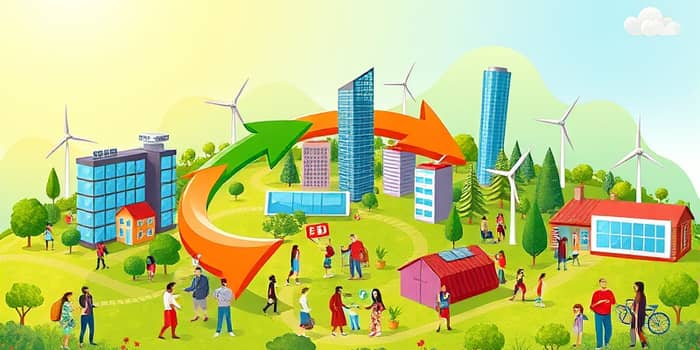
The circular economy is not just a trend. It is a fundamental reimagining of how we produce, consume, and thrive.
This model moves beyond the linear take-make-dispose approach that has dominated for decades. Minimizing waste and reusing materials are its core tenets, creating systems that promote enduring prosperity.
By closing the loop on resource use, businesses can unlock new opportunities. Long-term environmental and economic health becomes achievable through innovative practices.
The shift is driven by urgent global realities. Resource scarcity and climate change demand immediate action.
Adopting circular principles offers a path forward. It combines ecological stewardship with smart business strategy.
Understanding the Core Principles
The circular economy is built on three foundational principles. These guide every aspect of sustainable design and operation.
- Design out waste and pollution from the very beginning.
- Keep products and materials in use through reuse and repair.
- Regenerate natural systems to enhance environmental vitality.
This framework ensures resources flow continuously. It transforms waste into valuable inputs for new cycles.
Key Drivers of Change
Several forces are accelerating the adoption of circular models. Resource scarcity is a primary concern.
The world's population is growing rapidly. This increases strain on finite natural resources.
Supply chain resilience is another critical factor. Circular approaches reduce dependency on volatile markets.
They create more secure and localized systems. Dispersing geographic concentration of minerals enhances stability.
Environmental Benefits in Detail
The environmental advantages of the circular economy are profound. They address pressing issues like pollution and climate change.
- Recycling materials cuts the need for new resource extraction.
- Reuse systems eliminate harmful single-use plastics effectively.
- Closing loops prevents toxic chemicals from leaching into ecosystems.
Climate impact is significantly reduced. Recycling aluminum uses 95% less energy than new production.
Emissions from recycled minerals are much lower. This supports global climate neutrality goals by 2050.
Economic Returns and Business Advantages
Beyond environmental gains, the circular economy delivers tangible economic benefits. It fosters innovation and growth in multiple sectors.
This table highlights the multifaceted returns. Companies can thrive while contributing to a healthier planet.
Five Core Circular Business Models
Several business models exemplify the circular economy in action. Each offers unique ways to create value sustainably.
- Circular Inputs: Using recycled materials like metals and plastics.
- Sharing Economy: Companies sharing resources to reduce ownership needs.
- Product-as-a-Service: Customers access products via rental or subscription.
- Product Use Extension: Refurbishing items to extend their lifespan.
- Resource Recovery: Recycling end-of-life products into new materials.
These models demonstrate practical applications. Transforming waste into valuable feedstocks is key to success.
Real-World Success Stories
Many industries are already implementing circular strategies. Their stories inspire and provide blueprints for others.
In textiles, companies like Circos use subscription models. This reduces waste and keeps clothing in circulation.
Technology firms such as Re-Tek remarket used IT equipment. They divert vast amounts from landfills efficiently.
Food startups like Protix upcycle waste into protein. This creates sustainable alternatives to traditional sources.
- H&M collects tonnes of textiles for reuse with I:CO.
- Urban Mining Co recycles rare magnets with patented processes.
- Globechain operates a B2B marketplace for asset reuse.
These examples show the versatility of circular approaches. Creating closed-loop systems across sectors drives innovation.
Industrial Applications and Symbiosis
Industrial symbiosis takes circularity to a collaborative level. Companies exchange surplus resources to mutual benefit.
This reduces costs and sparks product innovation. SMEs in Denmark have improved competitiveness through such partnerships.
It fosters a community of sustainability. Reduced waste management and materials procurement costs are common outcomes.
Measuring Impact and Future Directions
Key metrics validate the effectiveness of circular models. Data shows significant environmental and economic gains.
- Recycling industries create millions of jobs globally.
- Trane Technologies' rental business grows over 10% annually in some regions.
- Re-Match achieves nearly 100% component reuse from synthetic turf.
Future efforts will focus on social equity and safety. Ensuring a just transition for all communities is vital.
Next phases include protecting workers and prioritizing domestic feedstocks. Addressing multiple material streams like batteries will be crucial.
Strategic Competitive Advantages
Embracing the circular economy offers long-term strategic benefits. It positions businesses as leaders in sustainability.
Industrial competitiveness is enhanced through reduced dependency. This strengthens geopolitical positioning in resource markets.
Sustainability integration becomes a core business practice. Shifting from disposable culture to innovation ensures relevance.
Modular designs enable easier repair and ownership. This aligns with growing consumer demand for ethical practices.
The circular economy is a journey of continuous improvement. It promises a future where business success and planetary health are intertwined.
By adopting these models, companies can build resilience. They contribute to a world that thrives for generations to come.
References
- https://www.immerse.education/beyond-syllabus/economics/what-is-the-circular-economy-definition-benefits/
- https://www.boardofinnovation.com/blog/circular-business-model-examples/
- https://www.milliken.com/en-us/blogs/circular-economy-sustainability
- https://www.bain.com/insights/circular-business-models-unlock-new-profit-and-growth-ceo-sustainability-guide-2025/
- https://www.unepfi.org/pollution-and-circular-economy/circular-economy/
- https://stateofgreen.com/en/news/10-examples-of-circular-economy-solutions/
- https://www.weforum.org/stories/2026/01/circular-economy-clean-energy-supply-chain-critical-minerals/
- https://www.ube.ac.uk/whats-happening/articles/circular-business-model/
- https://www.nsaction.us/post/looking-ahead-to-2026-making-a-circular-economy-work-in-and-for-america
- https://www.weforum.org/stories/2022/01/5-circular-economy-business-models-competitive-advantage/
- https://environment.ec.europa.eu/strategy/circular-economy_en
- https://www.ellenmacarthurfoundation.org/topics/circular-economy-introduction/examples
- https://climatepromise.undp.org/news-and-stories/what-is-circular-economy-and-how-it-helps-fight-climate-change
- https://www.oecd.org/en/publications/business-models-for-the-circular-economy_g2g9dd62-en.html