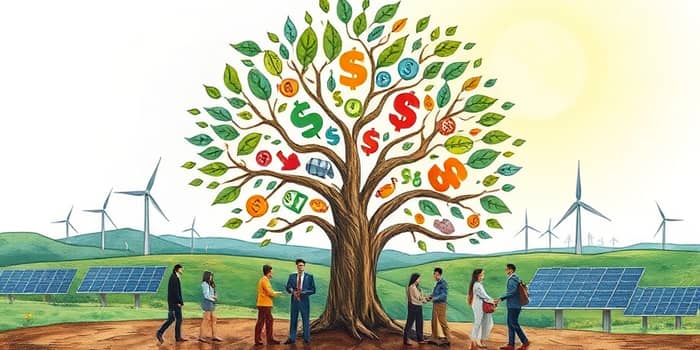
As global awareness of environmental and social challenges grows, so does the demand for investments that align profit with purpose. In 2025, sustainable investing stands at a crossroads, driven by shifting regulations, maturing data frameworks, and mounting investor interest.
This comprehensive guide offers in-depth analysis of market trends and practical insights to navigate the evolving ESG landscape.
Definition and Scope of Sustainable Investing
Sustainable investing integrates financial objectives with non-financial considerations, focusing on environmental, social, and governance factors. While ESG investing zeroes in on measurable corporate practices, sustainable investing embraces broader long-term impacts on society and the planet.
Analysts now routinely incorporate ESG analysis alongside traditional metrics, evaluating climate risk, labor standards, and board diversity to build more resilient portfolios.
Market Size and Growth of the ESG Market
By September 2025, the ESG market has reached unprecedented scale, reflecting a profound shift in capital allocation.
While some segments faced outflows amid geopolitical shifts, environmental-focused funds saw steady net inflows in early 2025. Forecasts suggest ESG assets could exceed $50 trillion by 2030, underscoring the movement’s lasting momentum.
Investor Interest and Sentiment
Global surveys indicate that 88–90% of investors express interest in sustainable strategies, with 89% already factoring ESG into decisions. Despite this enthusiasm, roughly 30% cite challenges finding suitable products.
- 83% of consumers demand active ESG leadership from companies.
- Europe accounts for 83% of global ESG assets.
- North American investors show caution, especially around energy.
The data highlights a widening gap between investor intent and available opportunities, signaling room for product innovation and education.
Sustainable Investment Strategies
Investors today employ diverse approaches to sustainable investing. Key strategies include:
- Integration – Embedding ESG factors into traditional financial analysis to enhance risk assessment.
- Screening – Excluding or including assets based on ethical criteria (e.g., fossil fuels, tobacco).
- Impact Investing – Targeting measurable social and environmental returns alongside financial gains.
These approaches have given rise to specialized products—environmental focus funds, faith-based portfolios, and thematic vehicles aimed at climate, biodiversity, or social justice objectives.
Key ESG Themes and Trends
Several themes dominate 2025’s sustainable investing agenda:
- Climate adaptation and resilience in vulnerable regions.
- Nature and biodiversity conservation initiatives.
- Clean energy expansion, with $2 trillion invested globally in 2024.
- Electrification trends: 17 million electric vehicles sold in 2024.
Regulatory dynamics also shape the landscape, as regions diverge on ESG disclosure mandates and standardized reporting frameworks like SASB, GRI, and TCFD gain traction.
Benefits and Performance of ESG Investing
Research consistently shows ESG integration offers improved risk management and enhanced resilience during market downturns. Funds with robust ESG criteria often match or outperform traditional peers over the long term.
High-rated ESG companies typically report stronger profitability, fewer material controversies, and lower systemic risk. Moreover, sustainable investments stimulate corporate innovation in renewable energy, circular methods, and equitable labor practices—creating long-term value for stakeholders.
ESG Metrics, Reporting & Regulatory Environment
Despite progress, ESG metrics remain uneven. Over 90% of S&P 500 firms now publish sustainability reports, but standardization is ongoing. The EU’s Corporate Sustainability Reporting Directive (CSRD) demands detailed disclosures, while U.S. regulators debate rulemaking at both federal and state levels.
Investors and companies alike are adapting to evolving frameworks, striving for greater transparency, comparability, and data integrity in ESG reporting.
Challenges and Critiques in ESG Investing
Key obstacles include inconsistent data quality, performance variability across regions, and a persistent supply gap for retail-friendly ESG products. Concerns about greenwashing—where firms overstate sustainability claims—continue to attract scrutiny.
Investor priorities sometimes conflict: some value impact above returns, while others demand market-rate performance, highlighting the need for clear product labeling and rigorous oversight.
Regional Insights
Europe leads global sustainable assets, driven by robust regulation and investor demand. North America’s ESG AUM grows steadily but faces political headwinds in energy sectors. Asia-Pacific and emerging markets are rapidly scaling clean energy investments and climate resilience projects, reflecting regional sustainability priorities.
Future Outlook
Looking ahead, sustainable investing is poised for further expansion. Innovation in renewable technologies, biodiversity finance, and climate adaptation will remain at the forefront.
Expect intensified regulatory focus on disclosure standards, growing demand for impact-oriented products, and deeper integration of ESG considerations across all asset classes—ultimately driving capital toward a more equitable and resilient global economy.
References
- https://www.imd.org/blog/sustainability/sustainable-investing/
- https://www.morganstanley.com/insights/articles/sustainable-investing-interest-2025
- https://www.financealliance.io/7-benefits-of-esg-investing/
- https://www.ici.org/research/stats/esg_investing
- https://www.keyesg.com/article/50-esg-statistics-you-need-to-know
- https://dfpi.ca.gov/news/insights/embracing-sustainable-investment-practices-with-esg-investing/
- https://www.diligent.com/resources/guides/esg
- https://www.thomsonreuters.com/en-us/posts/esg/2025-predictions/
- https://www.deloitte.com/us/en/insights/industry/financial-services/esg-investing-and-sustainability.html
- https://www.rothschildandco.com/en/newsroom/insights/2025/06/wm-business-with-humanity-esg-insights-for-2025-and-beyond/
- https://www.morganlewis.com/pubs/2025/10/fall-2025-esg-investing-quarterly-update
- https://online.hbs.edu/blog/post/sustainable-investing
- https://www.cfainstitute.org/insights/articles/what-is-esg-investing
- https://www.thecorporategovernanceinstitute.com/insights/news-analysis/the-future-of-esg-in-2025/
- https://www.nber.org/reporter/2023number3/esg-and-sustainable-investing
- https://www.homaio.com/post/invest-in-sustainable-development
- https://www.skadden.com/insights/publications/2025/06/esg-in-2025-a-midyear-review
- https://www.mckinsey.com/capabilities/sustainability/our-insights/does-esg-really-matter-and-why
- https://www.veriswp.com/sustainable-investing-and-esg-factors-in-2025-navigating-a-shifting-landscape/
- https://securities.cib.bnpparibas/esg-survey-2025/
- https://hbr.org/2020/09/social-impact-efforts-that-create-real-value
- https://www.morganstanley.com/insights/articles/sustainable-funds-outperform-traditional-first-half-2025
- https://www.morningstar.com/sustainable-investing/global-esg-mutual-fund-etf-funds-register-outflows-q3-2025-against-complex-geopolitical-backdrop
- https://www.wellington.com/en-us/institutional/sustainability/sustainable-investing