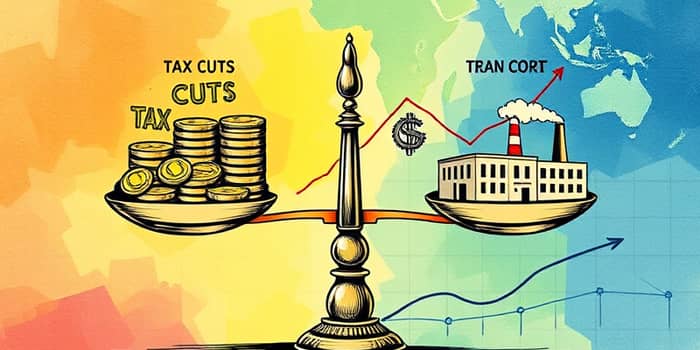
In the dynamic world of economics, few theories have sparked as much debate and transformation as supply-side economics.
This approach shifts focus from consumer demand to the power of production, offering a bold path to prosperity.
By understanding its principles, we can grasp how markets evolve and thrive in today's complex global landscape.
Core Principles: The Foundation of Supply-Side Thinking
At its heart, supply-side economics champions the idea that boosting aggregate supply drives growth.
It argues that when producers are freed from constraints, they innovate and expand output.
This leads to lower prices, increased consumption, and widespread employment gains.
The theory rests on three key pillars that form its actionable framework.
- Tax Policy: Reducing marginal tax rates incentivizes work, investment, and productivity, while high rates can stifle economic activity.
- Regulatory Policy: Cutting government interventions, such as regulations and subsidies, allows businesses to operate more freely and efficiently.
- Monetary Policy Critique: Central bank actions are often seen as ineffective, with a focus instead on supply-side measures to stabilize the economy.
Embracing these principles can unlock potential across various sectors.
Historical Origins: From Classical Roots to Modern Application
Supply-side economics has deep historical roots, tracing back to classical thinkers like Adam Smith.
It gained prominence in the 1970s as a response to stagflation, which challenged traditional demand-side models.
The 1980s saw its popularization under Reaganomics, with significant tax cuts aiming to revitalize the economy.
This era highlighted the theory's practical implications and sparked ongoing discussions.
- Early influences include Ibn Khaldun's insights and Smith's emphasis on free markets.
- The Laffer Curve, introduced by Arthur Laffer, illustrates how tax rates can impact revenue through behavioral changes.
- Reagan's policies reduced top marginal rates from 70% to 28%, aiming to stimulate growth.
- This period contrasted sharply with Keynesian demand-side approaches, which focus on fiscal stimulus.
Understanding this history helps us appreciate the theory's evolution and relevance.
Theoretical Framework: Supply vs. Demand Dynamics
In economic models, supply-side theory views the aggregate supply curve as nearly vertical.
This means that factors like technology and labor determine long-term output, not short-term demand fluctuations.
When barriers such as high taxes are removed, the curve shifts rightward.
This leads to increased production and lower prices, benefiting consumers and businesses alike.
Keynesian models, in contrast, emphasize the aggregate demand curve's slope.
They advocate for government spending to boost consumption and address economic downturns.
The Laffer Curve further supports this by showing that optimal tax rates maximize revenue without discouraging activity.
Grasping these concepts empowers individuals to analyze economic policies critically.
Positive Impacts: Evidence of Growth and Resilience
Proponents of supply-side economics point to numerous successes in fostering economic strength.
Incentives for saving and investment can lead to a larger tax base and sustained growth.
Recent examples, such as the U.S. post-pandemic recovery, demonstrate its potential.
Supply-chain improvements and labor market expansions contributed to stronger GDP growth compared to global peers.
- Post-2020, disinflation trends in the U.S. outpaced other nations, aided by supply-side adjustments.
- Lower prices from excess supply can naturally stimulate demand, creating a virtuous cycle.
- Correlations show that supply forces, like those from geopolitical events, have weakened the traditional growth-inflation link.
- This resilience highlights the theory's adaptability in modern economies.
These outcomes inspire confidence in supply-driven strategies for market stability.
Criticisms and Challenges: A Balanced Perspective
Despite its promises, supply-side economics faces significant criticisms from empirical evidence.
Tax cuts often fail to pay for themselves, leading to increased budget deficits.
For instance, the 2018 Tax Cuts and Jobs Act saw corporate tax revenue drop by 33%.
This has raised concerns about long-term fiscal sustainability and equity.
- Post-1981, GDP growth averaged 1 percentage point lower annually, adjusted for inflation.
- Income inequality has risen following major tax reductions, sparking debates on social impact.
- Investment in productivity and innovation sometimes lags behind corporate profit increases.
- Some models suggest that government spending under uninsured risk may not yield strong supply-side effects.
Acknowledging these challenges encourages a more nuanced approach to economic policy.
Market-Specific Impacts: A Detailed Analysis
Supply-side economics influences various markets in distinct ways, shaping economic outcomes.
The table below summarizes key effects and evidence across different sectors.
This analysis helps stakeholders make informed decisions in a volatile economic environment.
Modern Relevance: Navigating Today's Economic Landscape
In the 2020s, supply-side principles remain crucial amid global disruptions.
Pandemic-related supply-chain issues and geopolitical conflicts have tested economic resilience.
Policies focusing on production incentives can aid in recovery and long-term stability.
For example, immigration boosts to labor supply have supported growth in key economies.
- Recent inflation data shows U.S. PCE measures below CPI, indicating disinflation trends.
- Supply forces have altered traditional correlations between growth and inflation.
- Embracing free trade and regulatory flexibility can foster innovation.
- This modern context underscores the ongoing debate between supply and demand approaches.
By applying these insights, we can better navigate economic uncertainties and opportunities.
Conclusion: Embracing a Holistic Economic Vision
Supply-side economics offers a compelling narrative for market transformation and growth.
Its focus on incentives and production has reshaped economies worldwide, for better or worse.
As we look to the future, balancing these principles with social equity and empirical evidence is key.
By fostering informed discussions, we can inspire policies that drive prosperity for all.
References
- https://corporatefinanceinstitute.com/resources/economics/supply-side-economics/
- https://www.dallasfed.org/research/economics/2024/0326
- https://en.wikipedia.org/wiki/Supply-side_economics
- https://ctbaonline.org/file/648/download?token=cV7fD8lc
- https://www.annenbergclassroom.org/glossary_term/supply-side-economics/
- https://www.americanprogress.org/article/the-failure-of-supply-side-economics/
- https://fiveable.me/key-terms/principles-macroeconomics/supply-side-economics
- https://pages.stern.nyu.edu/~nroubini/SUPPLY.HTM
- https://www.ebsco.com/research-starters/economics/supply-side-economics
- https://www.econlib.org/library/Enc/SupplySideEconomics.html
- https://www.masterclass.com/articles/learn-about-supply-side-economics-history-policy-effects
- https://www.youtube.com/watch?v=XglYBwYT5Ps