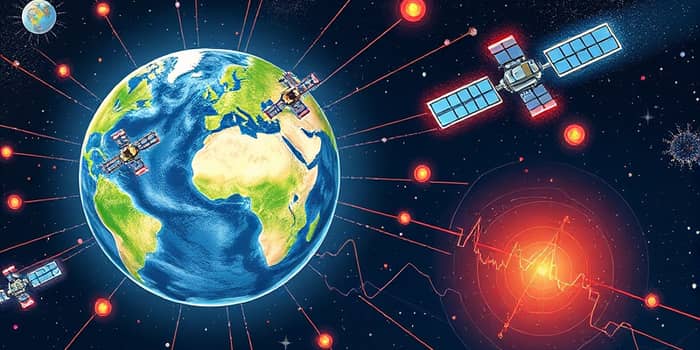
The dawn of a new era in space exploration is here, marked by rapid commercialization and unprecedented economic potential.
The global space economy has surged to $613 billion current scale, showcasing a 7.8% increase from previous years.
Commercial activities now dominate, accounting for 78% of the total, with satellites and broadband services leading the charge.
This growth is just the beginning, as future projections suggest the economy could triple to $1.8 trillion by 2035.
Such expansion is fueled by innovation, cost reductions, and diverse market opportunities that are reshaping industries worldwide.
From satellite manufacturing to human spaceflight, the space sector is becoming a cornerstone of modern economic development.
The Expanding Universe of Space Economy
Market size and growth projections paint a vivid picture of opportunity and transformation.
Explosive growth areas include several key sectors that are driving this expansion forward.
- Commercial human spaceflight has seen a staggering 611% growth in recent years.
- In-Space Servicing, Assembly and Manufacturing (ISAM) shows 168% growth, highlighting new capabilities.
- Space Situational Awareness has increased by 200% over three years, enhancing safety and coordination.
Emerging markets are also on the rise, driven by technological advancements and consumer demand.
- Direct-to-Cell satellite services revenue is projected to exceed $370 million in 2026, a 260% surge from 2025.
- Satellite-enabled IoT reached $1.8 billion in 2024 and will grow to $5.7 billion by 2030, with a 21.3% CAGR.
- Satellite-based 5G networks are expected to grow at 65.1% CAGR to $3.69 billion by 2028.
- Space-based edge computing is estimated to reach $1,807.3 million by 2033, with a 22.64% CAGR.
- The satellite IoT market is projected to hit $15.5 billion by 2034, reflecting a 23.1% CAGR.
This diversity in sectors underscores the breadth of commercial potential and innovation.
Manufacturing and Launch: The Backbone of Orbit
Satellite manufacturing is set for significant expansion, driven by increasing demand for connectivity and data services.
Expected to reach $30 billion in 2026, it will expand to $101 billion by 2033, with a 16% CAGR.
The launch vehicle market is also growing, estimated at $15.7 billion in 2022 and projected to $29.1 billion by 2027.
Satellite communications, valued at $25.2 billion in 2025, is expected to soar to $83 billion by 2035.
This table highlights the sustained growth across key areas, emphasizing the sector's robustness.
Medium Earth Orbit (MEO) segments are expected to account for 56.4% of market share in 2026.
Large satellites will capture 33% of the market, while communications hold 37%, indicating diverse applications.
Geographic and Industrial Landscape
North America dominates the satellite manufacturing market with a 53% share in 2026, driven by integrated aerospace frameworks.
Asia Pacific holds 22% and is expected to record the fastest growth, showcasing regional dynamism.
The industry structure is complex, with over 2,500 private companies and more than 70 national space agencies active globally.
- Major agencies include NASA (U.S.), ESA (Europe), CNSA (China), ISRO (India), JAXA (Japan), and Roscosmos (Russia).
Employment in the space sector exceeds 250,000 people worldwide, supporting innovation and operations.
Thousands of satellites are already in orbit, with more launched each year to meet growing needs.
Financing the Final Frontier
Capital formation is accelerating through innovative mechanisms that are reshaping investment landscapes.
Investments reached all-time highs of more than $70 billion in 2021 and 2022, highlighting strong investor confidence.
- Special Purpose Acquisition Companies (SPACs) are backing start-ups for public market access, enabling rapid scaling.
- Public-Private Partnerships with the Department of Defense are leveraging commercial innovation through contracts and co-investment.
Policy catalysts, such as the White House Space Executive Order, aim for a crewed U.S. Moon landing by 2028.
This order establishes a commercial pathway to replace the ISS by 2030 and shifts to commercial-first contracting.
These initiatives are expected to drive faster procurement reforms and boost space stocks in 2026.
Technological Innovations Driving Change
Cost reductions have been dramatic, with launch costs falling 10-fold over the last 20 years.
Data prices have also dropped, making connectivity more accessible and fueling further growth.
Orbital compute is emerging as a key narrative, tying space investment to AI infrastructure development.
- Multi-orbit solutions combine GEO, MEO, and LEO for flexible, high-performance connectivity.
- New technologies like open architecture terminals enable cross-orbital switching with maximized bandwidth efficiency.
These advancements are crucial for scalability and meeting the demands of a connected world.
The number of satellites launched per year has grown at 50%, supporting this technological evolution.
Direct-to-Cell Services: A Case Study
D2C satellite services are a prime example of partnership-driven growth in the space economy.
Revenue is fueled by collaborations between mobile network operators and satellite operators.
Satellite operators rely on partnerships rather than becoming full MNOs due to indoor coverage limitations.
Signals are obstructed indoors, making satellite-first services less valuable compared to terrestrial networks.
Starlink, despite acquiring over $17 billion in spectrum, is not expected to pivot to a full MNO.
This model highlights the importance of strategic alliances in commercializing orbit effectively.
Cross-Sector Impact and Benefits
Space-enabled technologies benefit numerous industries beyond space itself, creating ripple effects across the economy.
- Five key sectors will generate 60% of the global space economy by 2035: supply chain and transport, food and beverage, state-sponsored defense, retail, consumer and lifestyle, and digital communications.
- Additional benefiting industries include agriculture, information technology, insurance, and construction, all gaining from cost efficiencies and environmental benefits.
Supply chain and transport will see more efficient logistics, reducing costs and improving reliability.
Food and beverage sectors will benefit from better last-mile delivery of perishable goods, enhancing sustainability.
The space economy promises to help tackle global challenges such as climate change through innovative solutions.
Investment Outlook: Navigating the New Space Age
The space sector offers attractive investment and trading opportunities due to its volatility and growth potential.
AI remains the leading investment theme, and space adds significant high-technology investment potential.
With over 15-20 publicly traded pure-play space stocks, investors have diverse options to explore.
The sector's dynamics make for a healthy trading environment, appealing to both short-term and long-term strategies.
As we look ahead, the space race is no longer just about exploration but about economic transformation and global connectivity.
Embracing this new frontier requires strategic vision, innovation, and collaboration across public and private spheres.
References
- https://www.investing.com/analysis/examining-the-space-race-investment-theme-for-2026-200670621
- https://www.juniperresearch.com/press/global-d2c-revenue-set-for-370m-surge/
- https://navellier.com/11-18-25-examining-the-space-race-investment-theme-for-2026/
- https://www.satellitemarkets.com/americas/market-trends
- https://www.weforum.org/stories/2024/04/space-economy-technology-invest-rocket-opportunity/
- https://www.coherentmarketinsights.com/industry-reports/satellite-manufacturing-market
- https://investorplace.com/hypergrowthinvesting/2026/01/2026-could-be-the-breakout-year-for-space-stocks/
- https://www.gminsights.com/industry-analysis/satellite-communication-market
- https://www.census.gov/library/stories/2026/01/space-economy.html
- https://www.startus-insights.com/innovators-guide/satellite-industry-trends/
- https://itif.org/publications/2026/01/05/policy-reforms-to-launch-us-space-innovation/
- https://www.statista.com/statistics/262635/revenue-of-the-global-satellite-industry/
- https://www.analysysmason.com/research/content/articles/space-predictions-2026-nsi139-nsi140-nsi141-nsi142-nsi146-nsi147-nsi148/