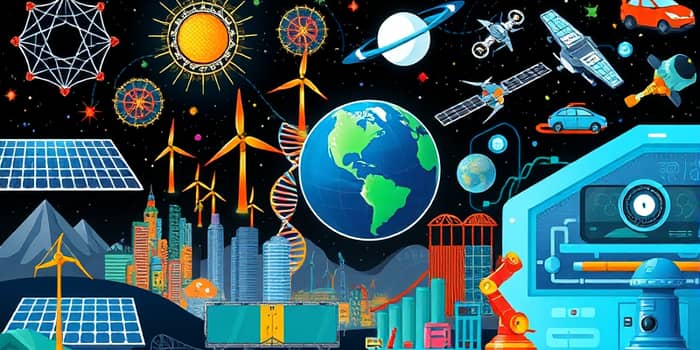
In 2025, industries around the globe are experiencing transformative growth driven by technology, sustainability initiatives, and shifting consumer demands. This analysis reveals how leading sectors are evolving and what lies ahead.
Macro Trends and Growth Themes
The global economy in 2025 is characterized by rapid digital transformation across industries and unprecedented policy support for innovation. Companies are investing heavily in automation, data analytics, and sustainability to maintain competitive advantage.
Supply chain resilience remains a top priority as businesses deploy AI-driven tools to anticipate disruptions. Trade uncertainty and regional dynamics are reshaping manufacturing locations and investment flows.
- AI and automation integration in operations
- Green energy and sustainability mandates
- Policy incentives for advanced manufacturing
- Accelerated R&D in health and biotech
Artificial Intelligence & Machine Learning
The AI & ML sector is soaring with a projected CAGR of 37.3%, targeting a market size of $407 billion by 2025. Adoption spans 67% of Fortune 500 firms, with generative AI revenues estimated at $89 billion.
Key segments include AI infrastructure, healthcare diagnostics, financial modeling, and manufacturing optimization. Companies are leveraging data-driven algorithmic decision making to enhance productivity and creativity.
Clean Energy & Sustainability
Clean energy investment is expected to reach $1.77 trillion in 2025, up 41% year-over-year. Solar costs have declined 89% since 2010, while offshore wind capacity has grown 45% annually.
Emerging sub-sectors such as energy storage and green hydrogen are attracting significant capital, buoyed by government incentives and corporate ESG goals. This reflects a broader shift toward long-term decarbonization strategies.
Healthcare Technology & Biotechnology
The health tech and biotech market will expand to $665 billion by 2025, at a CAGR of 31.7%. Precision medicine now achieves an 89% success rate, versus 43% for traditional approaches.
Remote patient monitoring devices total over 214 million, and AI-powered drug discovery timelines have shortened from over a decade to 3–5 years. Medical robotics and telehealth solutions are redefining care delivery.
Electric Vehicles & Sustainable Transportation
Electric vehicle sales are projected at 21.5 million units in 2025, up 48% from the previous year. Charging infrastructure has tripled since 2023, now exceeding 4.2 million global stations.
Autonomous driving features at Level 3–4 automation appear in 38% of new EVs, highlighting a trend toward next-generation mobility solutions and zero-emission transport networks.
Fintech & Digital Banking
Fintech continues its rapid ascent with a 26.5% CAGR, reaching $556 billion in 2025. Digital payments will process over $14.5 trillion in transactions, while embedded finance opportunities are estimated at $606 billion.
Blockchain asset holdings exceed $198 billion, and AI-driven investment platforms manage $4.6 trillion in assets. Consumers and enterprises alike are adopting neobanking services for seamless financial experiences.
Advanced Manufacturing & Industry 4.0
The Industry 4.0 market will hit $395 billion by 2025, growing at 22.3% annually. Over 41 billion IoT devices are now connected to smart factories, enabling predictive maintenance and digital twins.
U.S. chipmaking commitments total $500 billion, set to triple capacity by 2032. Manufacturers plan to allocate over 20% of budgets to smart systems, underscoring transformative production capabilities.
Space Economy & Satellite Technology
With a projected CAGR of 33.6%, the space economy will reach $546 billion in 2025. Satellite internet, space tourism, and zero-gravity manufacturing are emerging revenue drivers.
Private and government players are investing heavily in launch services, in-orbit infrastructure, and asteroid resource exploration, positioning space as the next industrial frontier.
Cross-Sector Analysis: Regional and Policy Perspectives
Regional dynamics are reshaping industry leadership. Asia-Pacific leads global EV manufacturing with 72% market share, while Europe drives green tech and cybersecurity innovation.
The U.S. incentivizes advanced manufacturing through increased tax credits, and data center expansion is fueled by AI demand. Reshoring trends benefit from a skilled workforce and regulatory reforms.
- Europe: Green tech leadership and automation
- Asia-Pacific: Semiconductor and digital payments dominance
- North America: Policy-driven manufacturing investments
Conclusion and Future Outlook
The next decade will see continued sector specialization, consolidation, and technology-driven disruption. Investors and leaders must navigate policy shifts, talent shortages, and supply chain risks with strategic, data-driven decision making.
Emerging opportunities lie in AI-powered services, sustainable infrastructure, and space-based ventures. Organizations that embrace digital tools and cultivate agility will define the industrial landscape of tomorrow.
References
- https://www.ibisworld.com/industry-trends/
- https://www.bls.gov/careeroutlook/2015/article/hospice.htm
- https://www.researchandmetric.com/blog/industry-growth-2025/
- https://www.blackstone.com/insights/article/building-the-future-megatrends-and-investment-themes/
- https://www.deloitte.com/us/en/insights/industry/manufacturing-industrial-products/manufacturing-industry-outlook.html
- https://www.cfr.org/task-force-report/chinas-belt-and-road-implications-for-the-united-states/findings
- https://www.jpmorgan.com/insights/banking/commercial-banking/2025-software-market-trends-outlook-and-industry-analysis
- https://blog.hubspot.com/marketing/marketing-strategy
- https://www.schwab.com/learn/story/stock-sector-outlook
- https://www.comptia.org/en-us/resources/research/it-industry-outlook-2025/
- https://www.bea.gov
- https://www.henkel.com
- https://www.oecd.org/en/topics/policy-issues/industry-sector-analysis.html
- https://plaid.com/resources/fintech/what-is-fintech/
- https://www.mckinsey.com/capabilities/tech-and-ai/our-insights/the-top-trends-in-tech
- https://www.morganstanley.com/insights/articles/bonds-beating-stocks-2025-fixed-income
- https://www.pwc.com/gx/en/issues/business-model-reinvention/outlook/insights-and-perspectives.html