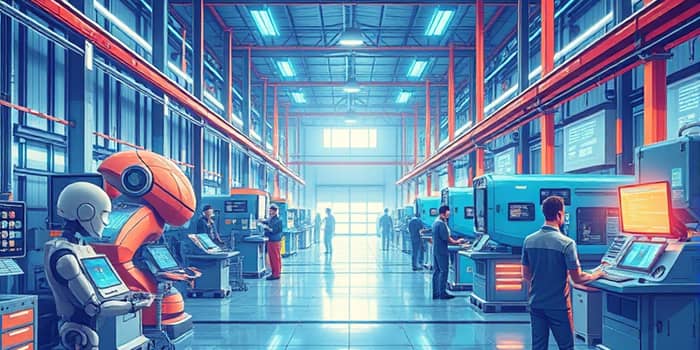
The robotics revolution is reshaping industries globally, driving unprecedented growth in automation and redefining how we work and produce.
From manufacturing to logistics, the integration of robotics is not just a trend but a fundamental shift in industrial capabilities, offering both challenges and immense opportunities.
This comprehensive guide explores the key aspects of this transformation, providing insights to help businesses and workers navigate the evolving landscape.
The global market for industrial robots has surged, with installations reaching an all-time high of $16.7 billion, underscoring the rapid adoption across sectors.
Projections indicate that the broader automation market will reach approximately $226.8 billion in 2025, highlighting the expansive scope of this technological wave.
By 2029, robot usage is expected to reach approximately 61.75 million units, transforming operations and efficiency on a global scale.
Market Scale and Growth Insights
The robotics industry employs over 2.7 million people globally, demonstrating its role as a major employer and driver of economic activity.
Growth is fueled by increasing demand for automation to address productivity gaps and labor shortages.
Key statistics reveal the scale of this revolution:
- 4.28 million industrial robots were operating globally by the end of 2023.
- Annual robot installations reached 541,302 units in 2023, with Asia accounting for 70% of new installations.
- The automotive industry leads with 35% of global robot installations, showcasing its early adoption.
This expansion is supported by a robust ecosystem of innovation and investment.
Technological Trends Shaping the Future
In 2026, technological advancements will further accelerate automation, with AI playing a central role.
AI-powered robots are becoming more autonomous, enabling smarter and more efficient operations.
Key trends include:
- Analytical AI processes large datasets to detect patterns and provide actionable insights.
- Predictive maintenance reduces downtime by anticipating failures in machinery.
- Collaborative robots, or cobots, now make up about 80% of new industrial robots, working alongside humans.
- Humanoid robots are projected to reach 2 million by 2035, with markets scaling to $1.7 trillion.
These innovations are making robotics more accessible and versatile than ever before.
Investment and Recovery Strategies
A moderate rebound in industrial automation is predicted for 2026, with companies focusing on strategic investments.
80% of manufacturing executives plan to allocate 20% or more of their budgets to smart manufacturing initiatives.
Key investment areas include:
- Automation hardware and data analytics for enhanced decision-making.
- Sensors and cloud computing to enable real-time monitoring and control.
- Predictive maintenance systems to optimize operational efficiency.
Most recovery will come from upgrading existing plants, emphasizing scalable and flexible solutions.
This table underscores the measurable impacts of robotics on industry metrics.
Impact on Workforce and Employment Dynamics
The robotics revolution brings both displacement and creation of jobs, requiring a balanced perspective.
Automation is expected to displace about 92 million jobs by 2030 but create 170 million new ones, resulting in a net gain of 78 million jobs globally.
This shift necessitates upskilling and adaptation for workers to thrive in new roles.
Productivity gains are significant, with 90% of workers using AI reporting time savings.
Companies investing in automation have reduced operating costs significantly, enhancing competitiveness.
However, concerns persist, as 75% of U.S. employees fear automation could make jobs obsolete.
To address this, strategic workforce development is essential for leveraging automation benefits.
Safety and Efficiency Improvements
Robotics contribute to safer work environments, with AI-enabled robots reducing factory accidents by up to 25%.
Global robot density has more than doubled from 74 to 162 per 10,000 manufacturing workers between 2016 and 2023.
South Korea leads with 1,012 robots per 10,000 workers, setting a benchmark for adoption.
In the U.S., robot adoption rose from 0.8 to 1.8 robots per 1,000 workers from 2009 to 2017.
These improvements highlight how automation can enhance both safety and operational output.
Competitive and Policy Context
The U.S. robotics sector is urging a national strategy to keep pace with global competitors like China.
Tariffs and supply-chain reliance are slowing investments, but policies like America's AI Action Plan aim to accelerate leadership.
This context emphasizes the need for coordinated efforts to harness automation's potential.
Key Drivers and Challenges
Adoption is driven by the need for improving productivity and addressing skilled labor shortages.
Versatile robots are accelerating due to IT/OT convergence, enabling more integrated systems.
Challenges include market volatility and the need for strategic planning and upfront investment.
Seamless integration into existing processes is crucial for success.
- Drivers: Enhanced competitiveness, agility, and resilience in manufacturing.
- Challenges: Longer decision-making timelines and careful budget allocation for measurable results.
Overcoming these hurdles requires innovation and collaboration across industries.
Future Outlook and Practical Guidance
The future is characterized by moderate, deliberate growth in 2026, with a focus on sustainable implementation.
Businesses should prioritize technologies that deliver clear, measurable results to maximize ROI.
Practical steps include:
- Investing in training programs to develop a skilled workforce for new automation roles.
- Exploring flexible models like Robotics-as-a-Service to reduce capital barriers.
- Leveraging data analytics for continuous optimization and predictive insights.
By embracing these strategies, industries can navigate the robotics revolution with confidence and innovation.
The journey ahead promises to redefine productivity, offering a path to a more efficient and resilient industrial world.
References
- https://www.apollotechnical.com/robotics-statistics/
- https://www.esa-automation.com/en/industrial-automation-outlook-for-2026/
- https://thunderbit.com/blog/automation-statistics-industry-data-market-insights
- https://standardbots.com/blog/industrial-automations
- https://hy-tek.com/resources/2026-warehouse-automation-trends-where-software-ai-and-robotics-converge/
- https://www.deloitte.com/us/en/insights/industry/manufacturing-industrial-products/manufacturing-industry-outlook.html
- https://ifr.org/ifr-press-releases/news/top-5-global-robotics-trends-2026
- https://www.cushmanwakefield.com/en/united-states/news/2026/01/industrial-market-shows-renewed-momentum-heading-into-2026
- https://www.daifuku.com/solution/intralogistics/insights/20260114.html
- https://www.automateshow.com/blog/automation-tips-and-trends-for-2026-how-to-plan-your-next-move
- https://www.startus-insights.com/innovators-guide/industrial-automation-report/
- https://www.mckinsey.com/mgi/our-research/agents-robots-and-us-skill-partnerships-in-the-age-of-ai
- https://www.automate.org/webinars/2026-industrial-automation-trends-what-to-expect-in-the-coming-year
- https://www.themanufacturer.com/articles/robotics-expert-predicts-three-trends-set-to-reshape-manufacturing-in-2026/