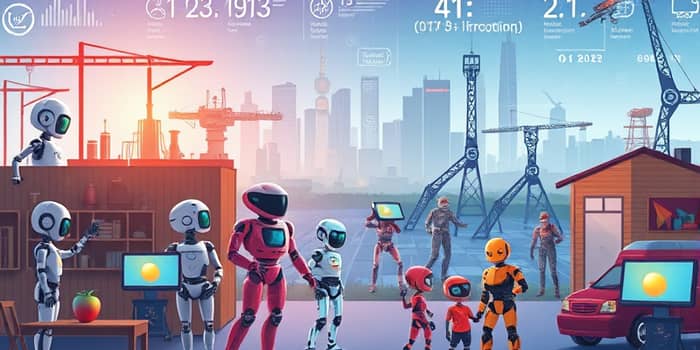
As we stand in the latter half of 2025, industrial landscapes are evolving at breakneck speed. From sprawling manufacturing floors to intimate household settings, automation is no longer a distant dream but an everyday reality. Businesses of all sizes are embracing intelligent machines to enhance productivity, safety, and sustainability. This transformation reflects a broader shift: machines are no longer confined to cages or rigid programming—they are becoming adaptive partners.
Across sectors, key innovations such as collaborative robots, AI-powered autonomy, and hyperautomation are redefining workflows. These trends promise not only efficiency gains but also the creation of new roles and opportunities for human workers. In this comprehensive analysis, we explore the latest predictions and case studies shaping the future of automation.
Revolution in Physical Robotics and Cobots
Collaborative robots, or cobots, have become central to modern factory automation. Unlike traditional industrial robots, cobots are designed to work safely alongside humans without the need for protective cages. They excel at repetitive and precision tasks, freeing people to focus on oversight, quality control, and decision-making.
- 57% of automakers plan cobot deployment to boost assembly flexibility and speed.
- Leading models like the RO1 handle CNC tending, palletizing, and packaging with ease.
- Humanoid robots are expanding roles in construction, warehousing, and laboratories.
In North America alone, orders reached 17,635 units valued at $1.094 billion in the first half of 2025. These figures underscore a clear trend: robotic integration is both scalable and affordable, even for small and medium-sized enterprises. Leasing options and no-code programming interfaces further reduce barriers to adoption, ensuring that businesses can ramp up automation without massive capital expenditure.
AI-Powered Autonomy and Intelligence
Beyond simple automation, the rise of AI-powered autonomous robots is transforming logistics and manufacturing. Autonomous Mobile Robots (AMRs) navigate dynamic environments using a blend of sensors, computer vision, and machine learning. They can reroute in real time, avoid obstacles, and optimize delivery paths without human intervention.
- An estimated 63% of organizations plan AI adoption within three years.
- Analytical AI now processes complex sensor data, enabling robots to handle unpredictable tasks.
- Generative AI is used to create digital twins and simulation scenarios, accelerating training cycles.
As AI investments grow by over 120% year-over-year, the industry is moving from pilot programs to full-scale deployment. Physical AI platforms trained in virtual environments allow manufacturers to test and iterate rapidly. With half of all manufacturers now employing AI vision systems for quality control, the potential for error reduction and yield improvement is immense.
Hyperautomation: The Next Wave of RPA
Software automation has also entered a new era with hyperautomation, a concept that blends Robotic Process Automation (RPA) with AI, business process management, and real-time analytics. In this environment, digital workers can plan tasks, invoke APIs, and collaborate with human counterparts to handle complex workflows.
- Agentic RPA combines AI planning with human oversight, enabling more dynamic task delegation.
- Cloud-native RPA platforms offer pay-as-you-go models, accelerating deployment for businesses of all sizes.
- McKinsey estimates generative AI could unlock $2.6 to $4.4 trillion in annual global value.
This convergence is particularly powerful in administrative and knowledge-based roles, from automated invoice processing to intelligent customer service agents. By breaking down data silos and orchestrating end-to-end processes, organizations can achieve real-time decision-making at unprecedented scales.
Transformative Industry Applications
Automation’s impact is felt across a wide range of sectors, each leveraging robotics and AI to address unique challenges. Below is a snapshot of current developments:
These examples illustrate how robotics and AI can tackle everything from routine maintenance to life-saving interventions. In manufacturing, predictive maintenance and real-time quality inspections are reducing downtime, while in caregiving, assistive robots are improving patient outcomes and easing labor shortages.
Broader Impacts and Future Outlook
As automation technologies become more pervasive, their broader impacts on society and the economy become clear. Sustainability is a core focus, with energy-efficient designs reducing carbon footprints. Automation also supports nearshoring, enabling localized production loops that minimize shipping emissions.
The workforce landscape is evolving. Rather than replacing human labor, robots are augmenting it—eliminating drudgery and enabling employees to focus on creative and strategic tasks. New roles in robot management, maintenance, and AI ethics are emerging, highlighting the need for continuous upskilling and training.
In education, classroom robots are teaching STEM concepts and fostering collaboration. Responsible AI frameworks and governance models are being developed to ensure ethical deployment, while regulatory bodies work to balance innovation with safety and transparency.
Addressing Concerns and FAQs
Will robots take over all jobs? No—automation excels at repetitive and data-intensive tasks, but human creativity and critical thinking remain irreplaceable. The collaboration model ensures humans stay at the helm, defining objectives and resolving edge cases.
How does this compare to current tech? Future robots leverage machine learning to handle unpredictability, a leap beyond rule-based systems. Autonomous systems coordinate entire supply chains in real time, a capability unavailable just a few years ago.
What about ethics and governance? Industry consortia and governments are establishing standards for transparency, bias mitigation, and safety. Companies are investing in AI ethics officers and compliance teams to navigate the complex landscape.
Are small businesses left behind? On the contrary, cloud-native platforms and leasing models have democratized access. Affordable cobots and SaaS-based automation tools are empowering SMEs to compete on a global scale.
In summary, the robotics and AI landscape of 2025 is defined by collaboration, adaptability, and inclusivity. By embracing these trends, organizations and individuals can harness the full potential of automation, driving innovation, productivity, and sustainable growth.
References
- https://standardbots.com/blog/future-of-robotics-predictions
- https://ifr.org/ifr-press-releases/news/top-5-global-robotics-trends-2025
- https://qbotica.com/the-future-of-rpa-top-trends-in-automation-for-2025/
- https://www.hostinger.com/tutorials/automation-trends
- https://www.mckinsey.com/capabilities/tech-and-ai/our-insights/the-top-trends-in-tech
- https://www.rockwellautomation.com/en-us/company/news/the-journal/8-key-industrial-automation-trends-in-2025.html
- https://www.designnews.com/automation/seven-automation-trends-mark-2025-from-ai-enhanced-systems-to-workforce-transformation
- https://www.automate.org/robotics/news/new-a3-report-signals-steady-automation-investment-in-first-half-of-2025
- https://www.blueprism.com/resources/blog/future-automation-trends-predictions/