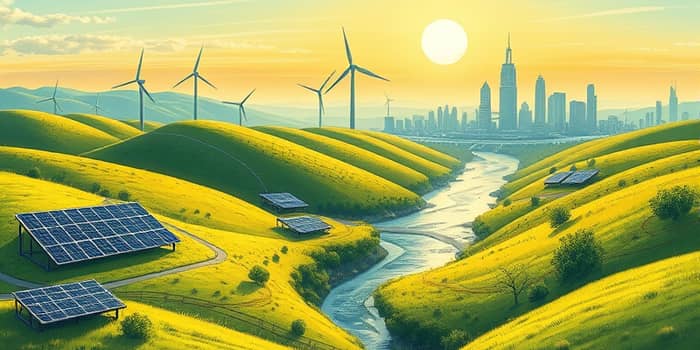
In the face of rising global energy demand and climate challenges, renewable power sources have emerged as the leading solution for a sustainable tomorrow.
From record-breaking solar output to historic milestones in wind capacity, the energy landscape is undergoing a profound transformation.
Global Trends and Projections
By 2026 at the latest, renewables are set to overtake coal as the world’s top electricity source, reaching 36% of global power supplies compared to coal’s 32%. This shift marks coal’s lowest share in a century and underscores the speed of change.
Outputs from wind and solar reached 4,000 TWh in 2024 and are projected to exceed 6,000 TWh by 2026, meeting over 90% of global electricity demand growth even as consumption rises by over 3% annually.
In 2024, low-carbon sources—including renewables and nuclear—accounted for 40.9% of global electricity, with renewables alone adding a record 858 TWh, a 49% surge above the previous peak.
Global renewable generation has grown from 2,886 TWh in 2000 to nearly 10,742 TWh in 2025, with expectations to hit 11,900 TWh in 2026. These figures illustrate an unprecedented pace of capacity growth, led by China’s massive solar and wind build-out.
Key Drivers and Challenges
- Rapid solar and wind expansion: Solar remains the fastest-growing source for two decades, often called the “engine of the energy transition.”
- Emerging demand sectors: Electrification of transport, industry, and data centers fuels a surge in clean energy installations.
- Policy momentum: Over 100 countries commit to tripling renewable capacity by 2030 for Paris Agreement goals.
- Political pushback: Resistance in some regions threatens local projects, yet global deployment continues unabated.
Leading Countries and Examples
Countries across diverse geographies are setting benchmarks in renewable integration, showcasing how policy, investment, and innovation combine to accelerate the green transition.
Below is a snapshot of select national achievements and targets:
Smaller nations like Costa Rica, Nepal, and Ethiopia achieve near 100% clean grids through hydro and geothermal, illustrating that resource constraints need not impede ambition.
Regional and Sector Highlights
The renewable revolution unfolds unevenly across regions, driven by local policies, market incentives, and resource endowments.
- United States: Renewables accounted for 93% of capacity additions in 2025, led by solar and storage, while large corporations lock in carbon-free power purchase agreements.
- Europe & China: Rapid coal declines are offset by nuclear restarts in Japan and new builds in China, with both regions expanding offshore wind at scale.
- Offshore wind: The Netherlands and Germany spearhead development, with Asia and Australia ramping up projects to harness coastal winds.
Future Outlook and Milestones
As fossil generation falls, clean power growth continues to outpace electricity demand, paving the way for dramatic emissions reductions worldwide.
The COP28 pledge unites over 150 leaders in a Paris-aligned commitment to phase out unabated fossil fuels by 2030. International agencies such as IRENA aim for 90% of electricity from renewables by 2050, while policy voices from WRI call for grid flexibility, storage solutions, and equitable procurement practices.
With 2025 global energy investment likely surpassing $3.3 trillion—$2.2 trillion directed to clean technologies—the momentum behind wind, solar, and emerging storage innovations shows no sign of slowing.
The coming years will test the resilience of supply chains, the flexibility of grids, and the ingenuity of policymakers. Yet, the remarkable trajectory of renewable installation offers hope that the world can chart a truly sustainable energy future.
By leveraging technology, financing, and international cooperation, societies can ensure that clean power not only meets growing demand but also drives the socioeconomic benefits essential for a just energy transition.
References
- https://www.carbonbrief.org/iea-renewables-will-be-worlds-top-power-source-by-2026/
- https://www.climatecouncil.org.au/11-countries-leading-the-charge-on-renewable-energy/
- https://www.ecohz.com/blog/five-renewable-energy-trends-into-2026
- https://www.wri.org/initiatives/clean-energy-supply
- https://ember-energy.org/latest-updates/world-surpasses-40-clean-power-as-renewables-see-record-rise/
- https://www.ren21.net/gsr-2024/modules/global_overview/02_policy/
- https://www.rystadenergy.com/insights/five-things-to-watch-in-the-global-power-sector-in-2026
- https://www.un.org/en/climatechange/raising-ambition/renewable-energy
- https://www.deloitte.com/us/en/insights/industry/renewable-energy/renewable-energy-industry-outlook.html
- https://www.cop28.com/en/global-renewables-and-energy-efficiency-pledge
- https://earth.org/energy-transition-where-are-we-headed-in-2026/
- https://www.weforum.org/stories/2025/12/global-energy-2026-growth-resilience-and-competition/
- https://www.energyinst.org/statistical-review