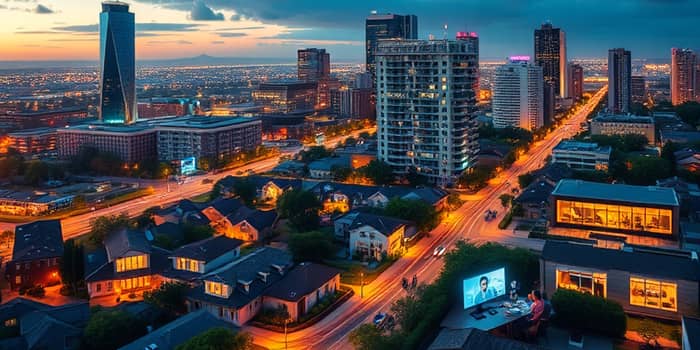
The way we work has undergone a profound transformation. As businesses adapt to new expectations for flexibility and balance, commercial real estate professionals face both unprecedented challenges and exciting opportunities. This article explores the remote work revolution and offers practical guidance for navigating a landscape defined by hybrid models, shifting demand, and innovative solutions.
The Rise of Remote Work: A New Era
The acceleration of remote work has been nothing short of remarkable. In 2026, approximately 27% of full-time employees worldwide operate fully remotely, while 52% embrace hybrid schedules. In the United States alone, 22.9% of workers are fully remote, and over 50% telework more than 2.5 days per week.
These shifts represent more than changing commute patterns; they mark a cultural transformation in work. Companies report a 159% increase in remote roles since 2005, and 81% of professionals now prioritize flexibility when evaluating job opportunities.
- 75 million jobs in the U.S. are remote-compatible.
- 65% of workers prefer fully remote roles.
- 61% would switch jobs for improved flexibility.
Impact on Office Space and Commercial Real Estate
As remote and hybrid work become mainstream, demand for traditional office space has softened. Vacancies have risen, rents are under pressure, and property values face a predicted 28% decline without adaptation. Meanwhile, companies save $10,000 to $11,000 per remote employee annually in real estate and operational costs.
Office utilization on hybrid days hovers below 30%, and average attendance sits 30% lower than pre-pandemic levels. This shift has led many landlords and tenants to explore flexible lease agreements, co-working arrangements, and technology-driven workspaces designed to enhance collaboration and engagement.
Emerging Opportunities in Other CRE Segments
While offices adjust to lower occupancy, other commercial real estate sectors are experiencing renewed growth. Retail, industrial, hospitality, and residential markets are evolving to meet new consumer and workforce needs. The following table summarizes key trends:
Strategies for Success in the New Landscape
Commercial real estate professionals must embrace innovation and agility. By adopting targeted strategies, landlords and investors can thrive amid changing market dynamics.
- Implement flexible lease terms: Offer short-term, modular leases and allow space sharing to retain occupancy and attract start-ups and small enterprises.
- Invest in experiential amenities: Create collaborative lounges, wellness zones, and advanced conferencing facilities to earn the commute and drive in-person engagement.
- Leverage technology upgrades: Integrate IoT sensors, smart HVAC, and AI-driven space-management platforms to optimize utilization and lower operating costs.
- Diversify asset portfolios: Balance office holdings with stakes in industrial, retail, and co-working sectors to mitigate risk and capture emerging growth areas.
Looking Ahead: Future-Proofing Your Investments
The remote work movement is not a fleeting trend—it represents a long-term shift in how organizations and individuals prioritize location, collaboration, and culture. To future-proof assets and strategies, stakeholders should consider the following approaches:
First, embrace a mindset of continuous adaptation. Market conditions will evolve as new technologies, such as virtual reality workstations and AI-enabled project management tools, mature. Maintaining strategic agility and innovation will be essential.
Second, foster strong tenant relationships. Proactively survey occupants about needs, offer customized workspace experiences, and design community events to strengthen loyalty and reduce turnover.
Finally, evaluate suburban and satellite office opportunities. As workers relocate farther from urban centers, demand for local work hubs and mixed-use environments is rising. Partnering with municipalities and co-working operators can unlock new revenue streams and foster vibrant neighborhood ecosystems.
By understanding the profound impact of remote work on commercial real estate and implementing thoughtful, data-driven strategies, industry professionals can turn disruption into opportunity. The remote work revolution is charting a new course for how people collaborate, live, and do business—and those who anticipate and adapt will lead the next chapter of this remarkable transformation.
References
- https://www.breeze.pm/blog/remote-work-statistics
- https://www.occupier.com/blog/remote-work-impact-on-commercial-real-estate/
- https://www.mckinsey.com/industries/real-estate/our-insights/flexible-works-enduring-appeal-affects-workers-employers-and-real-estate
- https://www.jdsupra.com/legalnews/understanding-the-impact-of-remote-work-2991672/
- https://www.nar.realtor/commercial-real-estate-market-insights/january-2026-commercial-real-estate-market-insights
- https://toljcommercial.com/impact-of-remote-work-on-commercial-properties/
- https://www.roberthalf.com/us/en/insights/research/remote-work-statistics-and-trends
- https://penniur.upenn.edu/publications/policy-brief-how-remote-work-is-affecting-real-estate-markets
- https://archieapp.co/blog/remote-work-statistics/
- https://www.pwc.com/us/en/industries/financial-services/asset-wealth-management/real-estate/emerging-trends-in-real-estate-pwc-uli.html
- https://primior.com/the-hidden-truth-how-work-from-home-is-reshaping-commercial-real-estate-in-2025/
- https://www.flexjobs.com/blog/post/future-of-remote-work-trends-report
- https://remotecoworker.com/blog/remote-work-statistics