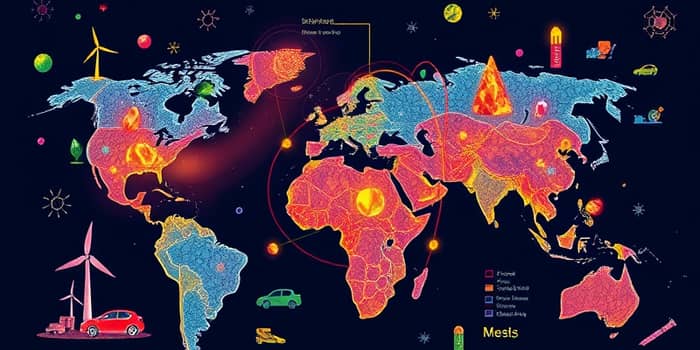
Rare earth elements drive the modern world, powering everything from smartphones to renewable energy systems.
As demand skyrockets, nations are racing to secure these critical metals and navigate emerging challenges in extraction, sustainability, and international relations. By understanding the complex interplay of geology and geopolitics, stakeholders can chart a path that balances national security, economic growth, and environmental stewardship.
Understanding Rare Earth Elements and Their Importance
Rare earth elements (REEs) consist of 17 metals: the 15 lanthanides plus scandium and yttrium. They are not actually rare in Earth's crust, but their complex extraction and refining processes and concentrated deposits make supply unpredictable. From the diminutive cerium used in catalytic converters to the strategic neodymium and dysprosium essential in high-performance magnets, REEs are indispensable to modern technology and defense.
Key subgroups include:
- Rare earth permanent magnet materials (neodymium, praseodymium, dysprosium, terbium), which represent a modest volume yet dominate market value.
- Heavy rare earth elements with high performance characteristics but severe supply bottlenecks, driving up costs and strategic risk.
- Light rare earths like cerium and lanthanum, abundant in volume but lower in economic value.
Mining REEs often involves separation techniques such as flotation, magnetic separation, and solvent extraction. These processes require sophisticated facilities and generate chemical byproducts. To maintain a reliable supply, companies must invest in state-of-the-art processing technologies and community engagement programs.
Global Production and Supply Dynamics
Global production of rare earth oxides reached approximately 280 kt in 2022 and is projected to exceed 390 kt by 2024, with a forecast 6% CAGR to 2028. Despite this growth, REE output remains minute compared to other industrial metals: copper at 25.7 Mt and zinc at 12 Mt. China commands the market, responsible for more than 70% of mining and over 90% of refining capacity, shaping global pricing and availability.
Outside China, the United States has revived the Mountain Pass mine, reopening in 2018 and beginning Nd-Pr oxide production in 2023. However, it faces challenges in scaling refining capacity and securing consistent feedstock. Emerging players like Australia, Vietnam, and Brazil are exploring new projects, yet processing infrastructure and permitting delays hinder rapid expansion. Building local value chains can reduce lead times and enhance national resilience against shocks.
Surging Demand for Technology and Clean Energy
The global energy transition and electrification of transport are escalating REE demand. Electric vehicles require six times more rare earth minerals than conventional cars, and wind turbines demand nine times more than gas-fired power plants. IEA forecasts suggest a 60% increase in REE demand by 2040, with magnets and battery technologies driving growth.
Key sectors include:
- EV and renewable energy applications, anticipated to account for nearly 50% of demand by 2030.
- Catalysts and battery components, with projected tenfold increases by 2050.
- Advanced electronics and defense systems, featuring in F-35 fighter jets and precision-guided munitions.
In practical terms, manufacturers are redesigning motors to reduce reliance on dysprosium while improving efficiency. Wind turbine makers are exploring larger turbines with optimized core designs that require fewer rare earths per megawatt. Engineers are collaborating with materials scientists to innovate magnet designs under resource constraints, ensuring performance while managing critical material usage.
Geopolitical Tensions and Strategic Risks
China’s leverage over rare earths has become a central geopolitical flashpoint. By imposing export controls and licensing requirements, Beijing has demonstrated its capacity to disrupt supply chains overnight. Western economies face vulnerabilities due to heavy reliance on imports, talent gaps in research, and limited refining infrastructure. The United States, for example, imports 80% of its REEs and depends on foreign intermediates to manufacture high-performance magnets.
The European Union is funding multi-billion-dollar initiatives to develop domestic supply chain alliances and research consortia. Japan has stockpiled critical elements, built recycling plants, and partnered with Australia and India. Such alliances aim to circumvent unilateral export restrictions and manage supply diversification, bolstering industrial security.
- U.S. Department of Defense investments exceed $439 million in domestic supply chains and recycling research.
- Critical Minerals Ministerial gatherings focus on aligning allies for AI, robotics, and defense supply needs.
Environmental Impact and Sustainable Solutions
Extraction and processing of rare earth minerals generate approximately 2,000 tons of toxic waste per ton of product, posing severe environmental hazards. Contaminants can leach into soil and water, impacting local communities and ecosystems. Companies face growing pressure to adopt cleaner practices and rehabilitate mining sites.
Recycling offers a promising pathway to mitigate these impacts. Currently, global recycling rates for e-waste stand at only 17.4%, but innovations in AI-powered sorting, direct magnet recycling, and government incentives could elevate this ratio to meet 25% of demand by 2035. Methods such as molten salt separation achieve energy savings exceeding 90% compared to conventional processing, and digital passports enhance traceability.
Some firms are piloting closed-loop mining where tailings are reprocessed to extract residual REEs. Local communities are demanding transparency and fair compensation under emerging regulations. By adopting circular economy principles, the industry can reduce dependency on virgin mining and minimize ecological footprints.
Looking Ahead: Diversification and Innovation
The coming decade will determine whether the West can wean itself off single-source dependencies. Strategies include expanding mining projects in countries like Canada, Brazil, and Africa; scaling domestic refining facilities; and establishing non-Chinese pricing benchmarks. Policymakers and investors must collaborate to fund research in alternative materials, such as iron-nitride magnets, though these remain early in development.
- Develop new mining and processing hubs to distribute geopolitical risk.
- Invest in substitution research and sustainable extraction technologies.
- Strengthen recycling infrastructure and promote end-of-life recovery.
Collaboration across governments, industry, and academia will be essential to building resilient supply chains. By prioritizing sustainable practices, innovative research, and strategic partnerships, nations can secure critical minerals and protect the environment simultaneously. Rare earth elements will continue to underpin breakthroughs in energy, defense, and electronics. The choices made today—in policy, investment, and technology—will shape the global balance of power and determine our collective future.
References
- https://global-reia.org/rare-earth/
- https://gqg.com/insights/critical-dependence-on-rare-earth-minerals/
- https://www.spglobal.com/energy/en/news-research/latest-news/metals/012726-rare-earth-supply-bottlenecks-set-to-persist-in-2026
- https://hir.harvard.edu/not-so-green-technology-the-complicated-legacy-of-rare-earth-mining/
- https://www.usgs.gov/centers/national-minerals-information-center/rare-earths-statistics-and-information
- https://www.okonrecycling.com/magnet-recycling-and-applications/sustainability-and-magnets/growing-importance-recycling-rare-metals/
- https://www.state.gov/releases/office-of-the-spokesperson/2026/02/2026-critical-minerals-ministerial
- https://kleinmanenergy.upenn.edu/research/publications/the-not-so-rare-earth-elements-a-question-of-supply-and-demand/
- https://www.csis.org/analysis/developing-rare-earth-processing-hubs-analytical-approach
- https://research.gatech.edu/how-us-can-mine-its-own-critical-minerals-without-digging-new-holes-0
- https://www.globalpolicywatch.com/2026/02/heavy-rare-earth-elements-rising-supply-chain-risks-and-emerging-policy-responses/
- https://www.statista.com/topics/1744/rare-earth-elements/
- https://natural-resources.canada.ca/minerals-mining/mining-data-statistics-analysis/minerals-metals-facts/rare-earth-elements-facts