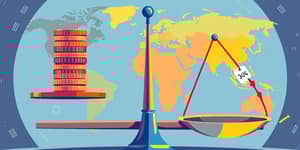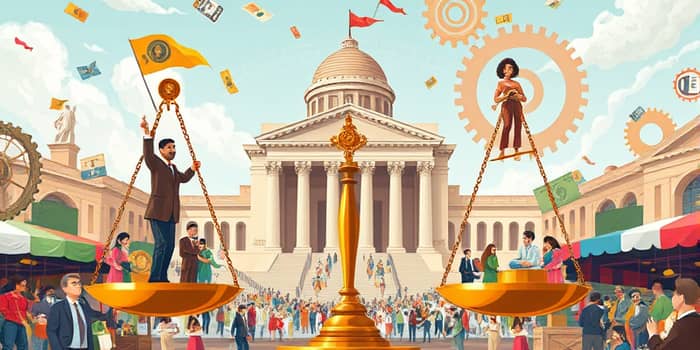
Political economy explores the deep connections between law, power, and wealth, revealing how governance and markets co-evolve. This field offers a lens to understand why nations prosper, how inequality emerges, and the forces shaping our daily economic realities. By tracing ideas from classical theorists to modern models, we gain practical tools to craft more equitable policies and institutions.
Core Definition and Scope
At its heart, political economy examines the interplay between political institutions and economic systems. It asks how laws, power relations, and public authority influence production, exchange, and the distribution of resources. Conversely, it studies how market dynamics shape policy choices, voter behavior, and institutional reforms.
Scholars emphasize that the mutual influence and historical dynamism of these spheres are constant: economic shocks alter power balances, while legal frameworks guide market incentives. Key questions include why some groups prosper, how states manage public goods, and what drives regulation or corruption.
Historical Origins and Evolution
The discipline emerged in the late 18th century, drawing on the Greek notion of the polity and household management. Early thinkers saw the state as an economic actor, viewing the state as the public household responsible for collective well-being. Over time, debates over government roles, private property, and market freedom shaped the field’s trajectory.
Mill’s work divided political economy into production, progress influences, and government roles. He argued that security and taxation were essential, while other interventions remained subject to public debate. He championed individual freedom and worker cooperatives as balanced paths between laissez-faire capitalism and centralized socialism.
Key Thinkers and Theories
Friedrich Engels emphasized that economic laws vary by historical stage and class configuration. He insisted that general rules emerge only after analyzing specific social formations. This perspective cemented the view of political economy as a historical science of changing material relations, where power and production co-determine social outcomes.
Karl Marx built on this foundation in Das Kapital, probing how labor, capital, and capitalists interact. Marx introduced the notion of surplus value and class struggle as engines of economic and political transformation. His analysis laid the groundwork for modern critiques of inequality and exploitation.
Major Approaches and Sub-Areas
Contemporary political economy spans multiple angles, blending economics, political science, and sociology to address diverse phenomena. Scholars classify core branches as follows:
- Role of government, classes, and power in resource allocation across economic systems.
- International political economy exploring trade relations, global finance, and development.
- Economic models of political processes and exploitative class dynamics.
Key Topics, Phenomena, and Examples
Central to modern debates is the concept of state-economy-society embeddedness, which highlights how political decisions shape inequality, market regulation, and fiscal outcomes. Economic crises often trigger institutional reforms, while enduring power structures influence business cycles and central bank independence.
- Economic regulation and antitrust enforcement
- Monopoly power and market concentration
- Rent-seeking and political corruption
- Distributional politics and welfare policy
- Taxation and the idea of equal sacrifice
- Public goods provision and fiscal deficits
Challenges arise from competing interests: powerful lobbies resist reforms, while broader electorates push for redistributive measures. Democracies often balance these pressures imperfectly, resulting in policy compromises and occasional gridlock.
Contemporary Relevance and Conclusion
Today’s political economists integrate quantitative models and qualitative insights to guide policy. International institutions like the IMF stress the impact of elections and interest groups, acknowledging the role of self-interested voters and bureaucrats in shaping macroeconomic outcomes. Game theory and public choice provide frameworks to anticipate coalition formation and policy stability.
As globalization, digital markets, and climate change reshape power structures, political economy remains vital. By studying past debates and employing rigorous tools, we can design institutions that foster growth, equity, and resilience. Ultimately, understanding the nexus of politics and economics empowers citizens and policymakers to build more just and prosperous societies.
References
- https://economicsociology.org/2016/08/27/what-is-political-economy-it-is-essentially-a-historical-science/
- https://en.wikipedia.org/wiki/Political_economy
- https://www.youtube.com/watch?v=JI11KV91ZO0
- https://www.britannica.com/money/political-economy
- https://www.ebsco.com/research-starters/literature-and-writing/principles-political-economy-john-stuart-mill
- https://www.imf.org/en/publications/fandd/issues/2020/06/political-economy-of-economic-policy-jeff-frieden
- https://research.hillsdale.edu/esploro/outputs/undergraduate/What-Is-Political-Economy-Studying-those/991019301480107081
- https://www.gov.harvard.edu/undergraduate/programs-of-study/political-economy/