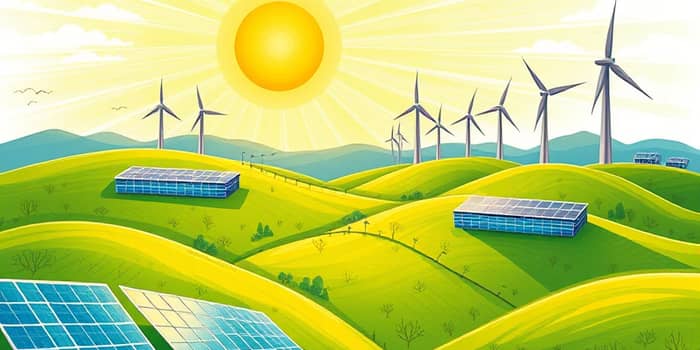
As the world races to curb climate change and redefine its energy systems, 2026 marks a turning point where **renewables overtaking fossil fuels** in electricity generation shifts from ambition to reality. This article explores the forces propelling solar, wind, and storage technologies into dominance, the challenges they face, and the strategies that stakeholders can adopt to ensure a resilient, low-carbon future.
Global Transformation of Power Generation
By 2026, renewables are projected to supply 36% of global electricity, surpassing coal’s 32% share. Between 2024 and 2026, wind and solar output jumps from over 4,000 TWh to more than 6,000 TWh, meeting nearly 20% of worldwide demand. Remarkably, wind and solar capacity additions account for over 90% of new renewable installations, reflecting their rapid growth of solar and wind.
Despite a 3.7% surge in global electricity demand in 2026—well above the 2.6% average of the prior decade—renewables satisfy more than 90% of the increase. This momentum underscores the reshaping the energy landscape worldwide, as policymakers and investors realign resources toward clean technologies.
Key 2026 Metrics at a Glance
Driving Forces Behind the Renewable Surge
Several factors converge to fuel the clean energy revolution. Rapid cost declines in photovoltaic modules and wind turbines, combined with economies of scale, make green power increasingly competitive. In the US, solar capacity additions soar to 69 GW in 2026–2027, representing a 21% rise in solar generation annually. Battery storage capacity, now at 37.4 GW with another 19 GW under construction, underpins reliability and unlocks higher penetration rates.
Corporations and hyperscale data centers sign long-term power purchase agreements to meet urgent decarbonization goals for data centers, while electrification of transport and industry adds new demand streams. In regions like Texas’ ERCOT market, solar generation nearly doubles from 56 BkWh in 2025 to 106 BkWh by 2027, with battery capacity climbing from 15 GW to 37 GW.
Challenges and Policy Dynamics
Even as wind and solar flourish, market and regulatory hurdles could slow progress. Policymakers and developers must navigate:
- Phaseout of tax credits under the One Big Beautiful Bill Act, raising solar costs by 36–55% and onshore wind by 32–63%
- Tariffs and FEOC rules targeting Chinese, Russian, Iranian, and North Korean components
- State-level renewable portfolio standard sunsetting and shifting incentives post-2026
- Supply chain constraints that underscore the need for building fast while staying flexible in procurement and logistics
Meeting Rising Demand Across Sectors
Global electricity demand is growing at 3.3% in 2025 and an estimated 3.7% in 2026, driven by digitalization, electrification of transport, and the expansion of air conditioning in developing markets. Key demand drivers include:
- Cloud computing and AI workloads requiring round-the-clock clean power
- Electric vehicles, with charging infrastructure linking grid and storage investments
- Industrial heat pumps and process electrification in manufacturing
- Residential and commercial buildings integrating rooftop solar and batteries
By pairing solar with storage, the industry can address storage intermittency challenges and deliver reliable power, fulfilling half of large corporate off-take agreements by 2026.
Storage, Firm Power, and Investment Trends
While batteries lead the pack in flexibility, other firm power solutions—geothermal, hydro, nuclear, and gas with carbon capture—play supporting roles. Capital flows are shifting: platform M&A activity surged 4.6×, and safe-harbor strategies propelled 38% of the 58.4 GW pipeline into construction. Yet renewable deal volume dipped 45% YoY in H1 2025, highlighting caution amid policy uncertainty.
To navigate risks, stakeholders are adopting four key investment principles:
- Diversify through multiple technology pathways to manage intermittency
- Reshore critical component manufacturing to strengthen supply chains
- Leverage AI and digital twins for predictive maintenance and optimization
- Secure long-term offtake agreements to underpin project financing
With these measures, the sector pursues an unprecedented expansion of battery storage and synchronized development of dispatchable assets.
Beyond Electricity: Confronting Systemic Limits
Though renewables now comprise over 33% of world electricity, they still account for under 8% of total final energy consumption. Fossil fuels continue to dominate heating, transport, and industrial processes. Bridging this gap requires scaling green hydrogen, sustainable bioenergy, and deep efficiency gains across end uses.
Ultimately, the transition hinges on collaboration between governments, investors, and communities. By embracing coordinated global policy interventions and fostering innovation, we can unlock a truly clean energy system.
The Road Ahead
As we look toward 2027 and beyond, the imperative is clear: seize the momentum of renewables, invest strategically in storage and firm power, and champion policies that accelerate decarbonization. By building fast while staying flexible, stakeholders can transform challenges into opportunities, forging a resilient energy future that benefits economies, ecosystems, and societies worldwide.
References
- https://www.carbonbrief.org/iea-renewables-will-be-worlds-top-power-source-by-2026/
- https://www.deloitte.com/us/en/insights/industry/renewable-energy/renewable-energy-industry-outlook.html
- https://www.eia.gov/outlooks/steo/
- https://www.eia.gov/todayinenergy/detail.php?id=67005
- https://www.wri.org/insights/state-clean-energy-charted
- https://www.energyinst.org/statistical-review
- https://ember-energy.org/latest-insights/global-electricity-mid-year-insights-2025/