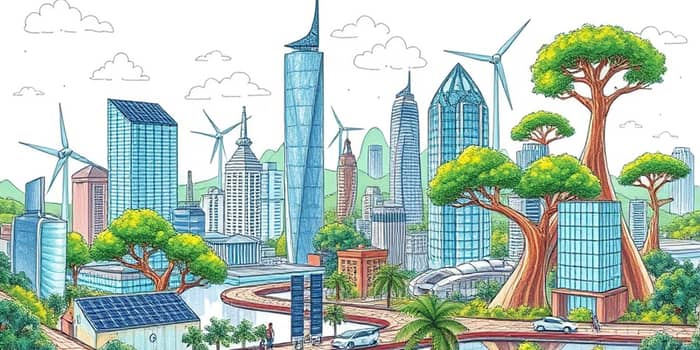
In the complex landscape of modern technology, distinguishing fleeting trends from genuine progress is more critical than ever.
Sustainable innovation represents a transformative shift that goes beyond mere efficiency to reshape how we live and work.
It involves intentional changes to products, services, and processes that yield both economic profits and positive environmental outcomes.
This approach ensures that growth does not come at the expense of our planet or future generations.
Understanding Sustainable Innovation
At its core, sustainable innovation is about balancing present needs with long-term ecological health.
It requires firms to rethink raw material use, manage energy consumption, and uphold fair labor conditions.
This holistic perspective integrates environmental, social, and economic dimensions into every decision.
By doing so, it moves away from traditional models that often ignore sustainability criteria.
Key characteristics include financial viability, systems thinking, and a collaborative spirit.
Types of Sustainable Innovation
Sustainable innovation manifests in various forms, each addressing different aspects of business and society.
Here are the primary categories:
- Product Innovation: Developing eco-friendly goods, such as modular smartphones or biodegradable materials, to reduce waste and extend product life.
- Process Innovation: Adopting methods like renewable energy sources or wastewater recycling in production to minimize environmental impact.
- Business Model Innovation: Creating value through models like product-as-service or sharing platforms that prioritize access over ownership.
- System-Level Innovation: Driving changes across industries, such as zero-waste industrial parks or smart city systems for broader sustainability.
These types work together to foster comprehensive solutions.
Real-World Examples of Impact
Several companies are leading the charge in sustainable innovation, demonstrating its practical applications.
Bio-bean converts waste coffee grounds into eco-friendly biofuel for public transport, showcasing circular economy principles.
Fairphone designs modular smartphones that are easier to repair, significantly reducing electronic waste.
Unilever rethinks packaging to cut plastic use, embedding sustainability into its core operations.
Google aims for 100% carbon-free energy by 2030, setting a benchmark for the tech industry.
Ecosia operates entirely on renewable energy, proving that small changes can have big effects.
Industry Sectors Driving Change
Multiple sectors are at the forefront of this movement, each contributing uniquely to a sustainable future.
- Renewable Energy: Innovations in solar, wind, and hydrogen power reduce CO₂ emissions and fossil fuel dependence.
- Sustainable Agriculture: Techniques like vertical farming and regenerative practices minimize environmental harm.
- Sustainable Fashion: Ethical production and circular models address waste and labor issues in the apparel industry.
- Net-Zero Buildings: Low-carbon construction and energy self-sufficiency transform urban landscapes.
- Sustainable Aviation: Electric planes and low-emission fuels aim to decarbonize air travel.
These sectors illustrate how diverse fields can unite under a common goal.
2026 Trends and Future Outlook
Looking ahead, several trends are set to redefine sustainable innovation in the coming years.
Energy and climate tech will see increased investments in renewable sources and carbon capture technologies.
Green computing innovations, such as neuromorphic computing and dynamic workload management, aim to reduce the energy demands of AI and data centers.
Digital technologies like AI, blockchain, and IoT enable real-time data tracking for emission reduction and resource optimization.
Here are key trends to watch:
- Sustainable supply chains with transparency and ethical sourcing as new standards.
- Water stewardship and corporate accountability for resource use.
- Social equity integration into ESG goals for fairness and inclusion.
- Nature-based solutions that restore ecosystems like forests and wetlands.
- Product life extension through repairability and durability focus.
These trends highlight the evolving landscape of sustainability.
Integrating Sustainability into Business Strategy
For companies, adopting sustainable innovation is no longer optional but a business imperative.
It future-proofs operations, meets regulatory compliance, and enhances brand reputation.
Implementing sustainable tech practices drives cost savings and meets consumer demand for eco-friendly solutions.
To get started, businesses should follow a structured approach:
- Audit current sustainability efforts to identify gaps and opportunities.
- Align goals with top trends, such as biodiversity and CSRD compliance.
- Invest in technology and foster stakeholder collaboration for scalable impact.
- Embed sustainability into core business functions, from R&D to marketing.
This integration requires strategic planning and cultural transformation.
Key Metrics for Measuring Success
Evaluating the impact of sustainable innovation involves tracking specific metrics that reflect progress.
The table below outlines essential focus areas:
These metrics help organizations stay accountable and drive continuous improvement.
Conclusion: Embracing the Journey
Sustainable innovation is not a destination but an ongoing journey of adaptation and growth.
It challenges us to think differently about technology, blending profit with purpose for a better world.
By fostering collaboration and systems thinking, we can navigate the tech labyrinth with clarity and conviction.
Let this be a call to action for businesses, innovators, and individuals alike to champion change.
Together, we can build a future where innovation sustains both people and the planet, ensuring prosperity for generations to come.
References
- https://online.edhec.edu/en/blog/sustainable-innovation/
- https://www.winssolutions.org/24-sustainability-trends-2026/
- https://ecampusontario.pressbooks.pub/leadinginnovation/chapter/chapter-5-sustainable-innovation/
- https://www.splunk.com/en_us/blog/learn/sustainable-technology.html
- https://en.wikipedia.org/wiki/Sustainable_innovation
- https://www.icl-group.com/blog/climate-tech-trends-2026-from-hype-to-execution/
- https://ezassi.com/sustainable-innovation/
- https://internationalbanker.com/technology/five-significant-tech-trends-that-will-feature-in-2026/
- https://nbs.net/what-is-sustainable-innovation-and-how-to-make-innovation-sustainable/
- https://www.spglobal.com/sustainable1/en/insights/2026-sustainability-trends
- https://digitalleadership.com/glossary/sustaining-innovation/
- https://www.deloitte.com/us/en/insights/topics/technology-management/tech-trends.html
- https://www.cisl.cam.ac.uk/news/blog/what-sustainability-innovation-and-why-does-it-matter
- https://eco-act.com/blog/2026-corporate-sustainability-trends/
- https://sustainabilitymag.com/top10/top-10-sustainability-innovations