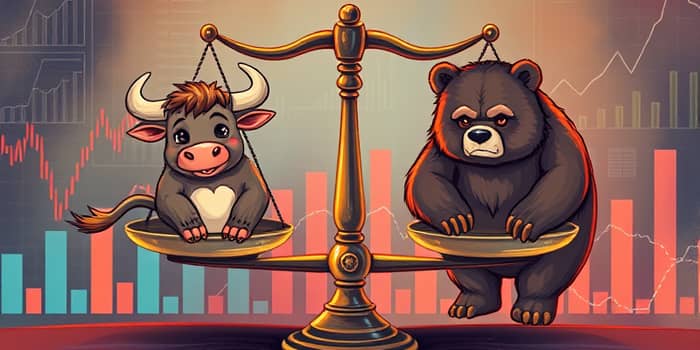
In the dynamic world of finance, market sentiment acts as the pulse of investor psychology, oscillating between fear and greed.
This emotional gauge is often touted as a leading indicator for economic trends, but does it hold predictive power?
Exploring this question reveals insights crucial for every investor seeking to navigate volatile markets with confidence.
The Psychology Behind Market Sentiment
At its core, market sentiment reflects the aggregate attitudes of investors toward securities or the broader economy.
It drives phenomena like herd behavior and speculative bubbles, where emotions can override rational analysis.
Understanding this psychological foundation helps investors recognize when sentiment might be distorting market realities.
This awareness is key to avoiding costly mistakes and making informed decisions.
Defining the Landscape
To grasp the debate, it's essential to clarify key terms and distinctions in financial analysis.
These concepts set the stage for evaluating whether sentiment leads or lags economic shifts.
- Market Sentiment: Investor outlook, categorized as bullish or bearish, influencing supply and demand dynamics.
- Consumer Sentiment: Measures like the Michigan Index or Conference Board Index, focusing on household economic views and confidence.
- Leading Indicators: Metrics designed to predict future trends, such as the yield curve or Purchasing Managers' Index.
- Lagging Indicators: Data that confirm past events, like unemployment rates after a recession has occurred.
This dichotomy highlights the tension between forward-looking hopes and retrospective confirmations in economic forecasting.
Tools to Gauge Sentiment
Various indicators help quantify market mood, though they come with significant caveats and limitations.
These tools are widely used by analysts but require careful interpretation to avoid false signals.
While useful, these tools are prone to false signals, especially in volatile or sideways markets, emphasizing the need for corroboration.
When Sentiment Predicts the Future
Historically, there are instances where sentiment has shown predictive qualities, offering hope to forward-looking investors.
These cases highlight the theoretical appeal of using sentiment as an early warning system.
- The Conference Board Consumer Confidence Index (CCI) has sometimes foreshadowed spending growth and economic expansions, suggesting a link between optimism and future activity.
- Technical indicators like RSI and Stochastic Oscillator can signal reversals before major price adjustments occur, aiding in timing entries and exits.
- Sentiment dips have occasionally preceded recessions, such as the subtle declines before the 2007-2009 financial crisis, providing cautious alerts.
- In pre-pandemic models, sentiment explained significant variation in economic data, hinting at its potential predictive power in stable periods.
These examples encourage investors to monitor sentiment for possible early signals, but with a grain of salt.
The Lagging Reality
Despite the optimism, data often contradicts sentiment's predictive power, revealing its reactive nature.
This evidence underscores the importance of combining soft data with hard metrics for a balanced view.
- Studies show weak correlations, with sentiment frequently trailing market movements rather than leading them, making it a poor standalone predictor.
- Post-pandemic disconnects reveal scenarios where strong macroeconomic data, like low unemployment, fail to lift sentiment, highlighting behavioral biases.
- Empirical models explain up to 77.4% of sentiment variation based on past data, suggesting it's more reactive than proactive in nature.
- The misery index, combining unemployment and inflation, often predicts sentiment levels accurately, indicating it's driven by current conditions.
- Social media and news amplification can distort sentiment readings, making them unreliable without context from objective sources.
These points emphasize that sentiment should not be overrelied upon for forecasting, but used as a supplementary tool.
Learning from History
Examining specific periods can shed light on sentiment's true nature and its practical implications for investors.
These case studies offer valuable lessons on navigating emotional markets with resilience.
- The 2007-2009 Recession: Sentiment showed early warning signs but was largely confirmed by subsequent market crashes, illustrating its coincident role.
- Post-2020 Economy: Despite robust labor markets, sentiment remains depressed due to inflation concerns, highlighting a persistent disconnect.
- Long-term Trends: From 1981 to 2017, sentiment typically exceeded confidence by 20 points, but this gap has reversed recently, reflecting shifting economic perceptions.
- Recent data as of late 2024 shows sentiment ~30% below December levels, underscoring ongoing challenges despite improvements in hard data.
By studying these examples, investors can better anticipate how sentiment might behave in similar future scenarios.
Navigating Sentiment Wisely
For investors, the key is to use sentiment as part of a broader toolkit to enhance decision-making and reduce risks.
These practical strategies can help integrate emotional insights with factual analysis for more robust outcomes.
- Combine sentiment indicators with technical analysis and hard data like GDP or employment figures to cross-validate signals and avoid false positives.
- Adopt a long-term trend-following approach to avoid being swayed by short-term emotional swings that can lead to impulsive trades.
- Monitor multiple sentiment sources, such as VIX and BPI, to get a comprehensive view of market mood and identify consensus or divergence.
- Be cautious of herd behavior; use sentiment to identify potential bubbles or oversold conditions, but always verify with fundamental analysis.
- Stay informed about broader economic contexts, as sentiment can be influenced by external factors like geopolitics or media narratives.
- Regularly review historical correlations to understand how sentiment has performed in past cycles, adjusting strategies accordingly.
Implementing these steps fosters a disciplined mindset, empowering investors to leverage sentiment without falling prey to its pitfalls.
Embracing a Nuanced Perspective
Market sentiment is a powerful force, but its role as a leading indicator is often overstated in popular discourse.
While it can provide early hints in certain contexts, the preponderance of evidence points to it being largely coincident or lagging in nature.
By integrating sentiment with other data sources and maintaining a disciplined approach, investors can make more informed and resilient decisions.
Ultimately, understanding sentiment's limitations is as crucial as recognizing its potential, fostering a balanced investment mindset that thrives in uncertainty.
This nuanced perspective encourages continuous learning and adaptation, key to long-term success in ever-changing markets.
References
- https://www.morningstar.com/investing-terms/leading-indicator
- https://www.efginternational.com/us/insights/2023/consumer-sentiment--a-lagging-indicator.html
- https://corporatefinanceinstitute.com/resources/career-map/sell-side/capital-markets/market-sentiment/
- https://www.brookings.edu/articles/the-paradox-between-the-macroeconomy-and-household-sentiment/
- https://www.readysignal.com/understanding-leading-indicators-a-key-to-business-success/
- https://www.deloitte.com/us/en/insights/topics/economy/spotlight/consumer-sentiment-spending-economic-conditions.html
- https://www.ig.com/en/trading-strategies/leading-and-lagging-indicators--what-you-need-to-know-190806
- https://economics.td.com/us-disconnect-between-consumer-economic-data
- https://www.bostonifi.com/resources/blog/leading-lagging-indicators
- https://www.wtwealthmanagement.com/whitepapers/2022-04/
- https://www.semantic-visions.com/insights/what-are-market-sentiment-indicators-and-why-do-they-matter
- https://www.sca.isr.umich.edu
- https://www.schwab.com/learn/story/hard-to-handle-look-hard-vs-soft-data
- https://www.etftrends.com/innovative-etfs-channel/exploring-economic-indicators-pce-inflation-gdp-consumer-sentiment/