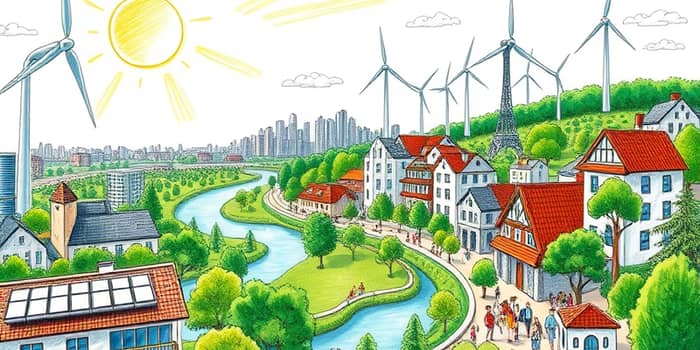
Across the globe, the financial sector holds immense power to catalyze change. By redirecting capital toward environmentally responsible projects, investors and institutions can not only generate returns but also safeguard our planet’s future. This article explores how green finance is evolving, the practical tools available, and how stakeholders can seize opportunities for impact.
Defining Green and Sustainable Finance
Green finance focuses specifically on environmental impacts, targeting initiatives such as renewable energy, carbon reduction, and biodiversity conservation. It ensures that market participants internalize environmental externalities and support projects aligned with global climate goals.
By contrast, sustainable finance adopts a broader lens, integrating environmental, social, and governance factors into every investment decision. It addresses issues from poverty reduction to corporate governance, creating resilient portfolios that align with the United Nations Sustainable Development Goals.
Market Size and Growth Projections
The green finance market was valued at USD 3,192.61 billion in 2023 and is projected to surge to USD 22,754 billion by 2033 at a CAGR of 21.7%. Meanwhile, sustainable finance is expanding even faster, with estimates ranging from USD 15.06 trillion in 2026 to USD 26.93 trillion by 2031 at a CAGR of 12.34%.
Key statistics underline this rapid growth:
- ESG investing could rise from USD 45.61 trillion in 2026 to USD 180.78 trillion by 2034.
- Corporate green bond issuances reached USD 500 billion in 2021 and may hit USD 530 billion by 2026.
- Renewable energy comprised 45% of green finance allocations in 2023.
Leading Segments in 2023
Financial Instruments and Products
Innovative products have emerged to support green and sustainable goals. These include:
- Green bonds for large-scale environmental projects.
- Green loans tailored to corporate sustainability targets.
- Sustainability-linked instruments that tie finance costs to ESG performance.
- Green investment funds pooling capital for diversified green portfolios.
Each instrument empowers businesses and investors to channel resources where they can achieve measurable environmental and social returns.
Key Drivers of Growth
A convergence of factors fuels this transformation:
- Regulatory support through incentives like the EU Green Deal and feed-in tariffs.
- Rising climate awareness among consumers, corporations, and governments.
- Investor demand for high returns with social benefits.
- Advances in data analytics boosting transparency and risk assessment.
These drivers are creating a virtuous cycle: better policies spur more investment, which in turn demonstrates the financial viability of sustainable projects.
Regional Insights
Europe leads the global green finance movement, holding a 35% market share valued at USD 1,117.41 billion. Strict regulations and robust incentives have accelerated renewable installations and green bond issuances.
The United States follows closely, with utility-scale solar and battery storage driving renewables to 23% of its electricity mix in 2021. Emerging markets in Asia and Latin America are also ramping up sustainable finance frameworks to attract global capital.
Benefits and Impacts
The advantages of green and sustainable finance extend across multiple dimensions:
- Environmental gains through reduced emissions and preserved ecosystems.
- Social progress, tackling poverty, hunger, and promoting equality.
- Economic resilience by managing risks and unlocking new markets.
By embedding ESG criteria, investors foster long-term thinking and social responsibility, ensuring that growth benefits both people and the planet.
Challenges and Opportunities
Despite strong momentum, challenges remain. Standardization of reporting, verification of impact, and closing the estimated USD 1.3 trillion annual financing gap are critical hurdles.
Yet, these challenges present opportunities for innovation. Technological solutions can streamline ESG reporting, while transition finance offers pathways for industries where green alternatives are nascent.
Trends and Future Outlook
Looking toward 2026 and beyond, several trends stand out:
- Expansion of sustainability-linked products across corporate and sovereign issuers.
- Integration of advanced analytics and AI to optimize ESG risk management.
- Growth of circular economy financing, supporting waste reduction and resource efficiency.
The market’s rapid evolution suggests that green finance will become a mainstream pillar of global capital markets.
Policy Examples and Global Initiatives
The EU Green Deal exemplifies policy ambition, aiming for a trillion-euro investment by 2030 to decarbonize key sectors. International platforms, such as the International Platform on Sustainable Finance, foster collaboration on harmonized frameworks.
Multilateral development banks and funds like the Green Climate Fund are expanding concessional financing, enabling low-income countries to jumpstart sustainable infrastructure and climate resilience projects.
Conclusion: Embracing a Green Future
Green finance is more than a trend—it is a fundamental shift in how capital markets operate. By aligning investments with environmental and social objectives, we can unlock inclusive growth and climate resilience.
Stakeholders across governments, financial institutions, and civil society must collaborate to refine standards, innovate products, and mobilize the resources needed. The journey toward a sustainable economy is both urgent and inspiring, offering a chance to secure prosperity for current and future generations.
References
- https://www.charteredbanker.com/resource_listing/cpdresources/what-is-green-and-sustainable-finance.html
- https://market.us/report/green-finance-market/
- https://online.jwu.edu/blog/green-finance-investing-with-sustainability-in-mind/
- https://www.mordorintelligence.com/industry-reports/sustainable-finance-market
- https://www.weforum.org/stories/2020/11/what-is-green-finance/
- https://www.moodys.com/web/en/us/insights/credit-risk/outlooks/global-sustainable-finance.html
- https://www.thebusinessresearchcompany.com/report/sustainable-finance-global-market-report
- https://finance.ec.europa.eu/sustainable-finance/overview-sustainable-finance_en
- https://www.fortunebusinessinsights.com/esg-investing-market-113824
- https://erl.scholasticahq.com/article/78117-the-nexus-between-green-finance-and-sustainable-green-economic-growth
- https://www.ca-cib.com/en/news/sustainable-outlook-2026-maturing-esg-fixed-income-market-moving-towards-resilience
- https://www.worldbank.org/en/topic/financialsector/brief/sustainable-finance
- https://www.precedenceresearch.com/sustainable-finance-market
- https://www.spglobal.com/sustainable1/en/insights/2026-sustainability-trends