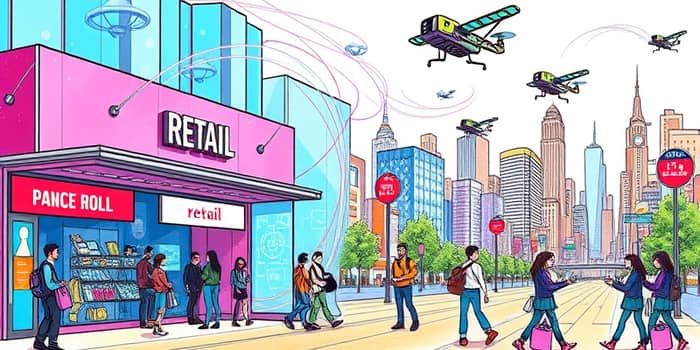
In a world where every click, swipe, and tap carries the promise of a purchase, the story of retail has been rewritten. Physical aisles blend with digital storefronts, and the line between in-store experiences and online convenience has all but vanished. Today’s retailers must not only adapt but also embrace a future defined by seamless integrations and data-driven decisions.
From towering global valuations to the billions of connected consumers, the journey of e-commerce has evolved through four distinct yet interwoven pillars: market size and growth, technology and operations, shifting consumer behaviors, and the boundless future outlook. Understanding each pillar offers a roadmap for businesses that aspire to thrive in this dynamic environment.
Market Size, Growth, and Macroeconomic Context
The scale of today’s retail universe is staggering. In 2025, the global retail industry is estimated to be worth around USD 30 trillion, with e-commerce accounting for approximately USD 7.5 trillion of that total. This balance represents a profound shift from mere experimentation with online channels to embracing e-commerce as a core retail growth engine.
This trajectory is propelled by an underlying CAGR of roughly 6–7% for total retail, compared to an 11–11.3% global e-commerce growth rate. The gap between mid-single-digit growth in brick-and-mortar sales and the double-digit expansion of online commerce underscores why businesses are rebalancing investments in digital channels and operational efficiency.
Adoption, Digital Buyers, and Penetration
One of the most remarkable chapters of this evolution is the sheer number of digital shoppers. By 2025, between 2.77 and 3 billion individuals—nearly one-third of the global population—will engage in online shopping, reflecting a penetration rate of over 54% among active internet users. In mature markets like the U.S., this figure climbs to 75% of internet users, driven by personalized experiences and convenience.
Across developing regions in Africa and Southeast Asia, rising smartphone ownership and internet accessibility are powering the next wave of consumer engagement. With 1.65 billion people projected to shop via smartphones and mobile accounting for up to 59% of online sales, businesses must craft experiences optimized for small screens and instant checkouts.
- Broader access empowers consumers in rural and emerging economies.
- Localized payment methods and digital wallets simplify transactions.
- Social platforms introduce new discovery and purchase pathways.
- Real-time customer service elevates brand loyalty and trust.
Mobile Commerce: The New Shopping Frontier
Smartphones have evolved into personal shopping assistants, shaping how retailers design interfaces and server infrastructures. In markets like South Korea, nearly 75% of online transactions occur on mobile devices, while the U.S. sees mobile share reach 44% on average and spike to almost 50% during peak events like Prime Day. This mobile dominance demands app-first mobile retail experiences that load quickly and engage seamlessly.
- 5G networks, projected to support 1.7 billion subscriptions by 2025, unlock immersive AR and live-stream shopping.
- App-based commerce yields conversion rates three times higher than mobile websites.
- Digital wallets facilitate over 50% of mobile checkouts globally.
- Personalized push notifications drive repeat purchases and re-engagement.
- Data-driven UX testing refines layouts and reduces cart abandonment.
Companies that master mobile commerce are not simply replicating web experiences on smaller screens—they are forging entirely new pathways for interaction, enriched by location awareness, voice search, and biometric payment options.
Social Commerce and Emerging Touchpoints
Social media platforms have transcended their roles as content hubs to become full-funnel social commerce platforms. In 2025, social commerce is expected to generate approximately USD 1.17 trillion in sales. Through features like in-app checkout, augmented reality try-ons, and shoppable videos, brands are meeting consumers in spaces where they already spend hours each day.
Survey insights from the DHL E-commerce Trends Report reveal that among 24,000 global shoppers, factors such as delivery reliability and sustainable packaging increasingly sway purchase decisions. Meanwhile, influencer partnerships and short-form video content drive discovery, turning engagement into direct transactions without redirecting users away from social feeds.
Digital Transformation Investments and Core Technologies
The momentum behind digital retail innovation is reflected in investment figures. From a market valued at USD 143.55 billion in 2020, the retail digital transformation segment is on track for an 18.2% CAGR through 2026. Leading retailers are reallocating budgets from physical store expansions to scalable cloud commerce platforms and robust omnichannel ecosystems.
Key technology priorities include data analytics (63% of retailers) and AI/ML initiatives (35%), enabling use cases that range from personalized marketing to inventory optimization. Consider these AI-driven applications:
- Individualized recommendations and targeted promotions.
- Real-time dynamic pricing and promotions engines.
- Demand forecasting using external signals like weather.
- Conversational commerce via chatbots and messaging apps.
- Edge AI for in-store analytics and visual shelf monitoring.
As AI becomes the brain of modern retail operations, forward-thinking companies are seeing measurable returns. Luxury brands report sales uplifts of 120% through conversational AI, while others have reduced hiring costs by up to 60% by automating routine customer interactions.
Future Outlook and Strategic Imperatives
Looking ahead, the convergence of emerging technologies—such as IoT-enabled supply chains, immersive virtual storefronts, and blockchain-powered transparency—will redefine the boundaries of commerce. Retailers that prioritize agility and cultivate a culture of continuous innovation will win in a landscape characterized by rapid change.
To stay ahead, businesses must embrace omnichannel as the default, invest in sustainable practices that resonate with eco-conscious consumers, leverage real-time analytics for proactive decision-making, and foster digital literacy across leadership teams.
The digital transformation of retail is not a one-time event but an ongoing journey. By aligning market insights, consumer behaviors, and cutting-edge technologies, companies can build resilient, customer-centric operations that stand the test of time. The evolution of e-commerce is proof that with vision and execution, every retailer has the potential to become a digital pioneer.
References
- https://cimulate.ai/resources/digital-commerce-statistics/
- https://www.cflowapps.com/digital-transformation-statistics/
- https://www.netguru.com/blog/ecommerce-statistics
- https://www.kenresearch.com/articles/global-retail-market-digital-transformation-trends
- https://www.flowlu.com/blog/productivity/ecommerce-statistics/
- https://www.visionet.com/blog/retail-digital-transformation-in-2025
- https://group.dhl.com/en/media-relations/press-releases/2025/dhl-e-commerce-trends-report-2025.html
- https://retalon.com/blog/retail-digital-transformation
- https://www.invespcro.com/blog/online-retail-statistics-and-trends/
- https://www.coherentsolutions.com/insights/top-digital-transformation-trends
- https://www.statista.com/topics/871/online-shopping/
- https://www.liveperson.com/blog/retail-digital-transformation/
- https://www.hostinger.com/tutorials/ecommerce-statistics
- https://www.deloitte.com/us/en/Industries/retail/research/global-powers-of-retailing.html
- https://thesocialshepherd.com/blog/ecommerce-statistics
- https://therobinreport.com/the-greatest-irony-of-retailing-in-2025-digital-transformation/
- https://www.mckinsey.com/capabilities/quantumblack/our-insights/the-state-of-ai
- https://www.pwc.com/us/en/services/consulting/business-transformation/digital-supply-chain-survey.html