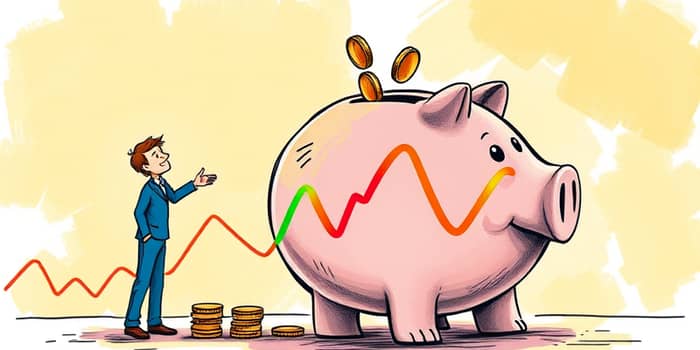
In a world where financial markets can swing wildly in weeks or even days, many investors grapple with the fear of buying at the wrong moment. The roller-coaster of headlines and price charts can turn excitement into anxiety.
By committing to a systematic plan, you can transform chaotic volatility into a powerful ally for long-term growth. Dollar-cost averaging offers a proven path to ride out the ups and downs with confidence.
Understanding Dollar-Cost Averaging
Dollar-cost averaging (DCA) is an investment approach that focuses on consistency over timing. Instead of making a single lump-sum purchase, you invest a fixed amount at regular intervals, regardless of market price.
- Set a fixed amount per period (e.g., $100 monthly).
- Choose a regular interval (weekly, bi-weekly, or monthly).
- Select quality assets like stocks, ETFs, or index funds.
- Automate purchases and stay committed.
By following this plan, investors avoid market timing traps and maintain progress through all market environments. The result is a smoother investment journey.
Over time, this strategy lowers the average cost per share, because you buy more when prices dip and fewer when they rise.
Numerical Examples: Illustrating the Power
Imagine you invest $100 each month in a volatile stock over five months:
In January, if the price is $150, you purchase 0.67 shares. When February’s price falls to $125, you acquire 0.80 shares. A March dip to $100 yields 1.00 share, April’s $120 grants 0.83, and May’s rebound at $150 adds another 0.67 shares. Your $500 total investment secures 3.97 shares at an average cost of $126 per share, versus 3.33 shares at $150 each with a single lump sum.
This example shows how DCA capitalizes on market swings, building more positions during downturns and tempering exposure at peaks.
Benefits of Embracing DCA
Adopting a DCA approach brings both quantitative and psychological advantages:
- Reduces timing risk by spreading investments.
- Builds investing discipline and habit.
- Manages emotions, curbing fear and greed.
- Leverages volatility to your favor.
- Works effortlessly with automatic contributions.
Beyond these points, DCA fosters consistent wealth building and encourages a long-term mindset, helping investors stick to their goals through market turbulence.
Potential Drawbacks and When to Consider Alternatives
While DCA shines in choppy conditions, it can lag behind lump-sum investing in persistent bull markets where prices rise steadily.
Compare DCA and lump-sum approaches side by side:
In a relentless bull market, lump-sum investors capture full upside immediately, whereas DCA participants deploy capital gradually. Ultimately, those who prioritize risk control over maximum gains often find DCA more aligned with their temperament.
Practical Tips for Implementing DCA
Putting DCA into action can be straightforward with modern tools:
- Automate purchases through your brokerage’s recurring investment feature.
- Match contribution frequency to your cash flow (e.g., align with paychecks).
- Choose high-quality, diversified assets like broad-market ETFs.
- Ignore short-term noise and stick to your plan.
- Review progress periodically, but avoid tinkering.
Automation creates an unshakable habit of investing, eliminating hesitation and emotional interference.
Historical and Psychological Context
DCA’s roots stretch back to retirement plans where regular contributions are common. By removing the need to predict market peaks and troughs, investors gain a protective cushion against regret.
Psychologically, DCA combats two powerful forces: the fear of missing out and the paralysis of overanalysis. When every market dip tempts you to wait for a further drop, a predetermined schedule restores control and confidence.
Conclusion: A Path to Smoother Investing
Volatility will always be part of financial markets, but it need not paralyze your investment decisions. By employing dollar-cost averaging, you convert unpredictable swings into a disciplined strategy.
Over years and decades, the habit of steady investing often outperforms attempts at perfect timing, demonstrating that steady progress trumps hurried gains.
Whether you are just beginning your journey or refining a seasoned portfolio, dollar-cost averaging offers a time-tested roadmap for building lasting wealth through consistent, disciplined action.
References
- https://heygotrade.com/en/blog/dollar-cost-averaging-dca-strategy
- https://www.home.saxo/learn/guides/trading-strategies/how-dollar-cost-averaging-dca-can-help-during-market-volatility
- https://www.newyorklife.com/articles/dollar-cost-averaging
- https://www.nerdwallet.com/investing/learn/dollar-cost-averaging-2
- https://www.investor.gov/introduction-investing/investing-basics/glossary/dollar-cost-averaging
- https://www.nysdcp.com/iApp/rsc/learning-library-dollar_cost_averaging.x
- https://www.fidelity.com/learning-center/trading-investing/dollar-cost-averaging
- https://www.sunlifeglobalinvestments.com/en/insights/investor-education/saving-for-retirement/The-pros-and-cons-of-dollar-cost-averaging/
- https://www.wellsfargoadvisors.com/planning/goals/dollar-cost-averaging.htm
- https://www.bernstein.com/our-insights/insights/2025/articles/dollar-cost-averaging-is-it-better-to-dive-in-or-dip-your-toes.html
- https://www.schwab.com/learn/story/what-is-dollar-cost-averaging
- https://investor.vanguard.com/investor-resources-education/online-trading/dollar-cost-averaging-vs-lump-sum
- https://www.tiaa.org/public/learn/financial-essentials/dollar-cost-averaging-and-compound-growth-in-retirement-savings
- https://www.ml.com/articles/what-is-dollar-cost-averaging.html
- https://www.youtube.com/watch?v=DojGdOFPZyE