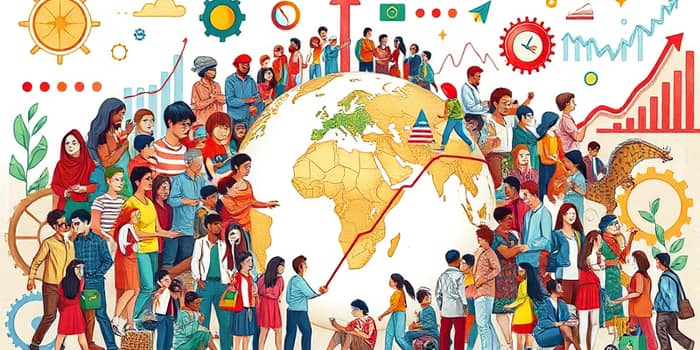
The world stands at a demographic crossroads, with projections painting a future of unprecedented change. Global population trends are shifting towards a peak and gradual decline, driven by falling fertility and rising longevity.
By 2050, the global population is expected to reach 9.664 billion, up from 8.232 billion in 2025. Fertility rates drop below replacement levels, slowing growth to a mere 0.5% annually.
This transformation is not uniform, creating stark regional contrasts that will redefine demand. Sub-Saharan Africa leads growth, while Europe and parts of Asia face contraction, setting the stage for complex economic dynamics.
The Global Population Trajectory
According to the UN, world population will peak around 10.3 billion in the mid-2080s before declining slightly. Growth rates are decelerating from historic highs, reflecting deeper societal changes.
Population momentum adds approximately 1.3 billion people between 2020 and 2050. This inertia underscores the long-term nature of demographic shifts, even as birth rates fall.
Key factors influencing this trajectory include several interconnected elements. Understanding these drivers is essential for anticipating future challenges.
- Declining fertility rates globally, now below 2.1 children per woman.
- Increasing life expectancy due to advancements in healthcare and nutrition.
- Population momentum from past high fertility periods, adding to growth.
- Migration patterns that alter regional balances and demographic structures.
The table below highlights country-specific projections from the UN World Population Prospects 2024, illustrating these trends in detail.
Regional Divergences: Growth and Decline
Sub-Saharan Africa is poised to drive about 50% of global growth from 2020 to 2050. Countries like Niger and Uganda may double in population by mid-century, adding millions annually.
In contrast, Europe and parts of Asia face significant declines. China's population is shrinking due to low fertility, with Japan and South Korea following similar paths.
These divergences create unique demand patterns across regions. Youthful populations in Africa strain resources, while ageing societies in Europe challenge welfare systems.
- Africa: High growth, median age of 25, driving demand for education and jobs.
- Asia: Mixed with India growing and China declining, affecting global labor markets.
- Europe: Steady decline with dependency ratios reaching 75% by 2050, straining pensions.
- North America: Stable growth via immigration, with the US adding population through migration.
Demographic Shifts: Ageing and Fertility
Globally, fertility rates are dropping below the replacement level of 2.1 children per woman. This leads to an ageing population, reshaping age pyramids from broad bases to narrow tops.
Life expectancy is increasing, amplifying the effects of ageing. In Spain, for instance, 67-year-olds now outnumber 25-year-olds, creating a demographic trap that worsens over time.
Dependency ratios, comparing non-working elderly to working-age populations, are rising. Europe faces the highest ratios, while Africa remains the youngest continent.
- Fertility decline: A global phenomenon reducing population growth and altering family structures.
- Ageing societies: Higher proportion of elderly increasing demand for healthcare and services.
- Dependency challenges: Rising ratios test fiscal sustainability and social security systems.
Economic Implications and Demand Changes
Demographics directly influence economic growth and demand patterns. Labor shortages emerge in ageing societies, while youthful regions face resource pressures like food and water scarcity.
Consumer demand shifts towards healthcare and leisure for older populations. Productivity gains become crucial to sustain economies as working-age cohorts shrink.
Welfare systems, such as pensions, are under strain. Funding retirees requires innovative solutions, including private savings and policy reforms.
- Labor markets: Shrinking working-age populations in China, Japan, and Europe challenge growth.
- Consumer shifts: Older demographics spend more on health, while youth drive education and housing demand.
- Resource pressures: Growing populations in Africa and South Asia increase competition for essentials.
- Fiscal challenges: Ageing tests pension and healthcare systems, necessitating reforms.
Policy Responses and Future Uncertainties
Governments and societies must adapt to these demographic realities. Immigration can offset declines, as seen in Spain and the USA, by balancing age structures.
Enhancing productivity through technology and education is key. Welfare reforms are necessary to ensure sustainability in the face of ageing populations.
Uncertainties remain, such as unexpected fertility changes or migration patterns. Health advancements could extend life further, altering projections and increasing dependency.
- Immigration policies: Managing inflows to address labor shortages and demographic imbalances.
- Productivity investments: Fostering innovation and skills to boost economic output.
- Social security reforms: Adapting systems to handle higher elderly populations and longer lifespans.
- Long-term planning: Preparing for demographic shifts through foresight and collaboration.
Conclusion: Embracing the Demographic Future
The demographic shifts ahead are not just statistics; they are stories of human lives and societal evolution. By understanding and acting now, we can turn challenges into opportunities for a more equitable and sustainable world.
Embrace innovation to enhance productivity and inclusivity. Foster global cooperation to address resource pressures and migration challenges.
Plan with foresight, investing in education and healthcare. The future is in our hands to shape through informed decisions and collective action, ensuring resilience for generations to come.
References
- https://www.caixabankresearch.com/en/economics-markets/labour-market-demographics/demography-and-destiny-world-awaits-us-2050-fewer
- https://pmc.ncbi.nlm.nih.gov/articles/PMC8393076/
- https://www.imf.org/en/publications/fandd/issues/2020/03/infographic-global-population-trends-picture
- https://www.visionofhumanity.org/after-the-peak-challenges-of-a-shrinking-world/
- https://www.ined.fr/en/everything_about_population/data/world-projections/projections-by-countries/
- https://www.visualcapitalist.com/countries-powering-global-population-growth-2050/
- https://www.un.org/en/global-issues/population
- https://en.wikipedia.org/wiki/Human_population_projections
- https://www.cbo.gov/publication/61164