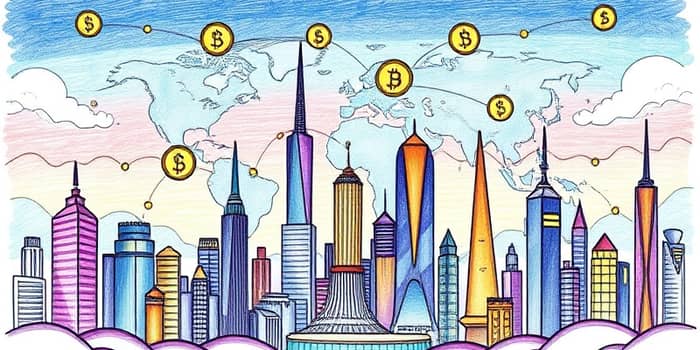
The financial world stands on the brink of a revolution, driven by the unstoppable rise of decentralized finance. DeFi represents a fundamental reimagining of financial systems, moving away from centralized control and towards a more inclusive future.
Built on transparent blockchain networks, it offers permissionless access to global capital markets, enabling anyone with an internet connection to participate. This shift promises to democratize finance in ways previously unimaginable.
With growth rates soaring into the trillions, DeFi is poised to reshape how we think about money and investment. The potential for exponential expansion and innovation is immense, making this a critical topic for all stakeholders.
To fully grasp this new era, we must explore the mechanics, opportunities, and challenges that define DeFi's journey.
How DeFi Works: The Technology Behind the Revolution
At its heart, DeFi relies on blockchain technology, which provides a decentralized and immutable ledger for all transactions. This ensures transparency and security without relying on traditional intermediaries.
Smart contracts automate financial agreements, executing terms automatically when conditions are met. Users interact through decentralized applications (DApps), creating a seamless experience.
- Blockchain Foundations: Distributed ledgers that record every transaction securely and publicly.
- Smart Contracts: Programmable agreements that eliminate the need for trust in third parties.
- Decentralized Applications (DApps): User interfaces that provide direct access to financial services.
- Decentralized Autonomous Organizations (DAOs): Governance structures managed by code and community consensus.
For instance, in lending, users can pledge digital assets into over-collateralized pools. Borrowers access funds via smart contracts, with interest rates set by supply and demand dynamics.
This peer-to-peer model reduces costs and increases efficiency. It empowers individuals to take control of their financial futures.
Market Scale and Growth: Explosive Projections
The DeFi market is experiencing rapid expansion, with estimates varying but all pointing toward significant growth. From modest beginnings, projections reach astronomical figures by the next decade.
Additional metrics underscore the scale. Total Value Locked (TVL) exceeds USD 52 billion, with Ethereum holding a dominant share. North America leads in adoption, reflecting strong institutional interest.
- Ethereum commands 58% of DeFi liquidity, solidifying its pivotal role.
- MetaMask boasts 30 million users, with 21 million monthly active, indicating widespread engagement.
- Uniswap, a leading decentralized exchange, processes billions in weekly volume, showcasing robust activity.
These numbers highlight a market in hyperdrive. They signal a future where DeFi could rival traditional finance.
Key Services and Innovations in DeFi
DeFi offers a diverse array of financial services, all powered by blockchain innovation. From lending to trading, these tools provide alternatives to conventional systems.
- Lending and Borrowing: Over-collateralized pools enable users to earn interest or secure loans without banks.
- Trading and Exchanges: Decentralized exchanges (DEXs) like Uniswap facilitate peer-to-peer trading with minimal fees.
- Derivatives and Speculation: Perpetual futures and prediction markets allow for advanced financial strategies.
- Insurance and Crowdfunding: Smart contracts manage risk and fund projects through mechanisms like ICOs.
- Tokenized Assets: Real-world assets can be represented on blockchain, unlocking new investment avenues.
These services are continuously evolving with new protocols, driven by community-led development. They foster a dynamic ecosystem where innovation thrives.
For example, yield farming has emerged as a popular way to maximize returns. It leverages liquidity pools to generate passive income.
Impact on Capital Markets: Redefining Access and Efficiency
DeFi has the potential to reshape capital markets by removing intermediaries and enabling borderless interactions. This can lead to more efficient and inclusive financial systems globally.
Tokenized assets allow for fractional ownership and global liquidity, democratizing investment opportunities. Fees are redistributed to participants rather than centralized entities, promoting fairness.
Imagine a world where anyone can invest in global markets with a few clicks. DeFi makes this possible by providing permissionless and transparent platforms that operate 24/7.
- Borderless Access: No geographical restrictions hinder participation, fostering true financial inclusion.
- Reduced Costs: Lower fees result from cutting out middlemen, benefiting all users.
- Increased Transparency: All transactions are recorded on public blockchains, enhancing trust and accountability.
This shift could eventually replace traditional custodians and clearing houses. It promises a more resilient and interoperable financial infrastructure.
Trends for 2026 and Beyond: The Future of DeFi
Looking ahead, DeFi is set to become even more dominant. Decentralized exchanges are expected to capture a larger share of crypto trading volume, potentially reaching 50% by 2026.
Institutional adoption is accelerating, with a focus on privacy and real-world asset integration. Ethereum continues to lead, but other blockchains are gaining traction.
- DEX Dominance: Projections indicate DEXs handling 25% of spot trading by end-2026, up from current highs.
- Institutional Interest: Emphasis on compliant solutions attracts large-scale players seeking secure entry points.
- Technological Advances: Improvements in scalability and interoperability will enhance user experience and adoption.
These trends suggest that DeFi is not just a niche phenomenon but a mainstream financial movement. It is evolving to meet the demands of a broader audience.
For instance, privacy features are being developed to cater to institutional needs. This could bridge the gap between traditional and decentralized finance.
Risks and Challenges: Navigating the Uncharted Waters
Despite its promise, DeFi comes with significant risks. The lack of regulation means limited investor protections, and smart contract vulnerabilities can lead to substantial losses.
High volatility and the irreversibility of transactions add to the challenges. Investors must conduct thorough due diligence before engaging with DeFi platforms.
- Regulatory Gaps: Operating outside traditional frameworks exposes users to legal uncertainties and potential crackdowns.
- Smart Contract Risks: Bugs or exploits in code can result in financial harm, as seen in past hacks.
- Market Volatility: Cryptocurrency prices fluctuate wildly, affecting the value of DeFi assets and investments.
- Security Concerns: Hacks and scams are prevalent, requiring vigilant security practices from users.
Understanding these risks is crucial for responsible participation. Education and caution are key to navigating this evolving landscape.
Regulators are beginning to take notice, which may bring more stability. However, the balance between innovation and oversight remains delicate.
Conclusion: Weighing the Transformative Potential
Decentralized finance represents a bold new era for capital markets, offering unprecedented opportunities and formidable challenges. With explosive growth and innovative services, it has the power to democratize finance on a global scale.
However, the risks cannot be overlooked. As the ecosystem matures, finding a balance between innovation and security will be essential. Whether DeFi becomes the new standard or a complementary system, its impact is undeniable.
By embracing this technology while remaining vigilant, we can harness its potential for a more inclusive financial future. The journey is just beginning, and the possibilities are limitless for those willing to explore.
References
- https://rsmus.com/insights/industries/financial-services/what-is-defi-and-how-will-it-reshape-capital-markets.html
- https://market.us/report/decentralized-finance-defi-market/
- https://en.wikipedia.org/wiki/Decentralized_finance
- https://blog.ju.com/defi-trends-2026/
- https://www.federalreserve.gov/econres/feds/decentralized-finance-defi-transformative-potential-and-associated-risks.htm
- https://www.skyquestt.com/report/decentralized-finance-market
- https://www.fireblocks.com/academy/decentralized-finance-guide
- https://www.grandviewresearch.com/industry-analysis/decentralized-finance-market-report
- https://www.nasaa.org/61141/informed-investor-decentralized-finance-defined/
- https://www.precedenceresearch.com/decentralized-finance-technology-market
- https://online.uwp.edu/degrees/business/mba/finance/why-defi-matters/
- https://www.statista.com/outlook/fmo/digital-assets/defi/worldwide
- https://www.stlouisfed.org/publications/review/2021/02/05/decentralized-finance-on-blockchain-and-smart-contract-based-financial-markets
- https://aws.amazon.com/marketplace/pp/prodview-pzyxqcijnvwmq
- https://www.fidelity.com/learning-center/trading-investing/crypto/decentralized-finance-defined