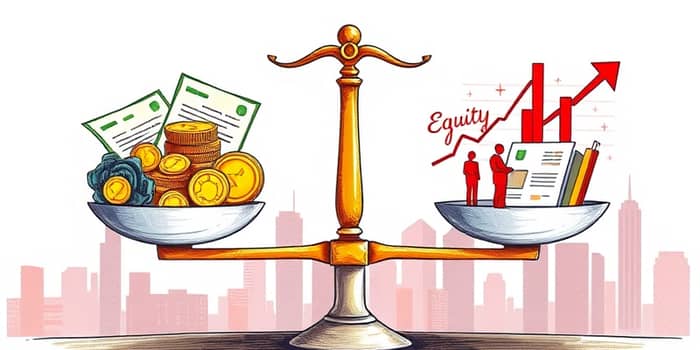
Choosing between debt and equity financing shapes a company’s trajectory, control, and cost of capital. Understanding the nuances ensures you can leverage growth while safeguarding flexibility and ownership.
Understanding Debt and Equity Financing
At its core, debt financing involves borrowing funds through loans, bonds, or lines of credit, with a contractual obligation to repay principal plus interest over a set period. Borrowers retain full ownership, benefiting from full ownership retention and the predictability of fixed obligations.
Conversely, equity financing means exchanging ownership stakes, such as shares sold to venture capitalists, angel investors, or public markets via an IPO. There is no mandatory repayment; instead, investors share in the company’s upside—and risk—through dividends or capital gains.
Comparing Key Factors
This table highlights trade-offs in ownership control versus cost, repayment obligations, and risk-sharing dynamics.
Advantages of Debt Financing
- Retains full ownership and decision-making authority.
- Interest tax-deductible lowers effective borrowing cost.
- Predictable regular installments help in precise budgeting.
- No dilution of future profits or equity stakes.
- Cheaper for established firms with solid revenue streams.
Advantages of Equity Financing
- No mandatory repayments or interest burden.
- Access to strategic investor networks and expertise.
- Shares business risk, reducing default probability.
- Ideal for startups lacking collateral or credit history.
- Flexibility in deploying capital without fixed timelines.
Disadvantages and Risks
Debt financing carries the constant pressure of predictable regular installments that strain cash flow during downturns. Failure to meet obligations can lead to penalties, damaged credit, or even bankruptcy and asset seizure.
Equity financing, while freeing cash flow, dilutes ownership. Investors often seek governance roles or exit provisions, potentially clashing with founders’ vision. The equity risk premium also makes this route more expensive in the long term.
Cost of Capital Dynamics
Understanding the interplay between cost of debt and cost of equity is essential to minimize your weighted average cost of capital (WACC). Initially, debt tends to be cheaper because interest expenses are tax-deductible, but excessive leverage raises borrowing rates and default risk.
Equity cost reflects the return shareholders demand for taking on more risk. Pure reliance on one source inflates WACC: too much debt amplifies distress costs, while too much equity forgoes valuable tax shields. An optimal capital structure balances both to foster growth at minimal expense.
Choosing the Right Mix
- Startups or high-growth ventures often favor equity for its flexible cash flow management and access to investor expertise.
- Established firms with predictable income can leverage debt to maintain control and benefit from tax deductions.
- During recessions, equity reduces default risk, but low-interest rates may make debt attractive.
- Acquisitions or major expansions may blend debt and equity to optimize funding costs and strategic partnerships.
Each scenario demands a tailored approach. Conduct stress tests on cash flow, evaluate investor expectations, and model WACC under varying debt-equity ratios to identify the sweet spot.
Final Thoughts
In the evolving landscape of business finance, choosing between debt and equity is rarely black and white. By weighing cost, control, and risk, entrepreneurs can craft a financing strategy that aligns with their growth ambitions and tolerance for uncertainty.
Ultimately, the ideal mix is dynamic. As your venture matures and market conditions shift, revisit your capital structure to ensure it continues to support sustainable expansion and preserves the founder’s vision.
References
- https://www.lucid.now/blog/capital-structure-scenarios-debt-vs-equity/
- https://www.pnc.com/insights/small-business/manage-business-finances/debt-financing-101-the-basics-benefits-drawbacks.html
- https://corporatefinanceinstitute.com/resources/commercial-lending/debt-vs-equity/
- https://www.thehartford.com/business-insurance/strategy/business-financing/debt-financing
- https://www.pnc.com/insights/small-business/manage-business-finances/debt-financing-vs-equity-financing-a-comprehensive-guide.html
- https://www.lightspeedhq.com/blog/advantages-of-debt-financing/
- https://growthlending.com/knowledge-bank/the-difference-between-debt-financing-and-equity-financing
- https://www.capstonepartners.com/insights/article-advantages-and-disadvantages-of-debt-financing/
- https://preferredcfo.com/insights/debt-vs-equity-financing
- https://corporatefinanceinstitute.com/resources/commercial-lending/debt-financing/
- https://www.mtb.com/business/education-portal/financing-small-businesses/debt-financing-vs-equity-financing-options
- https://www.british-business-bank.co.uk/business-guidance/guidance-articles/finance/pros-and-cons-of-debt-financing-during-a-recession
- https://redcliffetraining.com/blog/equity-financing-vs-debt-financing
- https://www.americanexpress.com/en-us/business/trends-and-insights/articles/what-is-debt-financing/
- https://www.truist.com/resources/commercial-corporate-institutional/financing/articles/debt-financing-vs-equity-financing
- https://www.business.com/articles/debt-vs-equity-financing/