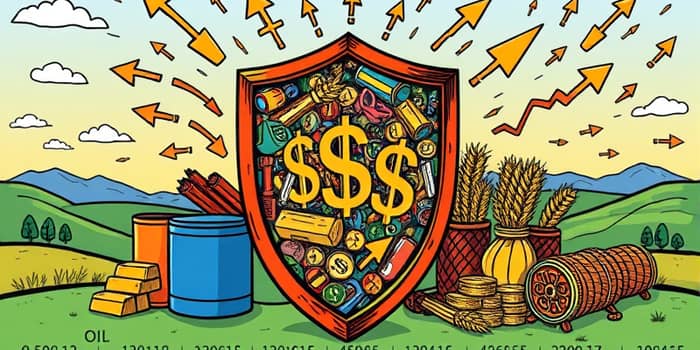
In today's interconnected global economy, commodity price volatility poses significant challenges for industries from agriculture to energy.
These fluctuations can disrupt supply chains, erode profits, and threaten long-term planning for businesses worldwide.
This comprehensive guide delves into hedging strategies that leverage futures contracts to mitigate these risks effectively.
By understanding market mechanics, participants can transform uncertainty into opportunity and foster resilience.
Understanding Commodity Futures and Hedging
Commodity futures are standardized agreements traded on exchanges like the CME and COMEX.
They enable buyers and sellers to lock in prices for delivery at a future date, facilitating efficient price discovery.
Hedging uses these contracts to protect against adverse price movements in physical markets.
- Producers, such as farmers or miners, sell futures to secure selling prices and avoid losses.
- Consumers, including airlines or food processors, buy futures to cap purchasing costs and ensure budget stability.
- Key markets encompass agriculture, energy, metals, and soft commodities, each with unique dynamics.
This approach allows businesses to navigate market uncertainties with greater confidence and foresight.
Futures markets have evolved to handle vast transaction volumes, ensuring liquidity and transparency.
The Nature of Price Swings and Volatility
Sharp price movements are often driven by volatility spikes that can occur within minutes.
Analysis of 2.2 billion transactions from 2012 to 2017 shows that these swings are not increasing in frequency over time.
Instead, they are linked to fundamental factors like supply-demand imbalances and external shocks.
- News releases, such as USDA reports or geopolitical announcements, can trigger rapid price changes.
- Economic uncertainty and emerging market importer concentration exacerbate volatility episodes.
- Basis fluctuations between futures and physical prices add another layer of risk to manage.
The table below illustrates examples of sharp movements in key commodities, based on top 100 largest 3-minute changes.
These volatility spikes underscore the importance of proactive risk management strategies.
Markets digest information quickly, with no structural weaknesses identified in recent studies.
Historical Perspectives on Commodity Movements
Historically, commodity markets have experienced cycles of intense volatility followed by periods of calm.
For instance, the 2007-2012 period saw dramatic swings in agricultural prices, not replicated in recent years.
From 2012 to 2017, data indicates a low frequency of sharp moves, with 2017 marked by reduced volatility.
- Gold has led significant rallies, with a 59.7% increase in the ag metals subsector recently.
- Silver surged 93% due to supply deficits and increased industrial demand.
- Investor sentiment has been low, but cheap valuations signal potential for bullish trends ahead.
Understanding these historical patterns helps in anticipating future market behavior and timing hedges.
Recent trends, such as the 2022-2024 cyclical bear market, highlight the need for adaptive strategies.
2026 Market Outlook: Risks and Opportunities
Looking ahead to 2026, several bullish themes are expected to shape commodity prices.
Key drivers include dovish monetary policies, lower interest rates, and the global energy transition.
For example, copper prices could rise to $12,000 per ton, a 20% increase, fueled by AI and green energy demand.
- Uranium may reach $100 per pound, up 33%, due to supply constraints and rising nuclear energy adoption.
- Brent crude oil is forecast to average $60-62 per barrel, with surpluses from increased production.
- Agriculture shows cautious optimism, with stable grain prices but rising demand from biofuels and population growth.
- Livestock, particularly cattle, could see gains due to the smallest U.S. herd in 70 years.
World Bank projects a 7% price drop in 2025-2026, but specific commodities offer growth opportunities.
Energy transition initiatives and geopolitical factors will critically influence market dynamics.
EV sales exceeding 20 million in 2025 may soften oil demand but boost metals like copper and lithium.
Practical Hedging Strategies for Market Participants
To navigate this volatility, businesses can employ various hedging techniques tailored to their needs.
Basis hedging exploits the gap between futures and physical prices, tying risk directly to uncertainty.
Producers hedge by selling futures contracts, while consumers buy futures to lock in costs effectively.
- Use futures on major exchanges for liquidity, ensuring efficient execution and minimal slippage.
- Options provide additional flexibility, allowing protection with limited downside in volatile markets.
- Monitor key risks such as tariffs, weather patterns, and policy changes to adjust hedges promptly.
- Tools include futures and options on 16 major contracts, covering ags, energy, and metals sectors.
For example, a farmer might sell corn futures ahead of harvest to secure a price, avoiding spot market drops.
An airline could buy crude oil futures to cap fuel expenses amidst potential spikes from OPEC decisions.
Markets incorporate information quickly, making timely hedging a powerful tool for stability.
Efficiency in futures markets ensures that risk transfer mechanisms operate smoothly without fragility.
Conclusion: Embracing Stability in a Volatile World
Commodity futures hedging is more than a financial tactic; it is a strategic imperative for long-term resilience.
By understanding market fundamentals and employing robust strategies, participants can thrive despite price swings.
As we move into 2026, staying informed and proactive will be key to capitalizing on opportunities.
Embrace the power of futures to secure a stable and prosperous future in ever-changing commodity markets.
With tools and insights at hand, businesses can transform volatility from a threat into a manageable element of growth.
References
- https://www.citigroup.com/global/insights/commodities-market-outlook-4q-25
- https://www.morganstanley.com/im/en-lu/institutional-investor/insights/outlooks/trends-driving-optimism-in-2026.html
- https://www.aberdeeninvestments.com/en-us/investor/insights-and-research/commodities-the-year-that-was-the-year-that-could-be-2026
- https://www.bmleh.de/EN/topics/international-affairs/foreign-trade-policy/volatility.html
- https://www.investing.com/analysis/10-charts-point-to-commodities-becoming-a-major-macro-theme-in-2026-200672589
- https://www.worldbank.org/en/research/commodity-markets
- https://open.clemson.edu/all_dissertations/1750/
- https://www.spglobal.com/energy/en/news-research/topics/commodities-2026
- https://www.jpmorgan.com/insights/global-research/outlook/market-outlook
- https://www.investing.com/commodities/real-time-futures