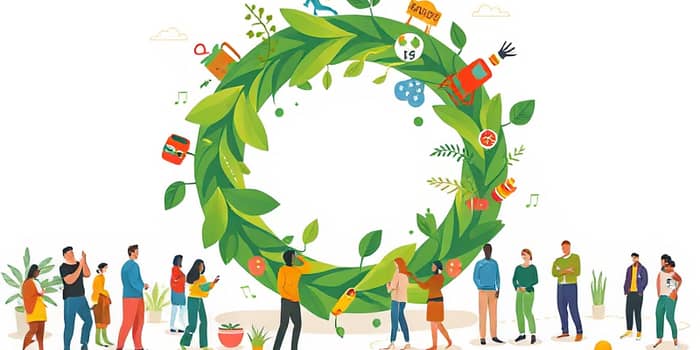
As the world navigates mounting environmental crises and economic uncertainties, the circular economy emerges as a powerful blueprint for sustainable prosperity. By reimagining traditional production and consumption patterns, businesses and investors can foster long-term resilience and responsible growth, while communities benefit from renewed economic opportunities and healthier ecosystems.
Defining the Circular Economy
The circular economy is a regenerative production and consumption model designed to keep products, materials, and resources in use for as long as possible. This approach mimics natural cycles, where waste does not exist—every byproduct becomes a new input. In contrast to the linear “take-make-dispose” model, the circular framework aims to eliminate waste and pollution by design, circulate materials through repair and reuse, and regenerate natural systems.
At its core, the circular economy fosters innovation in product design, logistics, and business models. Companies across manufacturing, technology, and service sectors are adapting new strategies, from modular components to extended producer responsibility schemes, driving a transition toward less resource-intensive operations.
Core Principles and the Rs Framework
Implementation of the circular economy relies on structured frameworks that guide decision-making. Two widely adopted models include the 5Rs and 9Rs, which outline hierarchies of action for businesses and consumers.
- Refuse: Avoid unnecessary consumption and opt for sustainable alternatives.
- Rethink: Challenge existing production and use patterns to minimize environmental impact.
- Reduce: Minimize resource extraction and material use at every stage.
- Reuse: Extend product lifecycles through second-hand markets and sharing schemes.
- Repair and Refurbish: Restore functionality and quality, delaying disposal.
- Remanufacture: Rebuild products using recovered parts to original specifications.
- Repurpose: Adapt items for new uses, giving them a second life.
- Recycle: Process materials into new products, reducing dependency on virgin inputs.
- Recover: Harness residual energy or materials where direct recycling is not feasible.
Unlocking Tangible Benefits Across Pillars
Adopting circular strategies yields profound advantages across environmental, economic, social, and business-specific domains. By quantifying these benefits, investors and policymakers can make informed decisions that align sustainability with profitability.
Environmental gains include drastic reductions in waste, pollution, and greenhouse gas emissions. Studies show potential cuts of up to 39% of global materials-related emissions through better design and material loops. Recycling critical minerals such as nickel, cobalt, and lithium generates 80% less GHG emissions than primary mining. Furthermore, resource conservation can reduce virgin material extraction by 90% less dependency on virgin materials, alleviating pressure on ecosystems and biodiversity.
On the economic front, streamlined material flows can deliver $640 billion in manufacturing savings by mid-century. New business models—such as product-as-a-service and leasing—enhance revenue streams while reducing upfront costs for consumers. The circular shift also fosters up to 8 million jobs globally in repair, logistics, recycling, and remanufacturing, revitalizing local economies.
Investing in a Circular Future
Strategic investments in circular initiatives present robust returns and risk mitigation. Companies that pioneer transparent supply chain practices attract ESG-focused capital, comply with emerging regulations like the European Circular Economy Law (2026), and strengthen resilience against resource price shocks.
Key levers for investors include financing scalable recycling infrastructure, supporting startups in advanced material recovery, and underwriting product platform models that decouple profit from material throughput. By prioritizing circular benchmarks—such as recycled content uptake and product longevity—investment portfolios can achieve both financial performance and positive environmental impact.
Real-World Examples and Case Studies
Several pioneering initiatives illustrate the circular economy’s transformative potential:
- Lighting-as-a-Service: Clients pay for illumination hours while providers retain ownership of fixtures, saving over £30,000 in operational costs within five years.
- Closed-Loop Textiles: Fashion brands collect end-of-life garments for fiber regeneration, reducing virgin cotton demand and water consumption.
- Battery Recycling Hubs: Facilities recovering lithium and cobalt from used electric vehicle batteries supply domestic manufacturing chains, cutting import dependencies.
These examples highlight how circular models can be integrated into diverse industries, from energy to apparel, delivering measurable environmental and financial returns.
Navigating Transition Challenges
Despite clear advantages, stakeholders face hurdles in shifting from linear to circular frameworks. High upfront capital requirements for new infrastructure, complex reverse-logistics networks, and entrenched consumer behaviors can impede progress.
- Initial investment costs for recycling and remanufacturing facilities.
- Supply chain reengineering to enable take-back and refurbishment.
- Regulatory uncertainty and varying regional standards.
Overcoming these barriers demands collaboration among governments, industry, and communities. Incentives such as extended producer responsibility, tax credits for sustainable design, and public–private partnerships can accelerate the transition.
Looking Ahead: A Resilient and Regenerative Economy
As global policy agendas align around climate goals—such as the COP30 targets—the circular economy will be pivotal in achieving net-zero emissions and halting biodiversity loss. Investors and businesses that embrace circularity today will secure competitive advantages, foster innovation, and build resilient economies capable of withstanding future shocks.
By committing to resource-efficient growth strategies and supporting circular ventures, we can catalyze a regenerative economy that delivers shared prosperity for people and planet. Now is the moment to harness the power of circularity and guide capital toward a sustainable, inclusive future.
References
- https://www.interlakemecalux.com/blog/circular-economy
- https://www.faistgroup.com/news/circular-economy-benefits/
- https://www.milliken.com/en-us/blogs/circular-economy-sustainability
- https://gaiacompany.io/benefits-of-a-circular-economy/
- https://www.weforum.org/stories/2026/01/circular-economy-clean-energy-supply-chain-critical-minerals/
- https://www.repsol.com/en/sustainability/sustainability-pillars/environment/circular-economy/index.cshtml
- https://www.nsaction.us/post/looking-ahead-to-2026-making-a-circular-economy-work-in-and-for-america
- https://climatepromise.undp.org/news-and-stories/what-is-circular-economy-and-how-it-helps-fight-climate-change
- https://legacy.circle-economy.com/blog/a-complete-guide-to-circular-economy-policies-targeting-eu-businesses-in-2026