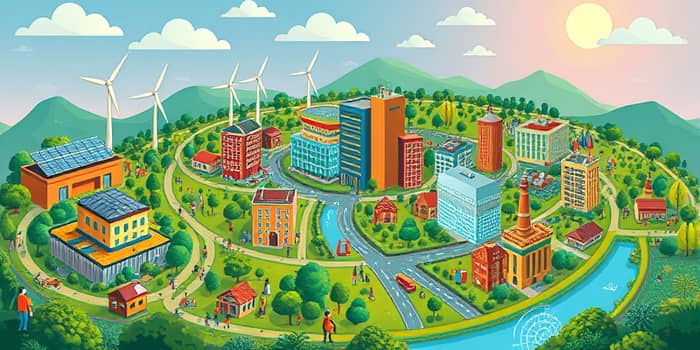
The shift from a linear “take, make, dispose” model to a regenerative, circular economy represents a profound transformation for businesses, communities, and the planet. Companies that embrace circular principles are discovering new pathways to resilience, innovation, and long-term profitability.
By reimagining products as services and designing for continuous reuse, organizations can unlock value that goes far beyond short-term gains. In this article, we explore the foundational concepts, real-world examples, and practical steps to guide any enterprise on a journey toward sustainable growth.
Understanding Circular Business Models
A circular business model seeks to eliminate waste and pollution by keeping resources in use, regenerating natural systems, and delivering value across multiple stakeholders. Unlike a linear economy, where raw materials are extracted, processed, and discarded, circular models emphasize closed loops through repair, refurbishment, remanufacturing, and recycling.
This approach rests on three pillars: sustainable production, sustainable sourcing, and end-of-life management. By integrating these pillars into strategic planning, organizations can drastically reduce their ecological footprint while uncovering new revenue streams.
Key Types of Circular Strategies
Businesses can adopt a variety of models to operationalize circularity. The following strategies each target different stages of a product’s lifecycle, from design to disposal.
- Product-as-a-Service: Customers pay for usage or performance rather than ownership, encouraging durable design and enabling asset recovery at end-of-life.
- Sharing Economy: Platforms facilitate shared access to vehicles, tools, or space to maximize utilization and reduce redundant production.
- Circular Product Design: Goods are engineered for repair, disassembly, and eventual reintegration into manufacturing cycles.
- Reverse Logistics: Collection and preprocessing networks enable upcycling of return flows into new products or materials.
Economic and Environmental Benefits
Investing in circular models offers both financial and sustainability gains. Companies realize cost savings through efficient resource use, generate recurring revenue via service offerings, and strengthen brand loyalty by meeting rising consumer demand for eco-friendly solutions.
Real-World Case Studies
Leading corporations around the globe have already reaped the rewards of circular innovation. Their successes illustrate both the economic viability and the positive social impact of sustainable business models.
- Unilever cut Scope 1 and 2 emissions by 74% from 2015 to 2023 and is targeting a 42% reduction in Scope 3 emissions by 2030, driven by supplier engagement and renewable energy investments.
- Subaru has achieved zero waste to landfill at its Indiana plant since 2004 and diverted over 22 million pounds of park waste through partnerships with national conservation agencies.
- Kaeser Kompressoren pioneered an air-as-a-service model, billing customers for compressed air usage while handling ongoing maintenance, optimization, and equipment modernization.
- Brambles operates an extensive pallet pooling network, circulating reusable containers between users and dramatically reducing transportation emissions.
Implementing Circular Principles in Your Business
Adoption of circular models begins with strategic alignment and cross-functional collaboration. Stakeholders from design, procurement, operations, and marketing must work in concert to redesign value chains for longevity from the outset.
Key actions include:
- Assessing current material flows and identifying hotspots for waste and pollution.
- Engaging suppliers in secondary material sourcing to replace virgin inputs with recycled or renewable alternatives.
- Redesigning products for easy disassembly and repair, thereby extending useful life and enabling remanufacturing.
- Establishing reverse logistics systems to collect and process returned goods at scale.
- Creating performance-based pricing models where revenue aligns with efficiency or sustainability outcomes.
Measuring Impact and Ensuring Continuous Improvement
Quantifiable metrics are essential for tracking progress and securing stakeholder support. Metrics may include material circularity rates, waste diversion percentages, lifecycle emissions, and revenue from service offerings.
By integrating data analytics and digital traceability, organizations can monitor product health through each phase, forecast maintenance needs, and orchestrate end-of-life recovery with precision. Transparent reporting on environmental and social performance further strengthens credibility and informs iterative improvements.
Ultimately, a circular economy mindset transforms linear risk into regenerative opportunity. Businesses that pioneer these models stand to benefit from enhanced resilience, innovation leadership, and deeper societal trust.
As global challenges intensify, the circular transition is not just a strategic advantage but a moral imperative. By investing in sustainable business models, companies can drive lasting positive change—for their bottom line, their customers, and the planet we all share.
References
- https://www.rts.com/blog/circular-business-model/
- https://www.schiller.edu/blog/green-business-models-case-studies-for-future-leaders/
- https://www.manutan.com/blog/en/circular-economy/how-to-start-a-circular-economy-in-your-business-strategy-and-how-to-implement-it
- https://www.bcg.com/publications/2025/sustainable-business-model-innovation
- https://www.boardofinnovation.com/circular-economy-business-models-explained/
- https://plant-values.de/en/sustainable-business-models-8-strategies-and-4-practical-examples/
- https://sustainabilityguide.eu/methods/circular-business-models/
- https://thrivabilitymatters.org/learn-thrivability/sustainable-business-models/
- https://www.ube.ac.uk/whats-happening/articles/circular-business-model/
- https://staging.bigbangpartnership.co.uk/sustainable-business-model-innovation/
- https://www.europarl.europa.eu/topics/en/article/20151201STO05603/circular-economy-definition-importance-and-benefits
- https://www.leeds.ac.uk/online-courses-blog/22900/what-are-sustainable-business-models-with-examples
- https://www.ellenmacarthurfoundation.org/topics/circular-economy-introduction/overview
- https://hbr.org/2025/05/sustainability-as-a-business-model-transformation
- https://hbr.org/2021/07/the-circular-business-model