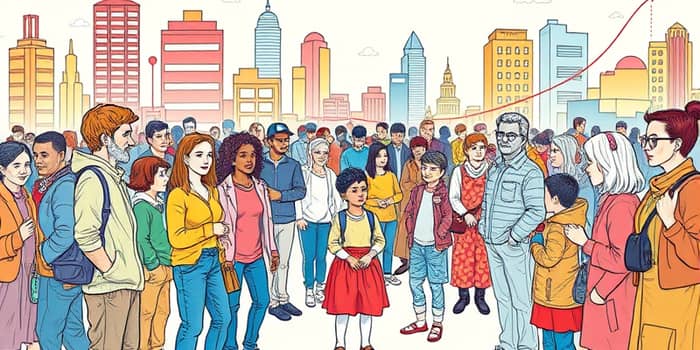
The world is at a demographic crossroads, where aging populations, declining birth rates, and migration patterns are rewriting the rules of economics and society. Understanding these shifts is essential for anyone aiming to thrive in this new era.
From businesses to policymakers, the ability to adapt to these changes can unlock growth and stability. Global population trends are shifting rapidly, with profound implications for labor, capital, and strategy.
By embracing a forward-thinking mindset, we can turn demographic challenges into actionable opportunities. Capitalizing on these shifts requires proactive planning and a deep dive into the data.
The Global Demographic Landscape
Key facts reveal the scale of transformation. World population is about 8.1 billion in 2025, with projections pointing to a peak of around 10.3 billion by 2084.
This growth is not uniform. Fertility rates are declining globally, with two-thirds of the population living in below-replacement countries.
- Global life expectancy increased by 7 years between 2000 and 2025.
- The number of people under 25 is projected to fall from 3.3 billion to 2.9 billion by 2100.
- More deaths than births are expected globally by 2085, signaling a contraction.
These trends highlight a move from a pyramid age structure to an obelisk, with fewer young people and more older adults. Age structure transformation is accelerating, driven by longer life spans and low birth rates.
Regional Insights: From Decline to Growth
Demographic shifts vary widely across regions, offering a mosaic of challenges and opportunities. In the United States, population growth is slowing, with a median age rising to 38.5 in 2025.
Without immigration, the U.S. working-age population would have stagnated since 2000. More deaths than births by 2036 underscore the need for strategic adaptation.
China faces even starker changes. Population decline is already underway, with projections showing a loss of over half its current population by 2100.
Europe and other advanced economies grapple with similar issues. Three-fifths have more deaths than births, relying on migration to mitigate decline.
- Net annual population change in Europe: Poland at -1.0%, Germany at -0.12%, UK at +0.45%.
- High-growth regions include Nigeria at +2.52% and India, expected to grow to 1.7 billion by 2061.
This regional diversity creates a complex global landscape. Labor-supply later-wave regions like Sub-Saharan Africa will enjoy a demographic dividend until 2050.
The Science Behind the Shifts: Demographic Transition Model
The demographic transition model explains these global patterns. Stages range from high birth and death rates to low stationary and population decline.
- Stage 1: High births, high deaths, low growth.
- Stage 2: Death rate falls, rapid growth.
- Stage 3: Birth rate falls, growth slows.
- Stage 4: Low births, low deaths, stabilization.
- Stage 5: Population decline as births fall below deaths.
Most rich countries are in Stage 4 or 5, while emerging markets transition from Stage 2-3 to 3-4. This new demographic reality means youth scarcity and an older age balance, as described by McKinsey.
Understanding this model helps predict future trends. Fertility declines shift age balances, impacting everything from labor markets to healthcare demand.
Economic and Labor Market Impacts
Demographic shifts directly influence economic growth and labor dynamics. Aging reduces GDP per capita growth through declining working-age ratios and changes in savings behavior.
This creates a demographic drag on growth, especially after 2050. Global labor force growth will slow sharply, leading to labor scarcity in many economies.
- Fewer young entrants into the workforce.
- More people working into their 60s, 70s, and 80s.
- Projected negative global population growth by 2028-29.
These changes affect wages, productivity, and career patterns. Upward pressure on wages is likely as employers compete for a smaller talent pool.
Productivity must rise through technology and training. Changing career patterns mean portfolios over ladders, with workers having an average of 29 employers.
Workforce age spans stretch from early 20s to mid-80s. This leads to clogged promotion ladders and delayed advancement for younger workers.
Strategic Opportunities: How to Capitalize
To capitalize on demographic shifts, start by embracing innovation and flexibility. Invest in technology and automation to offset labor shortages and boost productivity.
Focus on regions with growth potential. Target later-wave regions for expansion, leveraging their demographic dividend until 2050.
- Develop products and services for aging populations, such as healthcare and leisure.
- Implement lifelong learning programs to reskill older workers.
- Foster inclusive workplaces that span multiple generations.
- Use data analytics to anticipate demographic trends and adjust strategies.
- Enhance immigration policies to attract talent in declining regions.
For individuals, this means adapting career paths. Build diverse skill sets and networks to navigate frequent job changes and longer working lives.
Policymakers should reform social systems. Address dependency ratio challenges by encouraging savings and flexible retirement options.
Healthcare demand will rise with aging. Innovate in long-term care solutions to meet this growing need sustainably.
By taking these steps, we can turn demographic headwinds into tailwinds. Embrace change as an opportunity for growth and resilience in a shifting world.
References
- https://explodingtopics.com/blog/demographic-transition-statistics
- https://business.lehigh.edu/blog/2018/demographic-shift-brings-challenges-businesses-and-workers
- https://www.caixabankresearch.com/en/economics-markets/labour-market-demographics/demography-and-destiny-world-awaits-us-2050-fewer
- https://www.janushenderson.com/en-us/advisor/article/demographic-shifts-trends-and-implications-for-businesses-and-investors/
- https://www.pewresearch.org/short-reads/2025/07/09/5-facts-about-how-the-worlds-population-is-expected-to-change-by-2100/
- https://www.futureforcepersonnel.com/2025/02/26/how-economic-shifts-are-impacting-businesses/
- https://www.un.org/en/global-issues/population
- https://cepr.org/voxeu/columns/demographic-change-headwinds-economic-growth
- https://www.cbo.gov/publication/61390
- https://www.mckinsey.com/mgi/our-research/dependency-and-depopulation-confronting-the-consequences-of-a-new-demographic-reality
- https://www.visionofhumanity.org/after-the-peak-challenges-of-a-shrinking-world/
- https://www.schroders.com/en-us/us/institutional/insights/the-3d-reset-how-demographic-shifts-will-impact-global-economies-and-markets/
- https://www.worldometers.info/demographics/world-demographics/
- https://blogs.worldbank.org/en/developmenttalk/what-do-demographic-changes-mean-for-labor-supply-
- https://www.census.gov/newsroom/stories/world-population-day.html
- https://www.visualcapitalist.com/countries-powering-global-population-growth-2050/