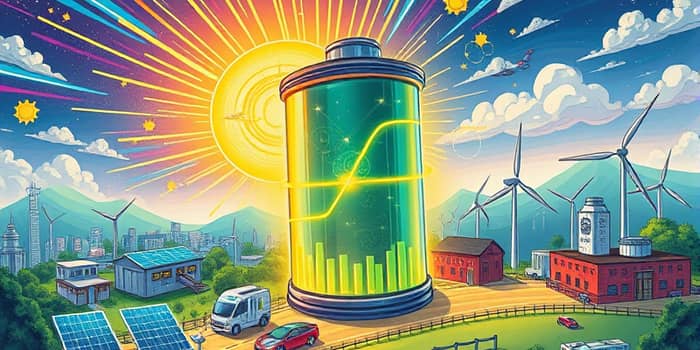
Imagine a world where clean energy is not just a dream but a tangible reality, powered by innovations that redefine how we store and use power. Battery breakthroughs are reshaping our future by driving the global shift towards sustainability.
From electric vehicles to grid-scale storage, these advancements are crucial for reducing carbon emissions and enhancing energy security. The energy transition relies on batteries that are safer, more efficient, and cost-effective.
This article explores the latest innovations that are making this possible, offering practical insights into how they can transform industries. We stand at the cusp of a revolution that will power everything from our homes to our vehicles.
The Solid-State Battery Revolution
Solid-state batteries represent a leap forward in energy storage technology. They replace flammable liquid electrolytes with solid alternatives, significantly improving safety.
ProLogium's recent unveiling of the Superfluidized All-Inorganic Solid-State Lithium Ceramic Battery at CES 2026 showcases this potential. Key specifications highlight its superiority in several areas.
- Volumetric energy density up to 860 Wh/L makes it highly efficient for compact applications.
- Ionic conductivity of 57 mS/cm at room temperature is about five times higher than conventional systems.
- Charging speed allows for 4–6 minutes to recharge 60–80%, addressing fast-charging needs.
- Safety is enhanced with no thermal runaway in testing, transforming batteries into passive low-risk energy reactors.
Other benefits include low-temperature performance comparable to room-temperature standards and no external pressure requirements. This simplifies design and reduces costs.
Challenges remain, such as high costs from expensive materials. However, manufacturing advantages like no rare elements use are paving the way for scalability.
Emerging Alternatives: Sodium-Ion and Beyond
Sodium-ion batteries are gaining traction as an affordable and abundant alternative to lithium-ion. Abundant and cost-effective sodium resources address supply chain vulnerabilities.
- Enhanced safety due to sodium's inherent properties reduces fire risks.
- High cycle stability ensures longer battery lifespan, making them ideal for grid storage.
- Cost-effective production lowers reliance on scarce materials like cobalt.
Potassium-Sodium-Sulfur (K-Na/S) batteries, with a breakthrough from Columbia Engineering, offer new possibilities. A new electrolyte has reduced operating temperatures from over 250°C to around 75°C.
This innovation enhances energy density and power density, making it suitable for long-duration energy storage. It uses inexpensive elements, aligning with sustainability goals.
Cobalt-Free and Lightweight Solutions
Cobalt-free lithium-ion batteries eliminate ethical and ecological concerns linked to mining. They maintain improved energy density and safety, appealing to consumer electronics and electric vehicles.
Lithium-sulfur batteries boast a remarkable energy-to-weight ratio. High energy density meets affordability in applications like aviation and renewable energy systems.
Graphene batteries offer exceptional conductivity and lightweight properties. Faster charging and high energy density make them ideal for electric vehicles and mobile devices.
Silicon batteries are set for large-scale deployment in electric vehicles by 2026. They promise extended range and efficiency, driven by ongoing innovations.
Driving Applications and Performance Metrics
Battery innovations are fueled by diverse applications across sectors. From electric vehicles to AI data centers, the demand for reliable power is growing.
- Electric vehicles require fast charging and extended driving range to boost adoption.
- Grid-scale energy storage supports renewable integration, ensuring stability in power grids.
- Consumer electronics like smartphones benefit from compact designs and longer battery life.
- Emerging technologies such as humanoid robots and eVTOL aircraft rely on advanced power systems.
Key performance metrics are critical for evaluating these breakthroughs. Energy density targets vary, with solid-state aiming for 860 Wh/L and lithium metal for 400–600 Wh/kg.
Charging speed is another focal point, with industry targeting 4–6 minutes for significant recharge. Safety metrics include thermal runaway prevention and non-flammable electrolytes.
Cycle life improvements, such as claims of 100,000 cycles, enhance longevity. Cost reduction through eliminating rare elements and simplified processes makes these technologies more accessible.
Market Outlook and Industry Drivers
The next-generation battery market is projected to reach hundreds of billions of dollars. This growth is driven by the clean energy transition and increasing demand for sustainable solutions.
Price trends have seen dramatic drops in lithium-ion costs, making batteries more affordable. Supply chain concerns are pushing innovation towards materials like sodium, which is more abundant.
- Infrastructure demands, such as AI data center growth, create urgent needs for flexible energy storage.
- Manufacturing maturity is evidenced by companies like ProLogium demonstrating mass-production readiness.
- Research focuses on improving energy density, extending operational duration, and lowering operating temperatures.
Notable timelines include 2026 for silicon battery deployment in EVs and practical applications of lithium metal batteries. The future holds no single miracle battery but a diverse portfolio of solutions.
The Path Forward: Embracing Innovation
As we look ahead, battery breakthroughs are not just technological achievements but enablers of a sustainable world. Renewable energy integration depends on advanced storage to balance supply and demand.
Practical steps for adoption include investing in research and scaling manufacturing. Governments and industries must collaborate to overcome challenges like high costs and scalability issues.
- Support policies that incentivize clean energy storage development.
- Encourage recycling initiatives to create circular economies for battery materials.
- Focus on education to raise awareness about the benefits of new battery technologies.
By embracing these innovations, we can power a brighter, cleaner future. The energy transition is within reach, driven by the relentless pursuit of better batteries.
References
- https://prologium.com/prologium-marks-20th-anniversary-at-ces-2026-unveils-breakthrough-superfluidized-all-inorganic-solid-state-battery-results/
- https://firstamerica.com/top-innovations-in-new-battery-technology/
- https://electrek.co/2026/01/14/batter-about-change-world-or-make-this-guy-fool/
- https://www.nrel.gov/news/detail/program/2024/how-nrels-research-in-battery-energy-storage-is-helping-advance-the-clean-energy-transition
- https://pv-magazine-usa.com/2025/12/31/whats-next-for-battery-technology-in-2026/
- https://www.engineering.columbia.edu/about/news/new-battery-technology-could-boost-renewable-energy-storage
- https://www.mewburn.com/forward/what-is-the-battery-sector-excited-about-in-2026
- https://www.energy.gov/eere/ammto/breaking-it-down-next-generation-batteries
- https://www.youtube.com/watch?v=Kt4c0o_3eyY
- https://www.enlit.world/library/six-key-developments-for-battery-tech-in-the-energy-sector-in-2025
- https://www.youtube.com/watch?v=ftUeNQ5227Y
- https://batteryinnovation.org/how-are-batteries-energizing-the-future/
- https://www.batterytechonline.com/trends/silicon-batteries-will-reshape-energy-storage-as-manufacturers-compete-on-performance-in-2026
- https://www.androidcentral.com/phones/what-you-need-to-know-about-solid-state-batteries